North Carolina's top court bows out of public school funding fight


Add Axios as your preferred source to
see more of our stories on Google.
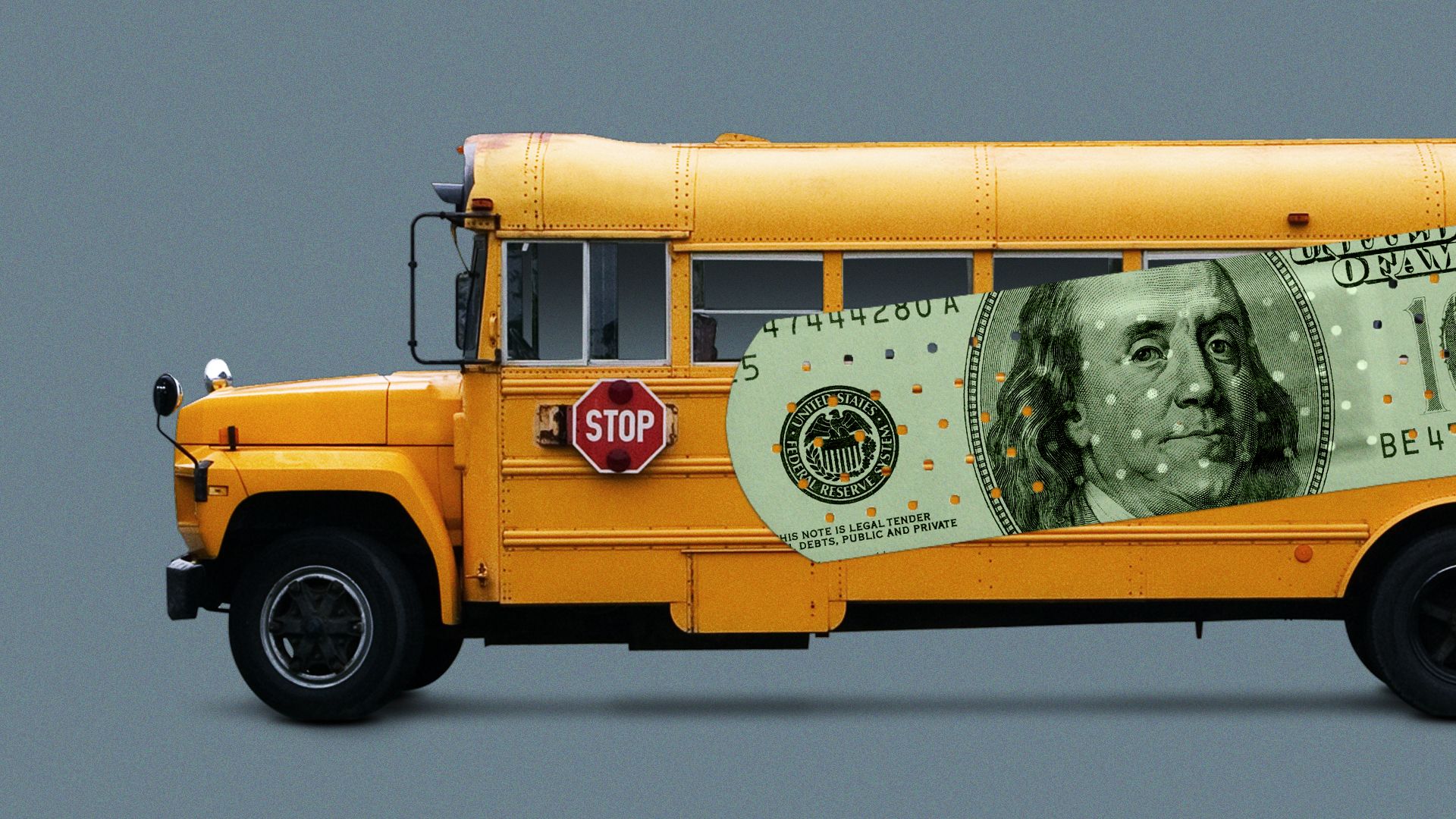
Illustration: Maura Losch/Axios
The North Carolina Supreme Court has thrown out a $5.6 billion school funding plan put forward after a decades-long fight over public education spending.
Why it matters: The Leandro case decision comes at a time when North Carolina student performance is still recovering from sharp pandemic-era declines in math and reading proficiency. Funding per student lags behind the national average.
Driving the news: The Thursday decision puts an end to the Leandro case, which has gone back and forth in the state's court system for more than three decades.
- The court ruled 4-3 to throw out the funding plan, with Republican Richard Dietz and Democrats Allison Riggs and Anita Earls dissenting.
Catch up quick: The Leandro v. North Carolina lawsuit dates back to 1994, when five low-income counties sued the state over what they considered inadequate funding for public education.
- The case has been heard at many different levels of the court, including multiple times at the state Supreme Court. But the current hearings trace back to 2021, when a superior court judge approved a settlement plan that ordered the state legislature to spend $5.6 billion over eight years more to ensure a right to "sound, basic education" for public school students.
- Republican lawmakers objected to the idea that the court could order it around on spending decisions, arguing that this is not the judiciary's role. But in 2022, the then-Democrat-majority state Supreme Court ruled the courts could compel the legislature to spend the money.
- Shortly after that ruling, however, Republicans took a majority on the Supreme Court and blocked the money. The case was heard again in 2024, but justices had not ruled on the case again until Thursday.
Caveat: Some policy-makers believed the plan would have cost billions more than the $5.6 billion estimate generated by consultants.
Between the lines: The state has embraced school choice in recent years, establishing opportunity scholarships in 2013 that cover the cost of private education tuition with tax dollars, allowing "families to access the best education for their child's needs."
- The News & Observer reports that the state has already spent $579 million this school year on vouchers for the vast majority of the state's 135,000 private school students.
- Not all of the state's top private schools accept vouchers, however, and many North Carolina students receiving vouchers attend religious schools, an Axios analysis found.
What they're saying: In the ruling, Chief Justice Paul Newby, a Republican, argued that the courts were not the correct venue to resolve a dispute over public school funding.
- "In our constitution, the people established a tripartite system of government. In doing so, the people did not vest the judicial branch with the power to resolve policy disputes between the other branches of government or to set education policy," Newby wrote.
- He added that decisions about the "desire to enhance education policy" should be made by those constitutionally charged with addressing policy issues.
In her dissent, Earls wrote that by not taking up the case, the court "betrays these constitutional commitments" to providing a sound education
- "Allowing the State to escape judicial scrutiny for constitutional rights violations through its behavior during litigation quickly turns constitutional rights into words on paper — morally compelling but functionally useless," Earls wrote.
The latest: The North Carolina Association of Educators issued a statement calling it a "moral failure" to dismiss the case on a legal technicality.
- "The people paying the price for our leaders' failure are not abstractions. They are the generations of children in rural communities, past and present, who waited for 30 years for a promise never fulfilled."