The Triangle's college grad boom


Add Axios as your preferred source to
see more of our stories on Google.
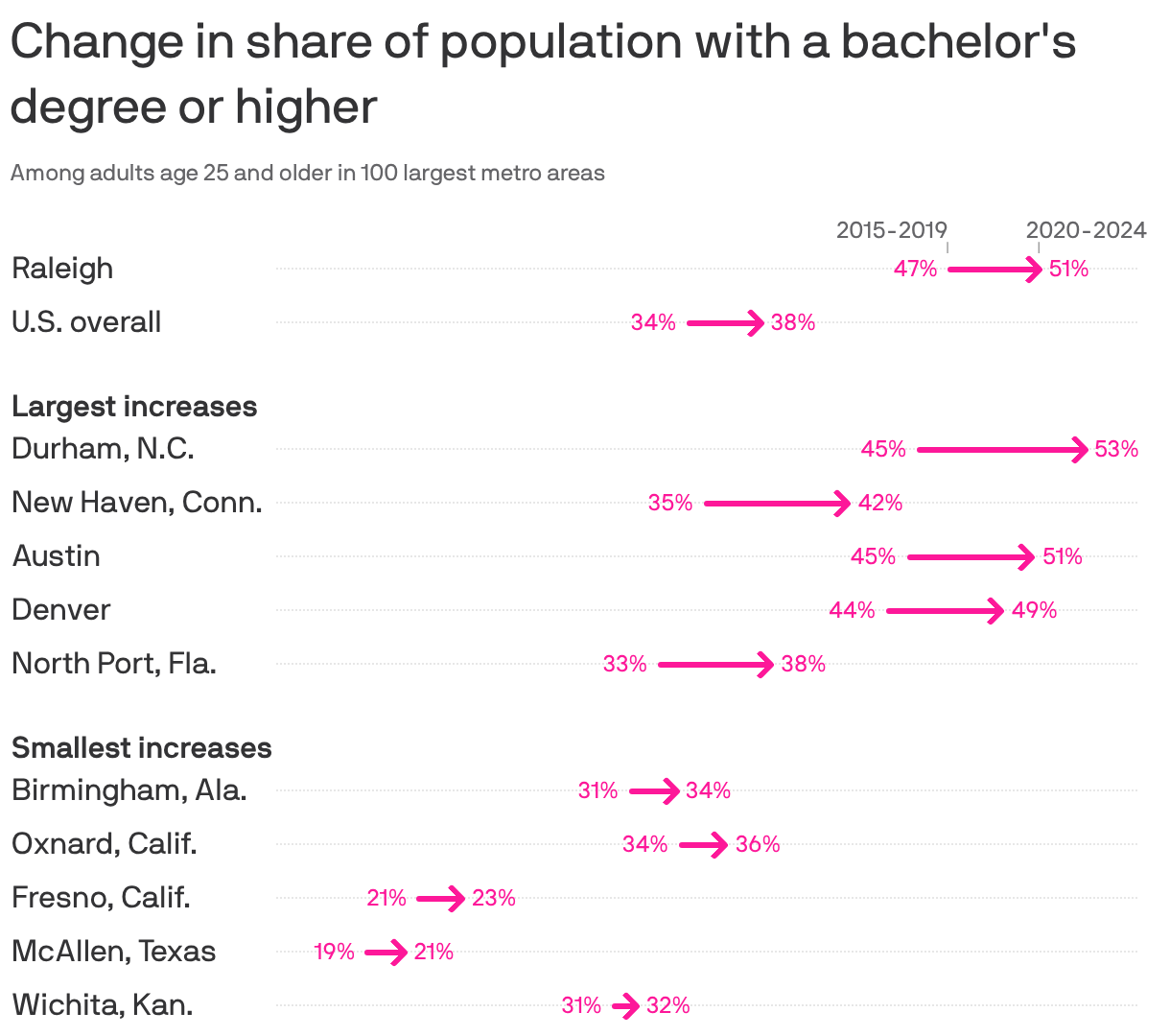
The Triangle has been one of the leading regions for adding residents with college degrees since the pandemic, a new report from the U.S. Census Bureau finds.
Why it matters: The Triangle has long prided itself on how much talent its universities produce, helping make the region one of the biggest areas for job growth over the past decade.
- Duke, N.C. State and UNC-Chapel Hill have all grown in recent years. UNC-Chapel Hill's Carolina North expansion, for instance, is expected to help it continue to expand its student population.
- But increasingly, the Triangle is also attracting those with college degrees from elsewhere and convincing them to settle down.
Driving the news: The share of Americans 25 and older with a bachelor's degree or higher rose from about 34% to 38% between the 2015-2019 and 2020-2024 periods, Alex Fitzpatrick and Jacque Schrag report from new census data.
Zoom in: The Durham-Chapel Hill metro area, home to UNC-Chapel Hill and Duke University, saw the biggest gain in education of all metro areas over that time period, according to the data.
- Durham's share of residents with a bachelor's degree or higher grew to 53%, up from 45%.
- Raleigh's grew to 51% from 47%, the 18th biggest jump.
Between the lines: These are the numbers that the state and its economic development officials are touting to future companies right now as they work to lure expansions.
The big picture: A metro's growth in college-educated residents has far-reaching societal effects, from rising incomes and pressure on the local housing market to political and cultural shifts.
📊 How it works: That's based on the Census Bureau's latest 5-year American Community Survey estimates.
- 🚚 A given metro's share can increase if more residents get their degrees, or if more people with degrees move into town.
What they're saying: "Over the last five years, we've noticed a significant increase in the percentage of adults completing higher education," said Erik Hernandez, a Census Bureau statistician.