North Carolina's income growth has lagged behind its neighbors since 1970


Add Axios as your preferred source to
see more of our stories on Google.
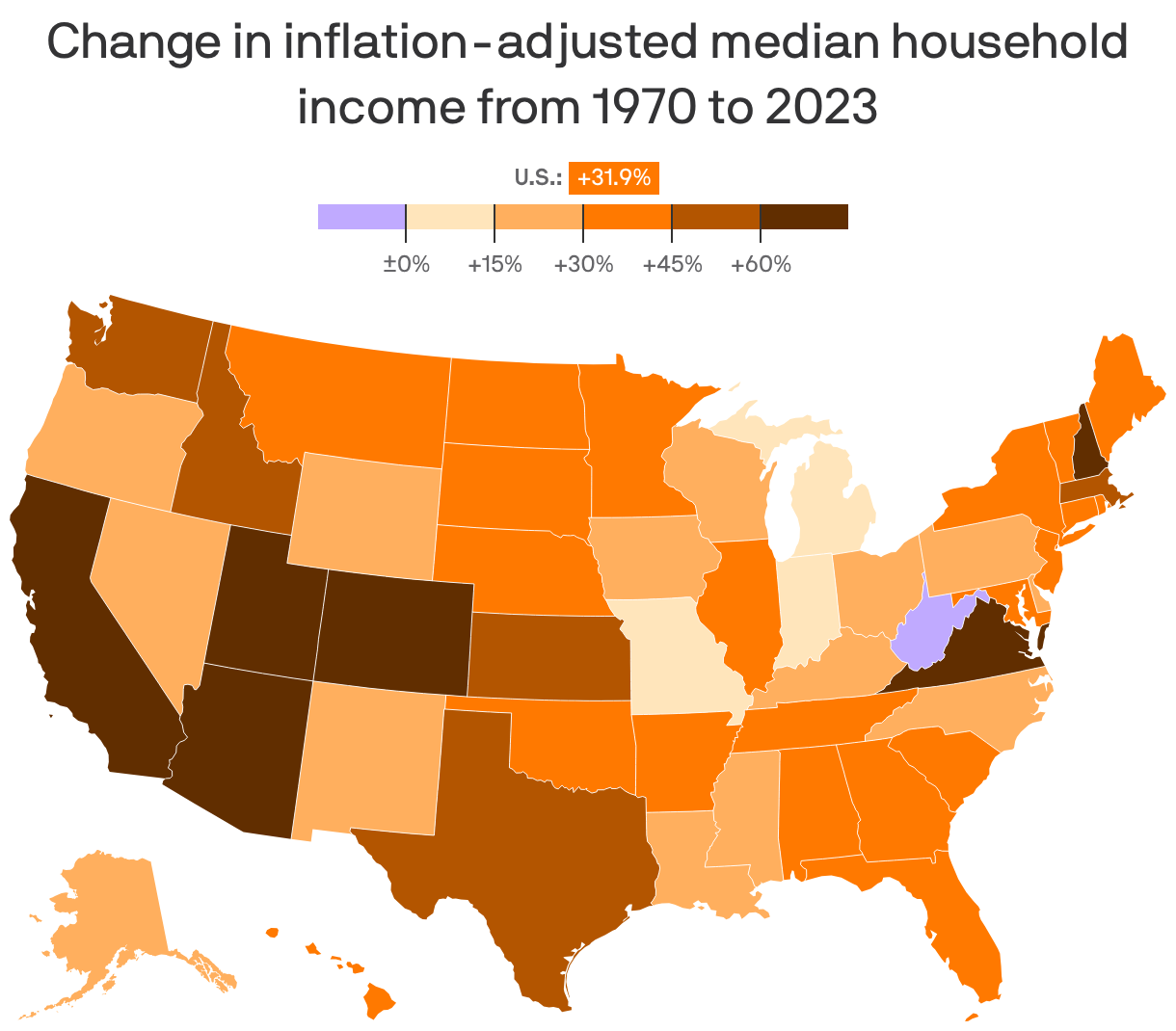
Between 1970 and 2023, North Carolina's household income has grown at a slower clip than its southern neighbors, according to a new report from the Urban Institute.
Why it matters: The report provides further evidence of the divergent nature of North Carolina's urban and rural economies, as the Triangle and Charlotte have outperformed the rest of the state by a wide margin in income growth.
Driving the news: When looking at inflation-adjusted incomes, North Carolina's household incomes grew by 24.3%, from $56,952 to $70,804 over the study's timeframe.
- That was slower growth than its neighbors: Virginia (60.1%), South Carolina (31.9%), Georgia (33.8%) and Tennessee (32.6%).
- Household incomes, however, were still higher than both South Carolina and Tennessee, though they trailed Georgia and Virginia.
Zoom in: "Income alone does not determine a family's prosperity, but it does offer a snapshot of economic growth," the D.C.-based think tank's authors wrote.
- The report noted that states that had more robust growth in educational attainment and immigration performed better over the study period, and that a loss in manufacturing jobs hurt some regions more than others.
In North Carolina, educational attainment has increased over the past five decades. The number of bachelor's degree holders has grown 28%.
- But at the same time, the number of manufacturing workers dropped 24%.
What they're saying: Michael Walden, an emeritus professor of economics at N.C. State University, pointed to North Carolina's uneven transition away from textiles and furniture manufacturing as slowing the state's income growth.
- While other manufacturing industries have popped up in the state, it hasn't been in the same numbers or with the same pathways as textiles and furniture.
- "Fortunately, the state [has] gained new sectors in technology, pharmaceuticals and recently in aerospace," Walden said. "The new jobs paid more but required higher training ... so workers in many of the textile-apparel-furniture [industries] had to take lower-paying service sector jobs. I would point to this transition as the reason for the findings."
The big picture: Income growth has surged in parts of the West, Mid-Atlantic and Northeast, while other regions have largely stagnated.
- New Hampshire (62%), California (61%), and Arizona (60%) round out the top growth states.
- Michigan (2.9%) saw the weakest gains.
- West Virginia was the only state where median household income fell, down 0.4%.