How a Durham startup protected Daniel Jones' broken leg with its 3D scans

Add Axios as your preferred source to
see more of our stories on Google.
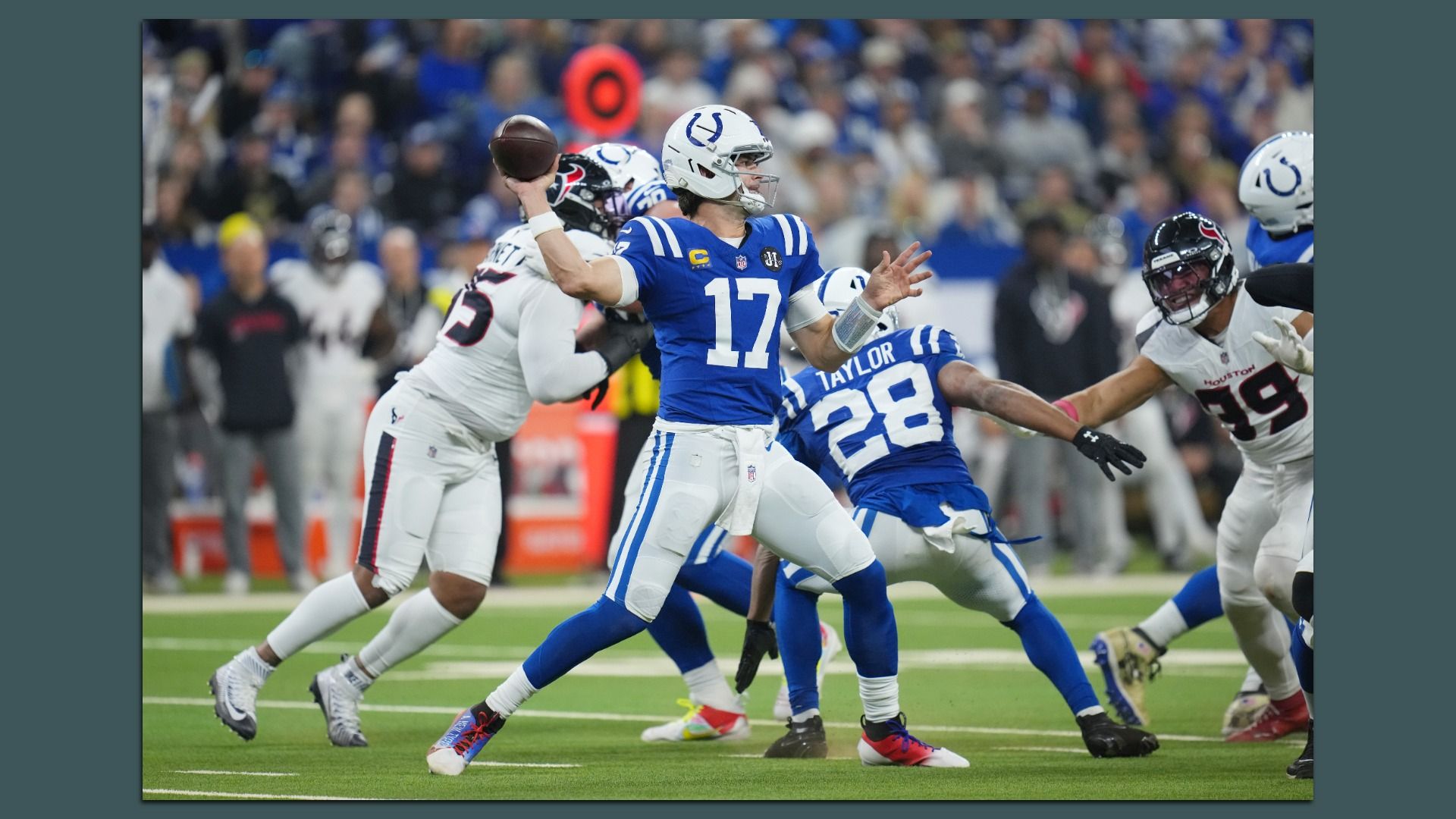
Indianapolis Colts Quarterback Daniel Jones is wearing a 3D-printed brace on his left shin. Photo: Dylan Buell/Getty Images
Editor's note: On Sunday afternoon, Daniel Jones left the game against the Jaguars with an Achilles heel injury.
When Daniel Jones, a Charlotte native who played college football at Duke, fractured his fibula last month, it came at a horrible time for the quarterback.
- After a disappointing end to his stint with the New York Giants last year, Jones has been resurgent this season for the Indianapolis Colts, putting up big numbers and leading the team into contention for a playoff spot.
Why it matters: With his season on the line, Jones turned to a small Durham startup run by some of his former college teammates to keep him on the field.
Driving the news: For the last three games, Jones wore a 3D-printed leg brace designed by Protect3D (pronounced "protected") that is meant to brace Jones' fractured fibula from direct blows.
- The company — founded in 2020 by Kevin Gehsmann, a former Duke linebacker from Greensboro — makes custom, 3D-printed braces used across major sports leagues and colleges.
How it works: Protec3D, which is based in downtown Durham, developed an iPhone app that lets people scan an injured body part — whether it is a hand, a face or an ankle — and capture its 3D-anatomical data.
- From there, the company is able to digitally design a custom brace and 3D print it from its offices in Durham. The goal is to be able to scan, print and deliver braces within 48 hours.
- Forty-eight hours was a little too slow for Jones, though, so Gehsmann hopped on a plane and delivered Jones' shin brace in person in Kansas City.
- "I'm lucky to have smart friends," Jones told reporters earlier last week. "It's pretty low-profile and fits to my leg pretty well. I don't really notice it."
Flashback: It's not the first time that the company has kept Jones, who Gehsmann calls "one of the toughest guys I know," on the field.
- In 2018, when the company was just an idea between Gehsmann and Clark Bulleit, who played center at Duke, Jones broke his collarbone in a game against Northwestern.
- Using a 3D print at Duke's engineering school, Gehsmann and Bulleit helped create a pad for Jones' shoulder. After trying several designs, they found one that Jones felt comfortable enough to play in.
- "It was like a light bulb moment for us, where the innovation we thought was possible ... worked," Gehsmann told Axios. "It really snowballed from there."
Zoom in: It's been a big year for Protect3D, which has 11 employees at its offices in Durham, many of them former collegiate athletes.
- The company raised $1.7 million in venture capital earlier this year and $1.3 million from Small Business Innovative Research award with the Department of War to study how its tech could be used in deployed settings.
- The company hopes to use the financing this year to expand its business into the orthopedic clinics, making its custom braces and orthotics available to a much larger audience.
What they're saying: "We've taken what we've done in the niche of elite sports medicine ... and grown the business into the clinical sector, where our products are insurance reimbursable," Gehsmann said. "The market is significantly larger than 32 NFL teams or 30 NBA teams."