N.C. appeals court says more than 60k voters must prove eligibility in state Supreme Court race

Add Axios as your preferred source to
see more of our stories on Google.
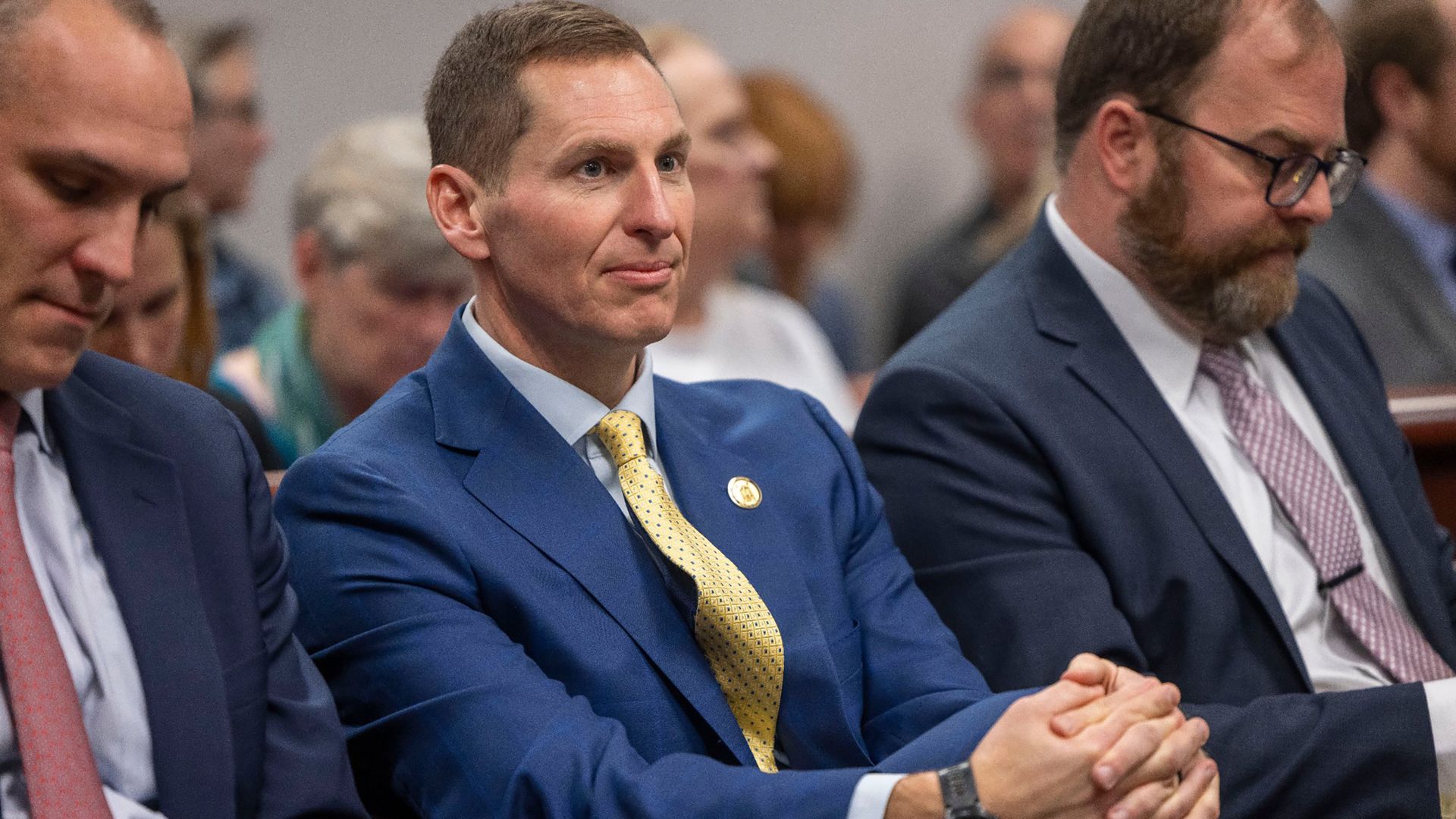
Judge Jefferson Griffin, the Republican candidate for the N.C. Supreme Court. Photo: Robert Willett/The News & Observer/Tribune News Service via Getty Images
A North Carolina appeals court sided with Republican state Supreme Court candidate Jefferson Griffin, ruling Friday that tens of thousands of voters were wrongfully counted, The Associated Press reports.
Why it matters: After two recounts, Griffin trails Democrat Allison Riggs by 734 votes for a seat on the N.C. Supreme Court — the only 2024 election race that has still not been decided in the country.
State of play: On Friday, a three-judge panel on the Court of Appeals decided in a 2-1 decision that more than 60,000 votes that have been challenged by Griffin were wrongfully counted in the tally.
- The ruling, which followed party lines, would require the State Board of Elections — which had previously dismissed Griffin's challenges — to ask those voters to prove their identity or be thrown out with 15 days.
- The decision could potentially flip the result of the election.
Between the lines: Griffin's challenge centers on three types of voters:
- Those who didn't have a driver's license or Social Security number registered in the state's voter database. (These voters, however, still had to prove their identity at the polls to vote in November, ProPublica noted.)
- Military and overseas voters who did not provide identification while voting.
- And overseas voters who have never lived in the U.S. (The appeals court threw out these votes, though it was the smallest number.)
What they're saying: "Free elections under ... the North Carolina Constitution include the right to an accurate counting of votes," said the opinion backed by Republican Judges John Tyson and Fred Gore, according to the AP.
- "Griffin has a legal right to inquire into this outcome through the statutorily enacted and post-election procedures available to him," they added.
Yes, but: The lone Democratic judge on the panel, Toby Hampson, countered that Griffin hadn't identified any voter who was ineligible to vote under current laws.
- "To accept Petitioner's indiscriminate efforts to call into doubt the votes of tens of thousands of otherwise eligible voters — without any showing any challenged voter was disqualified under existing law from voting —, is to elevate speculation and surmise over evidence and reason," he wrote, according to the AP.
What's next: Riggs on Friday vowed to appeal the decision, saying it "threatens to disenfranchise more than 65,000 lawful voters."
- Her appeal will likely send the case to the Supreme Court, where Riggs is still a sitting judge. She previously recused herself from prior deliberations the Supreme Court has heard on the case, the AP noted.
- "North Carolinians elected me to keep my seat and I swore an oath to the constitution and the rule of law," she said in a statement. "So, I will continue to stand up for the rights of voters in this state and stand in the way of those who would take power from the people."