Triangle's community health a leader in North Carolina and U.S.

Add Axios as your preferred source to
see more of our stories on Google.
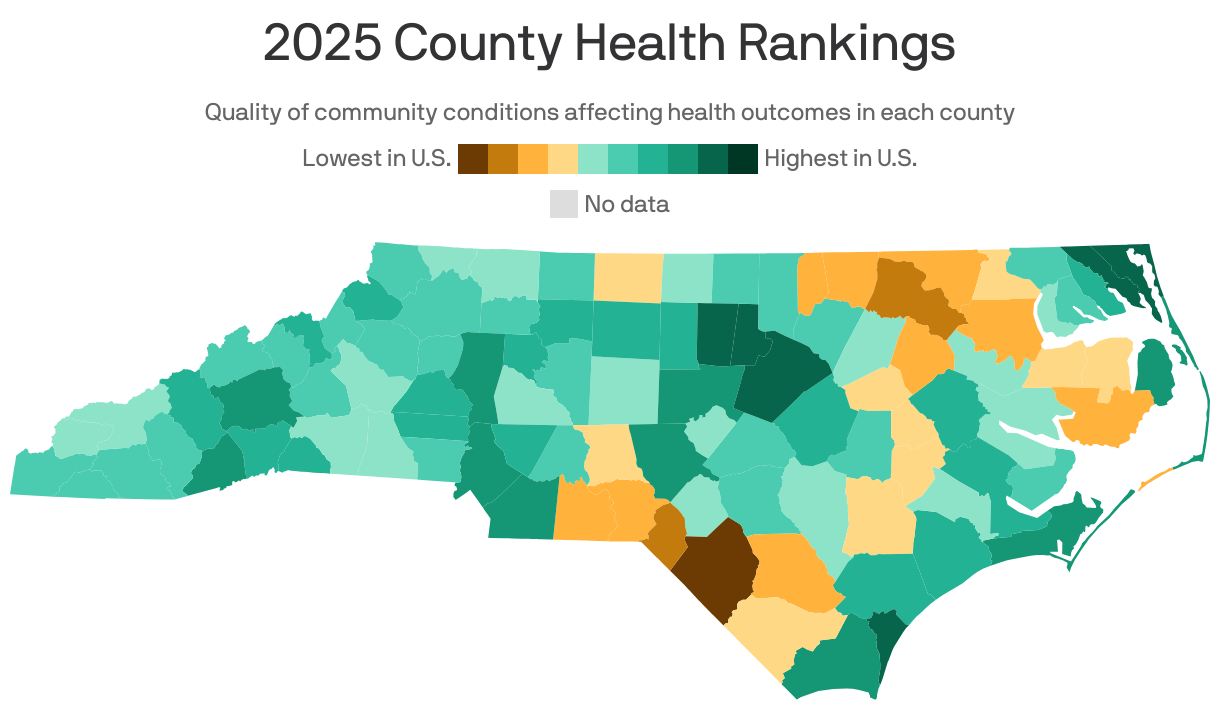
Life in the Triangle's counties is more likely to contribute to good health outcomes than in much of the country.
Why it matters: That is in large part due to the Triangle's strong economy offering things like easy access to primary care physicians, exercise opportunities, higher education levels and lower poverty rates.
Between the lines: These factors mean conditions vary significantly across the U.S. — and even within North Carolina itself, according to County Health Rankings & Roadmaps, a program of the University of Wisconsin Population Health Institute.
- Regions of the U.S. like Appalachia, the Deep South and Tribal territories were more likely to have community conditions that contribute to poorer health, such as underfunded schools and unaffordable housing.
- Many Eastern North Carolina counties lag behind the rest of the state.
Zoom in: For instance, 27% of people in Robeson County have poor or fair health, 15% are uninsured, and 38% of children live in poverty.
- In Wake County, though, just 13% of the population has poor or fair health, 9% are uninsured, and 8% of children live in poverty.
How it works: The report ranks counties by the quality of community conditions — also called "social determinants" — which range from affordable housing and well-funded schools to accessible broadband and self-reported mental and physical well-being.
Caveat: Though social determinants play a big role in the overall health of a community, the "conditions needed to create healthy communities are not available to everyone," per the report.
By the numbers: Wake County scored higher than the national average in a number of categories.
- The county has one primary care physician for every 1,160 people, compared with one physician for every 1,330 people nationally. (Durham had one for every 840 people and Orange one for every 550.)
- We also scored high on the food environment index, which measures food insecurity and access to healthy foods, with an 8.5, compared with a 7.4 nationally. (Durham was 8 and Orange 8.6.)
- 99% of the county has easy access to exercise opportunities, while nationwide that number is 84%. (In Durham, that figure was 91%, and Orange's was 83%.)
What they're saying: "The conditions necessary for healthy, thriving communities don't happen by chance," Sheri Johnson, principal investigator for the report, told Axios.
- "Communities can build power so that everyone has a say in shaping conditions to live long and well," Johnson said.