RPD needs major wage increases, outgoing police chief says

Add Axios as your preferred source to
see more of our stories on Google.
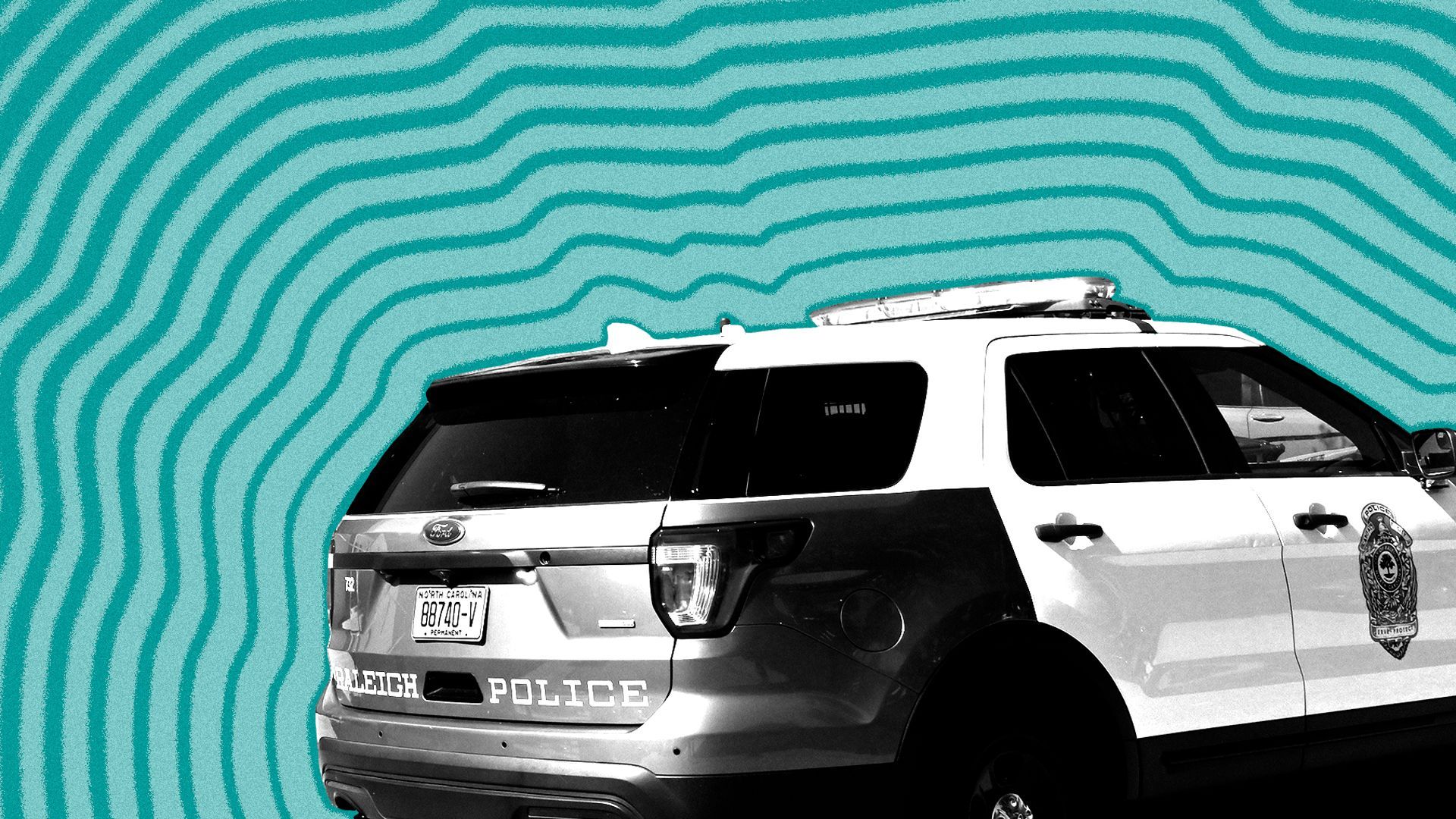
Photo illustration: Brendan Lynch/Axios. Photo: Peter Zay/Anadolu Agency via Getty Images
Estella Patterson, Raleigh's outgoing police chief, says she believes she will have successfully brought the Raleigh Police Department back to full strength by this summer.
Why it matters: Like many police departments across the country, RPD has been plagued by a large number of unfilled positions since the pandemic and the wider cultural response to George Floyd's killing in Minneapolis.
- When she joined in 2021, Patterson said morale at the department was low, recruitment had nearly dried up completely and smaller departments in the region were getting officers to leave Raleigh with salary increases.
By the numbers: RPD had around 51 vacant positions at the start of February, but with a large class in its current academy, Patterson is hopeful to be at zero vacant positions this summer.
- At one point, the department had around 150 vacancies, Patterson said, which she believes hamstrung RPD's ability to respond to calls and be a visible presence in areas like downtown.
- But last year's city budget increased the average police officer salary in Raleigh to $59,774 from $54,217, which Patterson believes helped.
What they're saying: More work needs to be done, Patterson said in an interview with Axios.
- "We need more officers for the size of our city," she said. "Our city is growing tremendously, but the number of resources is not right ... it does put a strain on where we put our officers and where they focus."
- To do that, Patterson added, salaries need to be increased more. "We should be the highest paid in this region," she said.
Driving the news: Patterson, the second Black woman to ever lead the RPD, will retire from the department in March. The city recently began a search for her replacement.
- Patterson will leave Raleigh with violent crimes in Raleigh on the decline for the past two years, Axios reported. But at the same time, the number of homicides in the city has increased.
Axios sat down with Patterson for a Q&A at RPD's headquarters. Answers have been edited for Smart Brevity and clarity.
What sort of impact do you hope to have left on this department?
I want Raleigh to continue to be a premier police department. When I got here, it was a great department. I think we upped the level. The morale is better overall.
- We have created new units here: our Greenway Unit, our Civilian Traffic Investigator Unit. I am so proud of that, because I felt I had my hands completely in that. I went to the General Assembly, spoke on behalf of the need for that, and now we're seeing it in fruition across the state ... having those civilian traffic investigators frees up the officers to be able to do the crime-fighting.
- I want to be remembered as the chief who was a leader who cared about the people who worked for her ... and that we put things in place around mental health to make sure that our officers are in a good position. They see trauma every single day, repeatedly. Some of them are on multiple crime scenes. So we have put some things in place and expanded our peer support unit. We are contracted right now with a company to add additional mental health resources. We have our full-time psychologists on staff. I think all those things go into really looking at the mental health of our officers.
What was morale like when you arrived in Raleigh?
Raleigh was a fantastic police department that had been stagnated and stifled because of world events, [like in] 2020 [with] George Floyd. That really hurt the profession. I don't know any officer who would say that what happened in Minneapolis was a good thing. We all agreed that was horrible, that was a tragedy, and that what those defendants got as a result of it, they deserved it because of what they did.
- But what it did for the whole profession was make us all feel like now we're under a microscope, and that all of us are bad cops, which is far from the truth.
What impact does Raleigh's pay have on keeping officers?
It is detrimental in the sense that we lost a lot of officers to Cary, to Wake Forest, to Garner, and when we did exit interviews with them, they said: "I have to feed my family, I hate to leave RPD, but what choice do I have?"
- That's disheartening as a chief to hear that, knowing that I really can't do anything to impact that, other than to try to find other incentives to help them stay here. But the bottom line is: They have to take care of their families, and if you have to drive 30 minutes into the city because you can't live here, that is something that the council, the mayor and the city manager have to take into account and fix it to make sure that they can afford to live in the city.
There's a lot of talk about DEI efforts being rolled back across the nation. Increasing the diversity of officers was important to you. Are you worried those efforts will fall by the wayside as you depart?
We've taken a "30x30" pledge, and by the year 2030, we're hoping that this police department will be 30% women and working hard towards that end. Right now we're at 10% to 11% roughly. So we have a little ways to go with that, but it can be done. We just have to be intentional about it.
- I'm hoping that the next leadership will take note of what we have learned. All of us have seen the effects of policing when it doesn't reflect your community. ... It will be a leadership decision, but my hope is that the next leader will take [diversity of officers] as a priority.
What caused violent crime to fall in the past two years?
I'm so proud that in 2023 we saw a reduction in violent crime, and then we saw it again in 2024. There are a couple of things I think are responsible for that.
- One is our community engagement because we're interacting more with the community, with the businesses in the downtown corridor. They see us. They know who we are. They knew who our leaders are, and they're having those conversations.
- Secondly, our investment in technology. We've talked about a lot Connect Raleigh, which is our ecosystem of cameras, particularly in our downtown area. We're encouraging the public to be a part of, to integrate their cameras with ours, that allows us to have more eyes in areas.
- We have our public safety partnership [with the Department of Justice]. The resources that provides have been really rewarding to us. They did a non-fatal shooting assessment for us, which allowed us to see: What are our pain points? What more can we do? It has helped us laser focus on violent crime and how to mitigate it.
What did you learn from the Hedingham mass shooting?
We've learned so much from Hedingham, and we've already implemented some of what we've learned. We saw it in the North Hills tragedy.
- You have to get [to a scene] quickly and collaborate with your partners. You set up incident command, so people know who's the chain of command. You start delegating assignments.
- [Response times improve with] more officers, Our emergency communication center extracting and getting as much information as they can to share with the officers who are en route to the scene. And then, again, cameras. Officers can pull cameras and start directing our officers where to go, where to rally, what areas to come to. If there's a possible suspect description, they can provide that based on what they're seeing on the cameras. So I think all of that goes into it.
- We are doing debriefs on every critical incident so that we can make sure we don't make mistakes, or that we can be the best that we can be when we're responding to these scenes. They're very chaotic, as people know, the public wants information. We're trying to do our media stand up so that we're giving the public information. We're using ReadyWake! to push out information. All those things are so important, and I think we've gotten so much better since Hedingham.