Cutting federal jobs could affect thousands in the Triangle


Add Axios as your preferred source to
see more of our stories on Google.
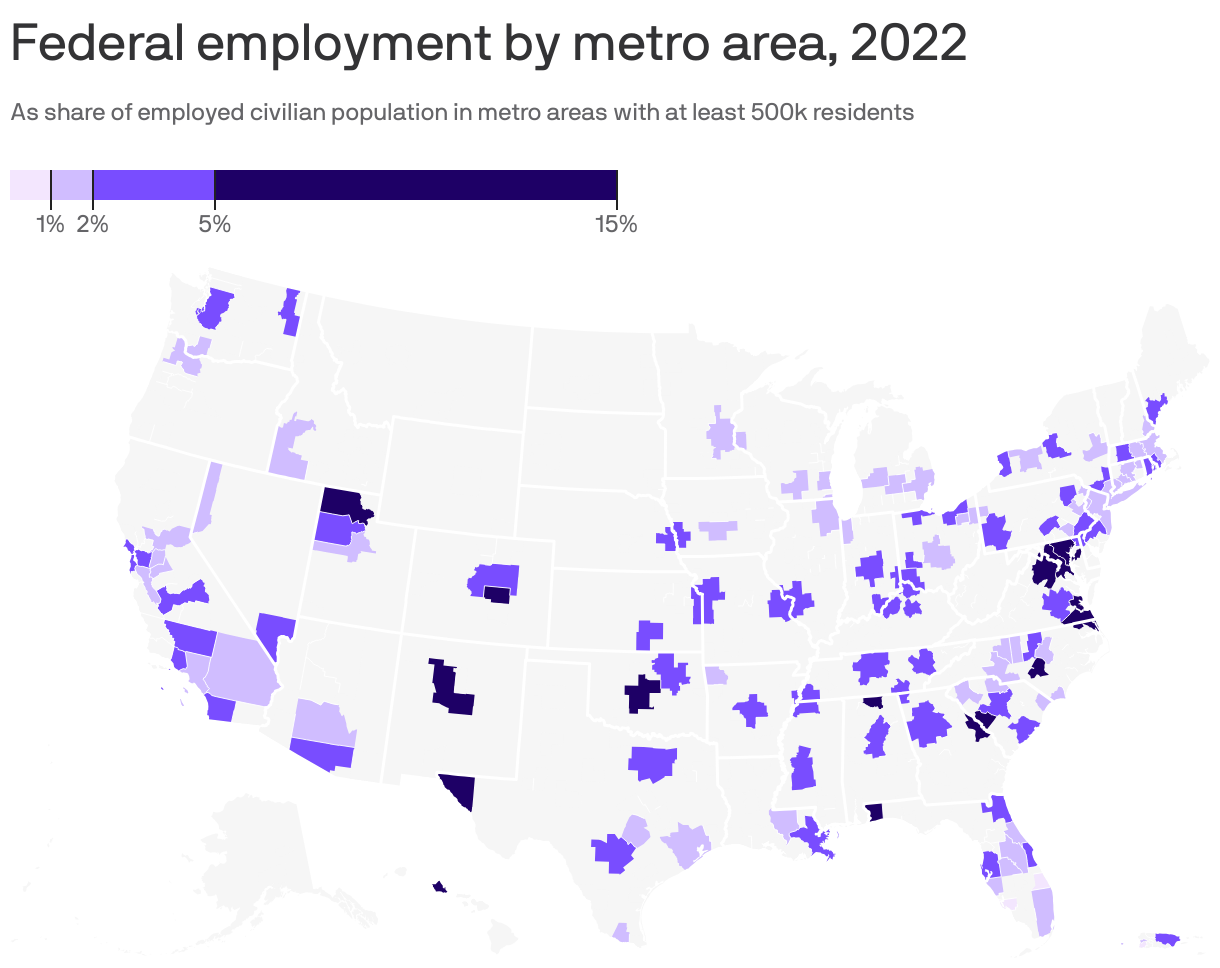
Cities and regions across the country, including here in the Triangle, could soon see thousands of job cuts by a key employer — the federal government, Axios' Asher Price writes.
Why it matters: Tapped by President-elect Trump to lead the new Department of Government Efficiency (DOGE), Elon Musk and Vivek Ramaswamy have vowed to cut what they deem to be wasteful spending.
- "We expect mass reductions," Ramaswamy told Fox News' "Sunday Morning Futures" on Nov. 17. "We expect certain agencies to be deleted outright. … We expect massive cuts among federal contractors and others who are overbilling the federal government."
By the numbers: In the Triangle, 2.2% of workers in the Durham-Chapel Hill metro area are employed by the federal government, or 7,559 workers out of 347,620, per the most recent Census Bureau data available.
- In Raleigh, they make up 1.6% of workers, or 12,539 workers out of 790,217.
- There are more than 23,000 federal government workers in North Carolina's 2nd, 4th and 13th congressional districts, which make up the majority of the Triangle area, according to the Congressional Research Service.
Zoom in: Locally, the federal workforce includes more than 2,000 workers at an Environmental Protection Agency research center in Research Triangle Park, along with the National Institute for Environmental Health Sciences office also in RTP, TSA employees, postal workers, correctional officers at the Butner federal prison and many more.
- The mass layoff of federal workers in the Triangle could also weigh on companies and institutions that partner with federal partners, from the university level down to small contractors.
There are more than 3,600 defense contracting firms in North Carolina, according to N.C. State University.
- Duke and UNC are both in the top 20 in funding from the National Institutes of Health — an agency whose budget Trump proposed cutting in his first term, NPR reported.
State of play: Michael Walden, an economist and emeritus professor at N.C. State University, said he believes the Triangle's economy could likely absorb some federal job losses since they make up a relatively small percentage of the overall labor pool. Those employees could potentially land jobs in other industries.
- Walden added, though, that while DOGE might be looking to cut government "waste" — what is considered "waste" is subject to interpretation and valuable work being done locally could be interrupted.
- "It appears to me that DOGE will need to make numerous subjective evaluations of federal activities in their pursuit of lower federal expenses," he said.
Zoom out: Federal employees make up the largest portion of the workforce in, naturally, Washington, D.C. (13.9%), with Huntsville, Ala., (9.3%), and Virginia Beach, Va. (9.2%), following.
- Cities with military installations tend to have a higher share, and 7.4% of workers in the Fayetteville metro area, home to Fort Liberty, are employed by the federal government.
Follow the money: The average annual pay for a federal employee is about $106,000, per ZipRecruiter.
- The U.S. has about 2 million civilian employees working across U.S. states and territories per a 2024 Congressional Research Service report, so cutting half the employees, as Ramaswamy has suggested, could save the government about $100 billion annually in salaries.
How it works: Sources tell Axios Musk wants to use AI and crowdsourcing to hunt for waste, fraud and abuse. But DOGE isn't a government department: Musk and Ramaswamy plan to set up a nongovernmental entity to try to pull off the entrepreneurial approach to government that Trump envisions.
What they're saying: "This will send shockwaves through the system, and anyone involved in government waste, which is a lot of people!" Musk said in a statement.
The other side: "People are apprehensive and fearful," Nicole Cantello, an attorney with the Environmental Protection Agency who now serves as a union president representing EPA workers in the Upper Midwest, told NPR.
- "Millions of Americans should brace for massive cuts to benefits and services they rely on for their survival under plans to target government spending and operations," American Federation of Government Employees National President Everett Kelley said in a Nov. 13 statement.
Reality check: But with federal employees throughout the country — think of your neighborhood letter carrier — it'll be hard for the Trump administration to make the kinds of widespread cuts it's considering.
- Members of Congress generally are wary of cutting hometown jobs and government services.
The bottom line: The aspiration of trillions of dollars of savings will run headlong into the unspoken governing theory of both parties, write Axios' Jim VandeHei and Mike Allen: It's easier and more popular to give than to take away.