NC agency tasked with post-hurricane home rebuilding is running out of money

Add Axios as your preferred source to
see more of our stories on Google.
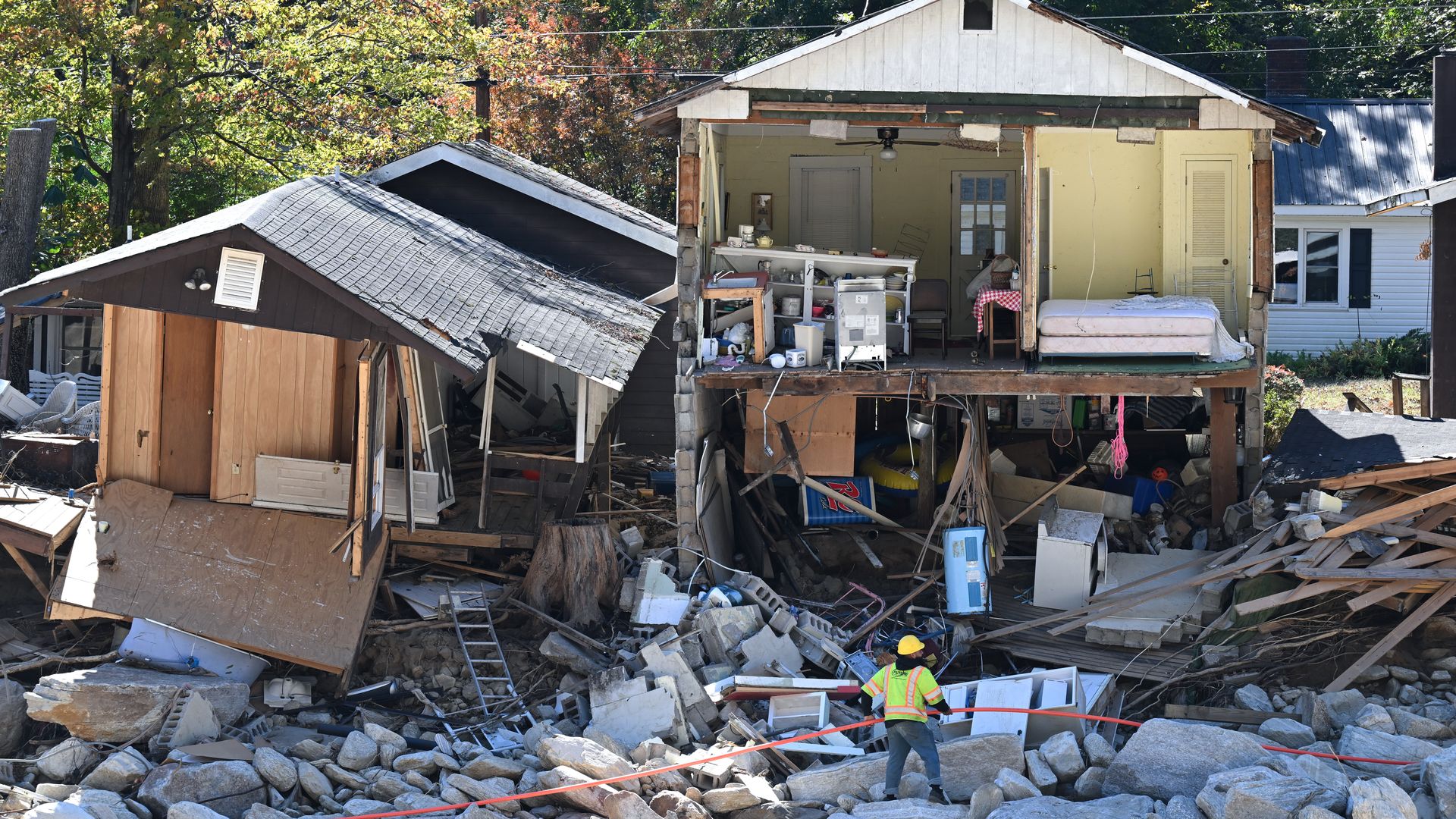
Homes destroyed by Hurricane Helene along the Rocky Broad River last month in Chimney Rock. Photo: Matt McClain/The Washington Post via Getty Images
The North Carolina agency tasked with the state's storm recovery efforts is short hundreds of millions of dollars.
The deficit could hamper its ability to rebuild or repair homes for 1,400 victims who are still displaced or living in storm-damaged homes after hurricanes Florence and Matthew, the program's director told lawmakers Monday.
Why it matters: It's been five and seven years, respectively, since Florence and Matthew devastated North Carolina, leaving behind a combined $21.8 billion in damages, per state estimates.
- As the state still struggles to rebuild from those storms, it's reckoning with yet another: Hurricane Helene, which left behind some $48.7 billion in damages, far and away the deadliest and most detrimental storm in the state's history, preliminary estimates show.
Driving the news: The Office of Resiliency and Recovery, a troubled agency known as RebuildNC and created by outgoing Democratic Gov. Roy Cooper, was designed to help the state recover in Helene's wake.
- Cooper's administration quietly requested an additional $175 million to finish the work of rebuilding the 1,400 homes. It needs that funding immediately, the governor's office said in a request to lawmakers last month, to avoid stopping work on homes already being rebuilt or repaired.
- Lawmakers are now questioning the agency's ability to lead the state's Helene recovery efforts, however, given its newly discovered massive funding deficit.
Catch up quick: For years, RebuildNC has faced intense scrutiny from the Republican-controlled legislature.
- In the years since Matthew and Florence, its slow repair and construction operation has left storm victims homeless or living in hotels and motels. For years, lawmakers have been critical of the agency's leadership.
Friction point: The agency's request last month came just days before the state legislature was set to take up another Helene disaster recovery package, and Republican leaders were furious.
- Lawmakers called a hearing, demanding that RebuildNC leaders address how the agency could need such a large sum and how long they've known they needed the funds.
- "(NCORR's) attempts to hide problems rather than own up to their incompetence has resulted in a continuing disaster for hurricane victims," Republican Senate leader Phil Berger said in a statement last month.
- He accused Cooper of "financial carelessness" and chastised him for asking for additional funds "with little to no time to evaluate the request."
The latest: In a two-hour hearing Monday afternoon, lawmakers pummeled RebuildNC director Laura Hogshead and governor's aide Pryor Gibson with questions about the agency's need for additional funding.
- One lawmaker, Republican state Rep. Brenden Jones, asked for Hogshead's resignation. Jones represents Columbus and Robeson counties, two of the places hardest hit by Matthew and Florence.
- Hogshead took responsibility for the funding deficit but declined to resign.
By the numbers: RebuildNC would need $221 million to "solve all its problems," Gibson, deputy legislative counsel to the governor, told lawmakers Monday.
- Worst case scenario, it would need as much as $264 million if it could not pull funding from other sources, Hogshead said. The agency has requested at least $40 million per month for the next three months, per Gibson.
- The agency is also footing a bill of around $2 million per month to house those displaced in the meantime, Hogshead said.
- By the end of the program, RebuildNC will have served about 4,200 applicants.
- For someone whose application to have their home rebuilt has been accepted, it can take "in excess" of 500 days for them to get into a modular home after their application has been approved, Hogshead told lawmakers.
- The agency is currently averaging more than 100 home completions a month, up from around 60 homes per month in 2022.
Zoom in: Rebuild NC has previously cited the pandemic, rising construction costs and labor shortages as the need for more funding. Asked Monday how the agency ended up lacking the funds to complete the remaining projects, Hogshead said: "We simply were not watching carefully enough."
- "That's an understatement," Jones replied.