How ShotSpotter did in Durham during its one-year pilot

Add Axios as your preferred source to
see more of our stories on Google.
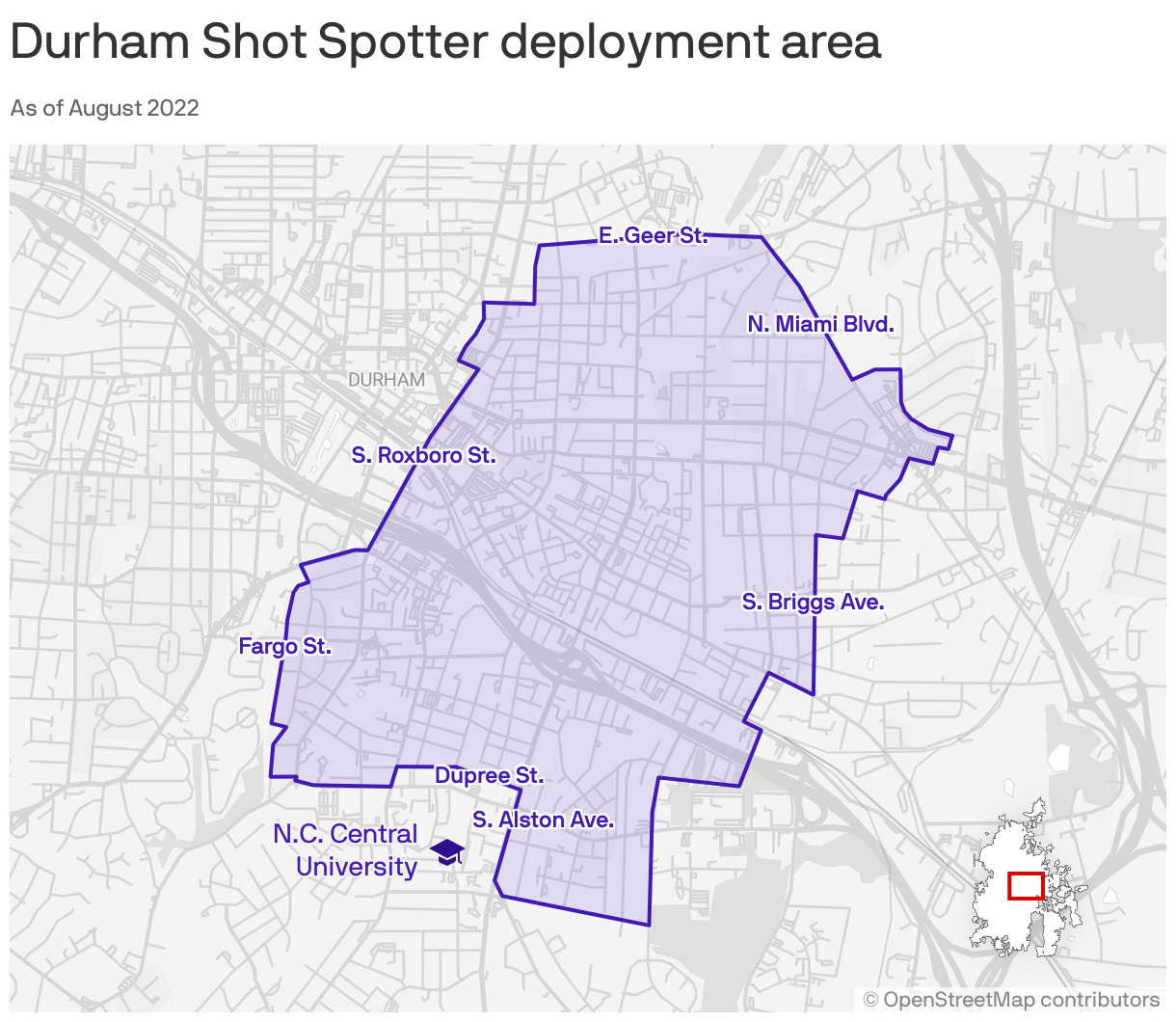
A new Duke University report reveals the AI-powered gunshot detection technology ShotSpotter helped Durham police make several gun-related arrests last year.
- But it also often sent reports that police ultimately could not find evidence for.
Why it matters: Durham launched a yearlong pilot of ShotSpotter — now rebranded as SoundThinking — in a three-mile area in December 2022 to see if it could improve response times to shootings. Durham's City Council is now debating whether to bring back the technology full time.
- Its implementation has been controversial. It was blocked for many years by previous councils over concerns it would lead to over policing of Black neighborhoods.
What they found: As part of the pilot program, Duke University's Wilson Center for Science and Justice provided a free analysis of how well ShotSpotter performed.
- There is no evidence that ShotSpotter reduced gun violence in the city, Philip Cook, an emeritus professor at Duke, told the city council on Thursday.
- But it did notify police about more shootings compared to just 911 calls.
By the numbers: ShotSpotter produced 1,416 reports during its one-year pilot. For most, however, a subsequent police investigation could not confirm there were gunshots — especially if there was no corresponding 911 call.
- Of the 825 alerts for which there was no related 911 call, 91% did not result in a crime report.
Between the lines: Of the 282 confirmed gun shots in the pilot area, 26% were detected only through ShotSpotter.
- And of 29 gunshot incidents that resulted in arrests, seven only happened because of a ShotSpotter notification.
- ShotSpotter did not detect every instance of gun violence. It failed to pick up eight shootings with one or more victims due to human or system failure.
State of play: Response times improved throughout the city last year. Within the pilot area, they improved by 1.2 minutes more than elsewhere, according to the report.
- One person's life may have been saved, according to Cook, who said police officers responded within minutes of one ShotSpotter notification and were able to provide immediate aid.
- "We are not medical doctors … but it is plausible there is that one case where there might have been a life saved," Cook said.
How it works: ShotSpotter places audio sensors in cities with the goal of quickly pinpointing where possible gunshots have been fired.
- When the microphones detect a potential shooting it sends an alert and address to the police.
- For every alert that ShotSpotter sent to the city, the Durham Police Department responded with two patrol cars without flashing lights or sirens.
What's next: Durham City Council could vote at its next meeting to spend $658,500 to extend its contract with SoundThinking for three years.