RTP's next transformation

Add Axios as your preferred source to
see more of our stories on Google.
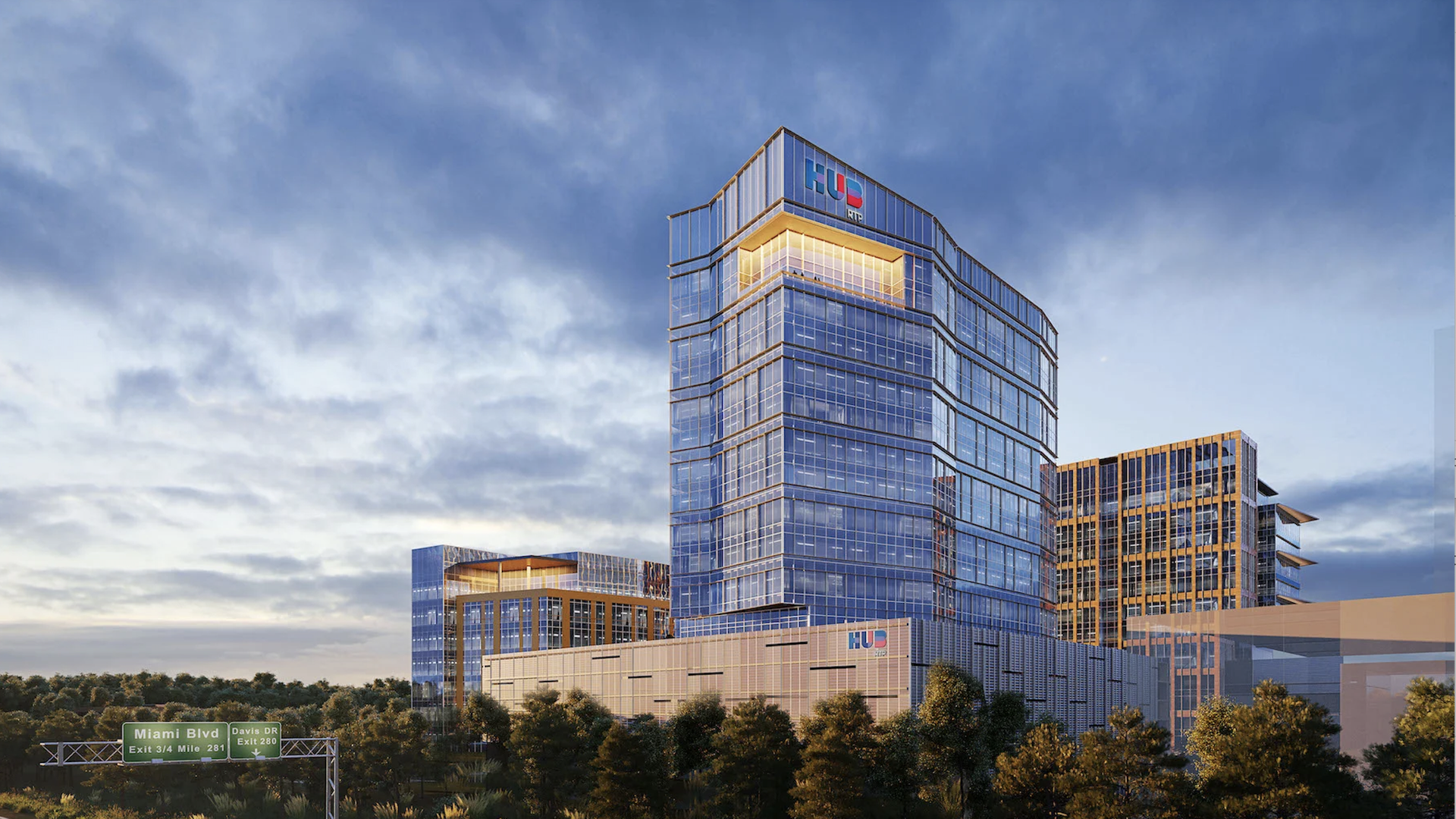
A rendering of HUB RTP's office towers, courtesy of Research Triangle Foundation
What do the next 50 years look like for Research Triangle Park?
- The leaders of the business park, home to more than 300 companies and an economic driver for the region, want to turn the sea of corporate campuses into a connected collection of mixed-use developments.
Driving the news: The Research Triangle Foundation, the not-for-profit that manages RTP, plans to put forward a new zoning proposal to Durham and Wake counties next year that would allow for landowners in the park to build more types of housing and commercial spaces.
- RTP would also need to revise its land covenants to allow for landowners to redevelop their existing properties.
Why it matters: RTP sits at the intersection of Raleigh, Durham and Chapel Hill, and spans 7,000 acres — nearly half the size of Manhattan Island — across the border of Durham and Wake counties.
- The potential rezoning could open up a huge swath of the Triangle to denser housing, as the region's rapid growth is expected to continue.
- Residential development there could ease future transit headaches, as the tens of thousands of workers in the park currently all commute in.
- It could also make RTP more attractive to the next generation of workers and help companies retain talent, Levitan told Axios.
By the numbers: Currently 20% of RTP (roughly 1,400 acres) is surface parking, according to Scott Levitan, the CEO of the Research Triangle Foundation.
- If you were to just use some of those parking lots — many of which are underused due to hybrid work trends — for redevelopment, you could add thousands of new housing and commercial options.
State of play: Levitan is pushing RTP's evolution as RTP 3.0.
- 1.0 was its original incarnation, home to a vast amount of corporate campuses that workers commuted into.
- 2.0 is the under-construction HUB RTP, which is envisioned as the park's downtown and features its first office towers, retail centers, restaurants and apartments.
- 3.0 would be about letting smaller, mixed-use developments spring up around the rest of RTP and building out infrastructure, like new greenways, to connect them.
Be smart: The Research Triangle Foundation cannot make landowners redevelop their land, and many of them, Levitan noted, would likely prefer not to.
- But a new zoning overlay would give many of them the option to pursue redevelopment.
What they're saying: "The 1960s model [of development] just really isn't relevant anymore," Levitan told the Durham County Commissioners earlier this month.
- "Our goal is to … think about how those 7,000 acres can be more optimally used and deployed for the vision for our region," he added