U.S. Supreme Court transforms admissions for UNC


Add Axios as your preferred source to
see more of our stories on Google.
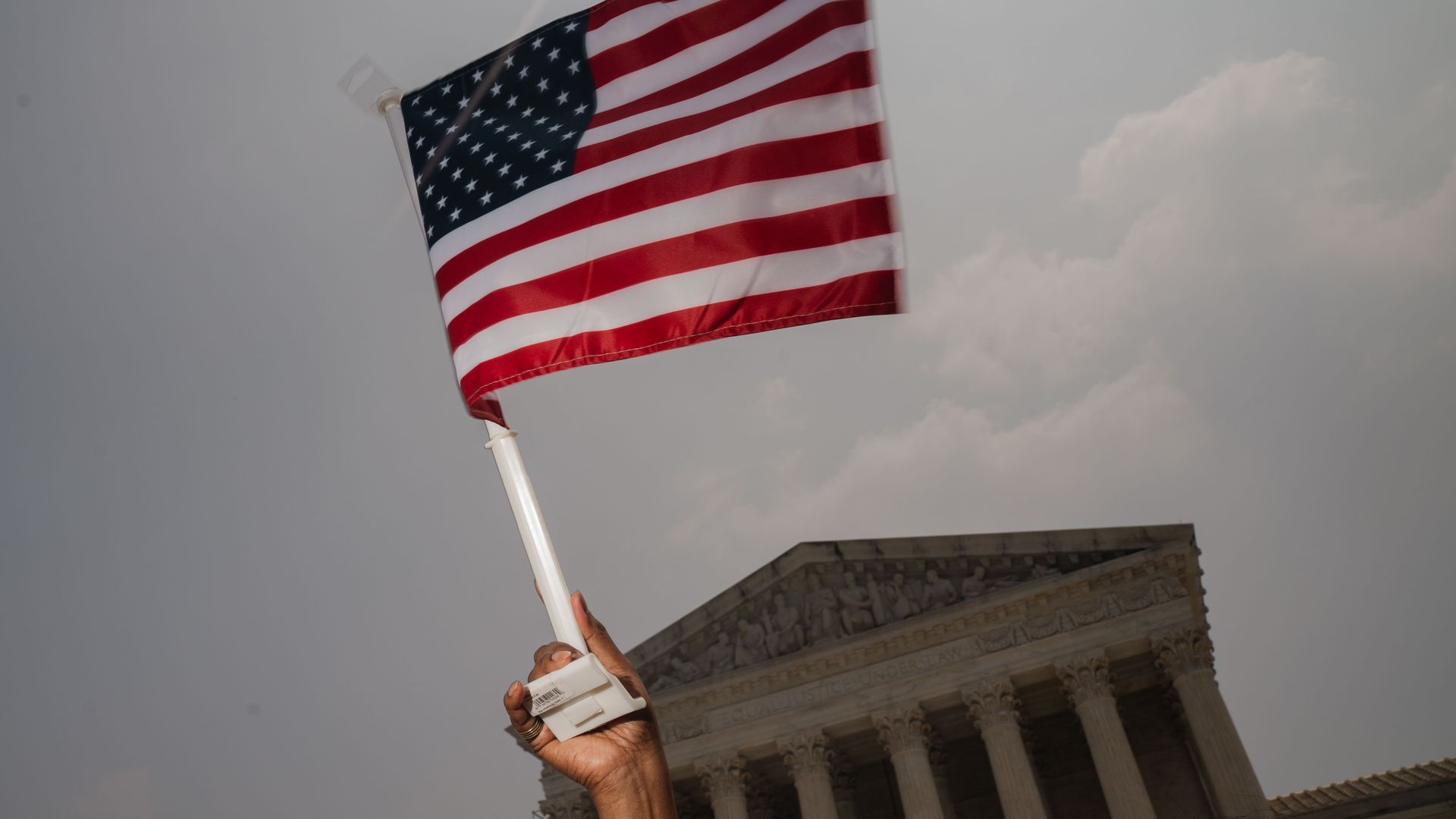
A woman holds an American flag during a rally outside of the Supreme Court of the United States after it ruled Thursday that race-conscious admissions are unconstitutional. Photo: Kent Nishimura/Los Angeles Times via Getty Images
In a case taking on the admissions practices of UNC and Harvard, the U.S. Supreme Court ruled Thursday that colleges can't explicitly consider applicants' race in admissions.
Why it matters: The ruling will radically transform how colleges in North Carolina and across the country are able to attract a diverse student body, and it will force schools to reimagine long-standing hallmarks of the admissions process, Axios' Erin Doherty and April Rubin write.
The big picture: The move could lead to a drop in the number of Black and Hispanic students at some universities, if the nine states where affirmative action has already been banned are a guide.
- In California, which banned affirmative action at public schools in 1996, Black and Hispanic enrollment fell 40% the year after at Berkeley and UCLA, two of its more selective schools, NPR reported.
- At the University of Michigan, Black students made up 4% of the student body in 2021 — down from 7% in 2006, the year voters approved a referendum to ban the practice.
Reality check: The court's decision could make the college essay even more important, the New York Times reported. Chief Justice John Roberts noted applicants can still discuss in applications how race affected their life.
- Yes, but: "Universities may not simply establish through the application essays or other means the regime we hold unlawful today,” he added in the decision.
Catch up quick: The conservative-majority Supreme Court ruled 6-3 against the admissions processes at Harvard along with UNC, both of which gave a little extra weight to applicants from certain underrepresented groups.
- The high court sided with the conservative nonprofit Students for Fair Admissions, which argued that the universities' admissions processes discriminate against white and Asian American applicants.
- The ruling comes despite the fact that the Supreme Court has historically backed affirmative action programs at colleges — most recently in 2016, when it rejected a challenge to a race-conscious admissions program at the University of Texas-Austin.
The other side: In a dissenting opinion, the court's liberal justices argued that educational opportunity contributes to achieving racial equality.
- "This limited use of race has helped equalize educational opportunities for all students of every race and background and has improved racial diversity on college campuses," Justice Sonia Sotomayor wrote in another dissenting opinion.
- "Ignoring race will not equalize a society that is racially unequal. What was true in the 1860s, and again in 1954, is true today: Equality requires acknowledgment of inequality," Sotomayor wrote.
Zoom in: UNC-Chapel Hill vowed to review the opinion and take steps to comply with the law, even though the opinion wasn't what the university hoped for, Chancellor Kevin M. Guskiewicz said in a statement Thursday.
- "Carolina is committed to bringing together talented students with different perspectives and life experiences and to making an affordable, high-quality education accessible to the people of North Carolina and beyond," Guskiewicz said in another statement.
- "I know that this decision may raise questions about our future and how we fulfill our mission and live out our values. But Carolina is built for this, and we have been preparing for any outcome."
The school's board of trustees' statement struck a different tone: "On behalf of the people of our state, we will work with the administration to ensure that the University of North Carolina at Chapel Hill complies fully with today's ruling from the nation’s highest court," board chairman David Boliek said in a statement.
- "We intend for America's oldest public university to keep leading."
Go deeper: Ending affirmative action is watershed moment for higher education