Federal cuts strain Pittsburgh public media



Add Axios as your preferred source to
see more of our stories on Google.
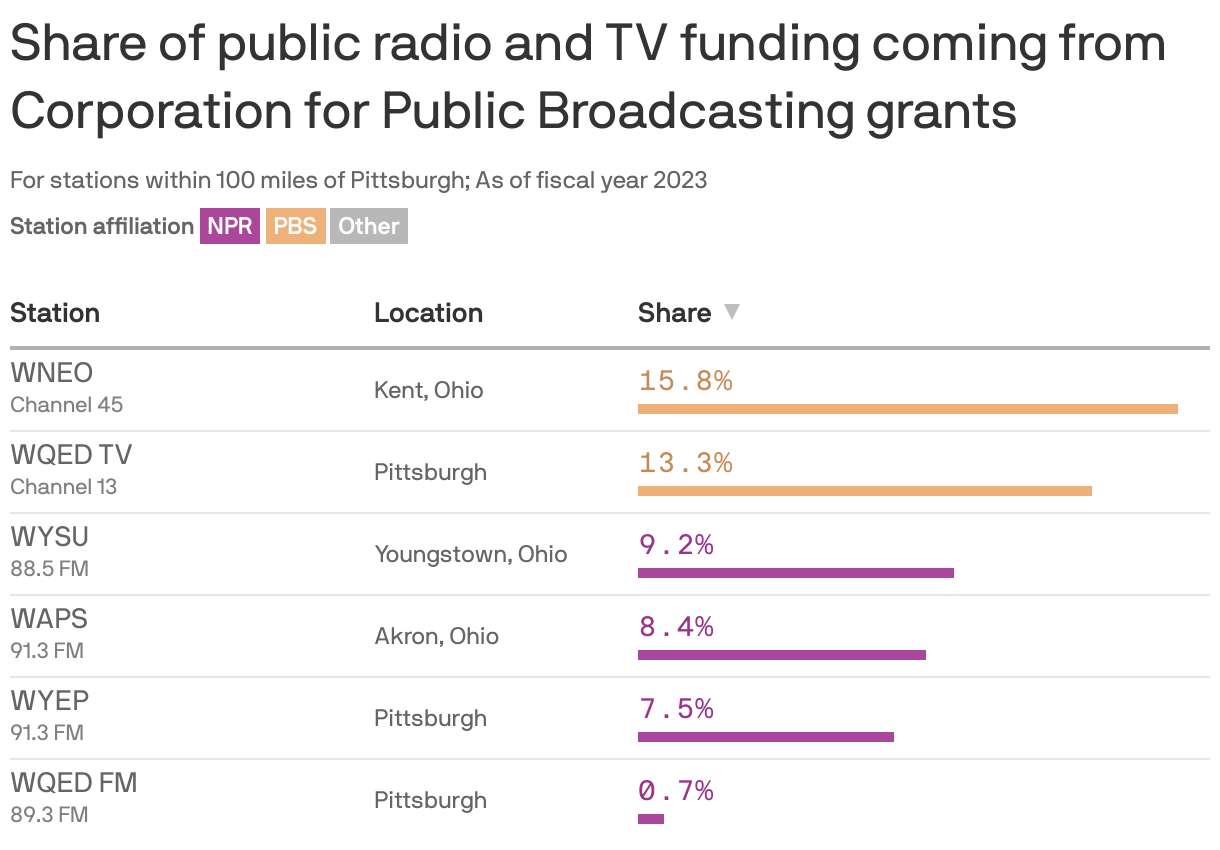
Pittsburgh's public TV and radio stations are facing $2.5 million in annual shortfalls due to Republican-led federal cuts.
Why it matters: Public media outlets serve essential community newsgathering and emergency roles, but the Trump administration and others on the right have long accused them of left-leaning bias.
Context: Congress rescinded $1.1 billion in Corporation for Public Broadcasting (CPB) funding for all stations across the nation, based on publicly available financial data collected by a former NPR staffer and shared with Axios.
Driving the news: WQED, Pittsburgh's PBS affiliate, laid off 19 employees on Wednesday, mostly in marketing, membership, and production, after cutting five positions in May, TribLive reports.
- WQED President Jason Jedlinski said the move follows the elimination of federal funding and aims to secure WQED's long-term financial stability.
The big picture: For hundreds of stations with available data, CPB grants made up about 10.3% of U.S. public TV stations' overall funding as of fiscal year 2023, and 4.1% for radio stations.
- That share is much greater for some stations.
Zoom in: 13.3% of funding for WQED was provided by CPB grants.
- Two of the region's public radio stations — WYEP and WESA — received 7.5% of their combined funding from CPB grants.
Caveat: Public media stations can also receive other forms of federal grants, plus corporate sponsorships and donations from (ahem) viewers like you.
- WESA and WYEP recently raised over $500,000, but are still short of their $700,000 shortfall and will seek more funding to cover next year's gap.
What they're saying: WQED has already been losing hundreds of thousands of dollars in foundation support over the years, Jedlinski said in a webinar.
- "The documentary budgets, whether for national programs WQED used to create … or Rick Sebak local shows … has declined given other priorities for marketers among other types of media," he said.
Between the lines: Public media stations in relatively populous, high-income cities tend to have better access to donors.
- But rural stations tend to be more reliant on federal dollars — while also serving key roles for local news and emergency broadcasts, including weather and AMBER alerts.
The other side: Republicans have long sought cuts to public broadcasting with efforts tracing back to the Nixon administration.
- The Trump administration has argued that public media creates media that is overly supportive of Democrats and liberal views, and taxpayer dollars shouldn't be used for that.
The latest: Many public TV and radio stations have pressed their pleas for donations, hoping to appeal to viewers and listeners in their time of need.
- A donation request greets viewers every time they open WQED's Passport streaming app.