Deportation looms for Arizona woman who's out of legal remedies

Add Axios as your preferred source to
see more of our stories on Google.
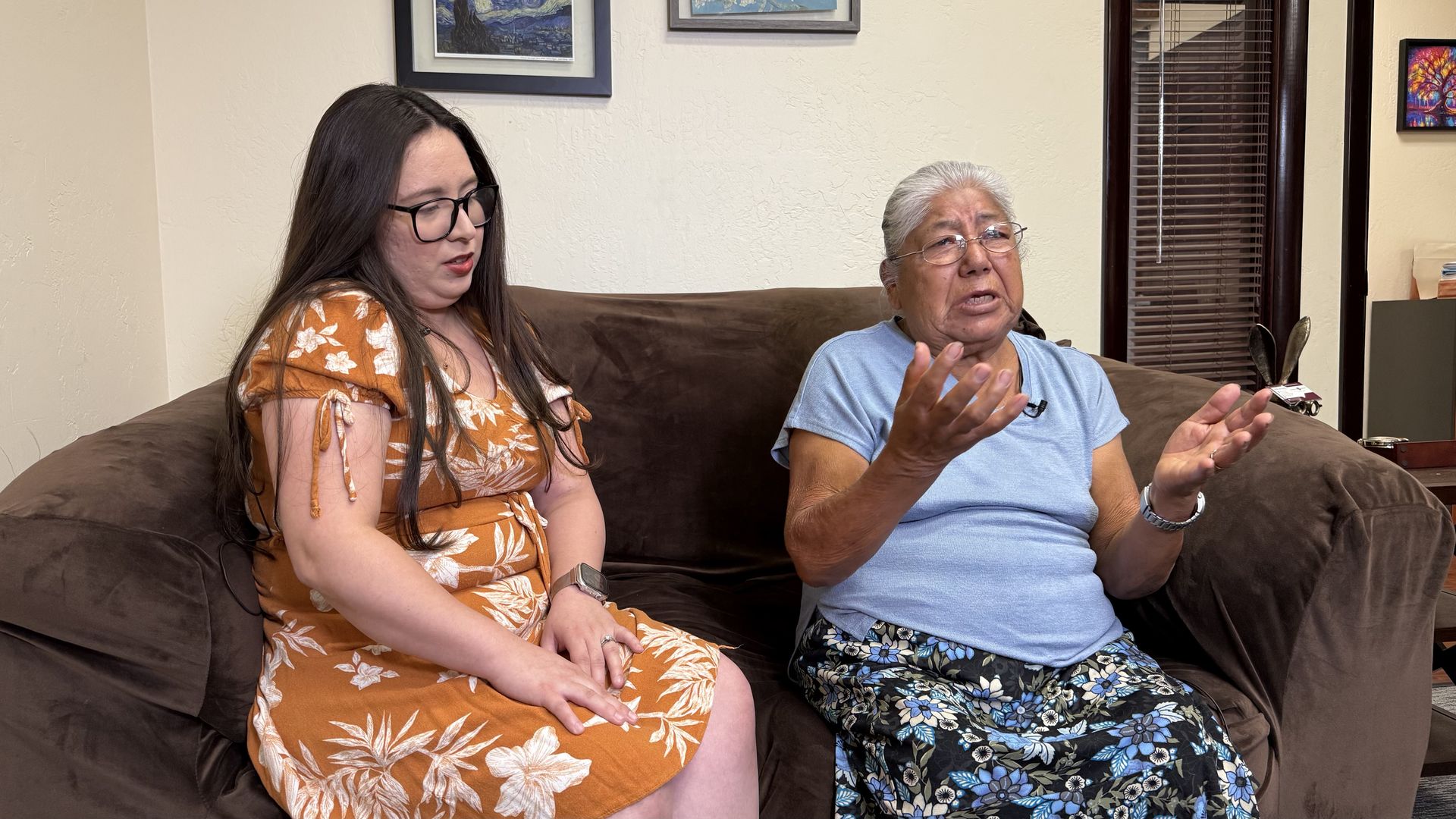
Epifania Juares-Gonzalez, right, discusses her likely deportation to Mexico after 35 years in the U.S., while Jackie Robles translates. Photo: Jeremy Duda/Axios
A 76-year-old Valley great-grandmother who entered the U.S. illegally 35 years ago is facing the near-certainty that she'll be deported to Mexico.
Why it matters: Epifania Juares-Gonzalez is unable to work due to age and health issues, and has no family in Mexico who can help care for her.
- Through a translator, a relative explained that she has a younger sister in Mexico City, but Juares-Gonzalez's high blood pressure prevents her from living in the metropolis where the elevation is higher.
- The sister cares for grandchildren and wouldn't be able to relocate to take care of her.
State of play: Juares-Gonzalez is scheduled for an August hearing in immigration court, at which she'll almost certainly either be ordered deported or offered voluntary departure, her attorney, Monika Sud-Devaraj, told reporters last week.
- The death of her husband, who was in the U.S. legally and had a green card, and her son, who was a U.S. citizen, eliminated a path to seek cancellation of her removal proceedings.
Background: Juares-Gonzalez, who is from the Mexican state of Michoacán, came to the U.S. illegally in 1991.
- She received a notice of pending removal proceedings in 2011 and applied three years later for cancellation of removal, a process by which some people with family in the U.S. can challenge deportation and seek green cards.
- Those proceedings were frozen later that year under Obama-era policies that closed removal cases for people who were a low priority for removal.
- Under President Trump, those policies changed in July 2025, and removal proceedings were renewed for previously low-priority cases like Juares-Gonzalez.
Zoom in: Under a 1996 overhaul of federal immigration law, Juares-Gonzalez must return to Mexico for years before seeking legal status because she acknowledged in her 2011 application that she'd re-entered the U.S. illegally after going to her mother's funeral in Mexico around 1999.
- She can no longer seek cancellation of removal because she needs a qualifying family member who is either a U.S. citizen or has a green card and is under 21 years old.
- Her husband and son died while her case was frozen.
- Neither of her other two adult children can serve as qualifying family members.
What she's saying: Juares-Gonzalez is frightened about the likelihood of being forced to return to Mexico, she told reporters in a sometimes-tearful interview through a translator.
- "She is prepared to go, but she is scared for the separation of her family," translator Jackie Robles told Axios.
- Sud-Deveraj said she understands that illegal entry is a crime and that "it's not a revolving door," but emphasized that Juares-Gonzalez has no criminal record and has never received public assistance.
The other side: The U.S. Department of Homeland Security said Juares-Gonzalez faces removal proceedings because she entered and is living in the country illegally, saying in an email to Axios: "If a Justice Department immigration judge orders her removed, we will remove her from the United States."
The bottom line: Sud-Devaraj acknowledged that there are no legal remedies remaining for Juares-Gonzalez, and her case is up to the discretion of DHS.
- "Hopefully someone will have a heart," she said when asked why she was attempting to draw attention to her client's case.