Voters could get chance to reshape Arizona's redistricting process

Add Axios as your preferred source to
see more of our stories on Google.
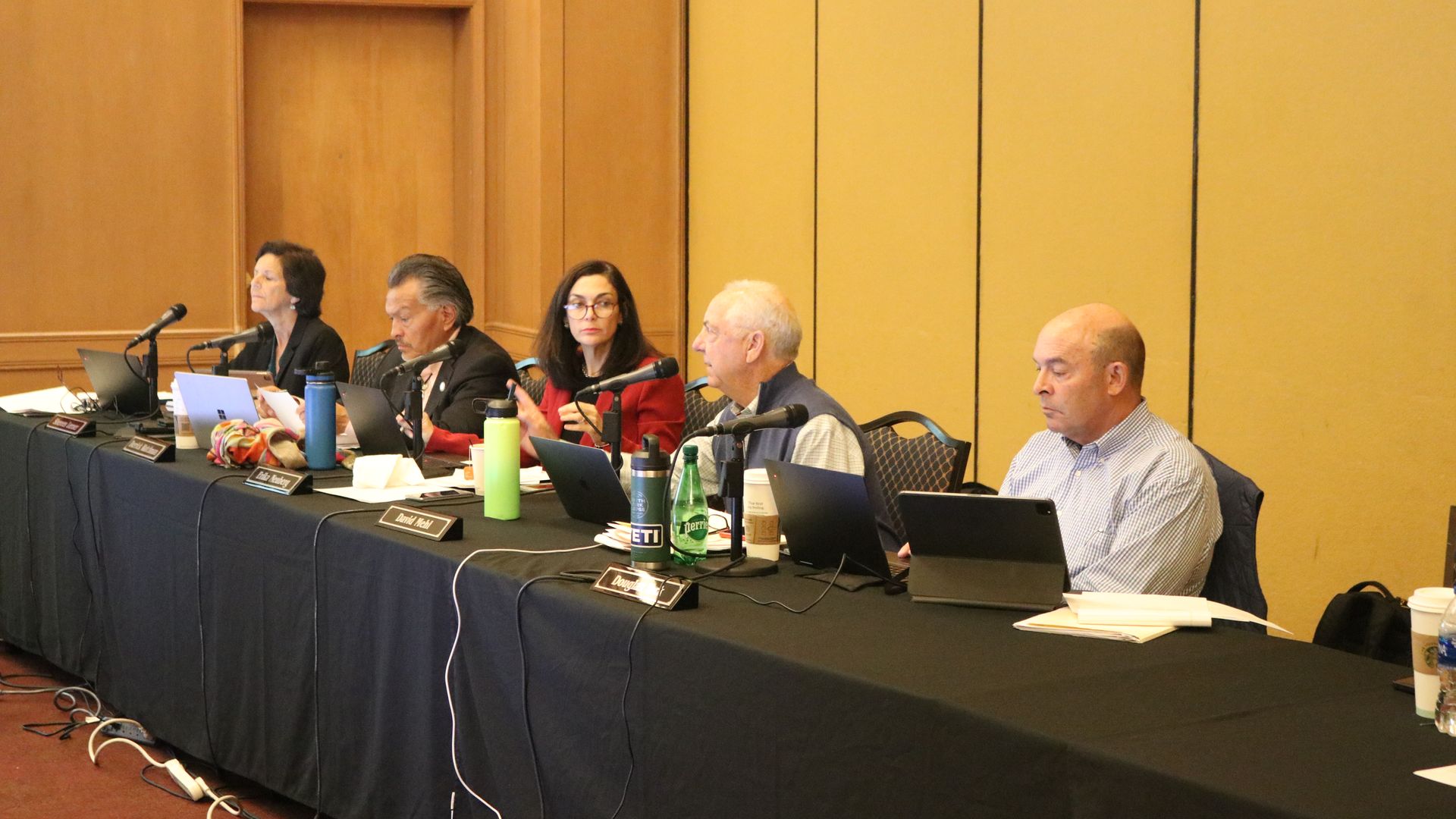
The Arizona Independent Redistricting Commission meets on Oct. 28, 2021. Photo: Jeremy Duda/Axios
Arizonans may get a chance to overhaul the commission that redraws the state's congressional and legislative districts every decade.
Why it matters: A proposal under consideration in the Legislature would ensure that a single tiebreaking vote can't give one party control of what's intended to be an independent process that determines who represents Arizonans in Congress and the Legislature.
State of play: The legislative ballot referral would expand the commission from five to nine members — three Democrats, three Republicans and three who don't belong to either party, one of whom would serve as chair.
- Two commissioners must come from outside Maricopa or Pima counties, guaranteeing rural representation for the first time.
- The Fair and Independent Redistricting Commission, as the panel would be renamed, would need at least six members to approve district maps.
The intrigue: The measure aims to fix perhaps the biggest complaint about Arizona's current process: that it centralizes too much power under the independent chair, who serves as make-or-break tiebreaker between Republicans and Democrats, Sen. J.D. Mesnard (R-Chandler), the sponsor, told colleagues in the Senate.
Flashback: In 2011, Senate Republicans impeached independent chair Colleen Mathis, whom they accused of colluding with the commission's Democrats to draw maps that favored their party. The Arizona Supreme Court later reversed the impeachment.
- In 2021, Democrats accused chair Erika Neuberg of favoring Republicans.
Between the lines: The measure would require the most- and least-populous legislative districts to be within 5,000 people, a smaller population deviation than currently allowed.
Threat level: This will likely hinder efforts to ensure Native American representation in the Legislature.
- Legislative District 6, which includes the Navajo Nation, was drawn with nearly 21,000 fewer people than the most-populous district, but was carefully crafted to ensure voters could elect Native American candidates.
- "The premise of this bill is to silence the voice of tribal membership, tribal nations at this level," Sen. Theresa Hatathlie (D-Coal Mine) said on the Senate floor on Monday.
What they're saying: Mesnard told Axios he's willing to support an amendment that would exempt tribal nations but won't budge on the population limit, noting in a committee last month," there's kind of nothing more fundamental than equal representation."
What we're watching: Sen. Lauren Kuby (D-Tempe) said she supports expanding the commission and would like to see even more than nine members, but voted against the measure because of the population deviation issue.
What's next: The measure goes to the House after Senate Republicans approved it on a party-line vote Monday.
- If the House approves it, the measure will appear on the November ballot.