GOP seeks limits on early ballot drop-offs, voting by mail

Add Axios as your preferred source to
see more of our stories on Google.
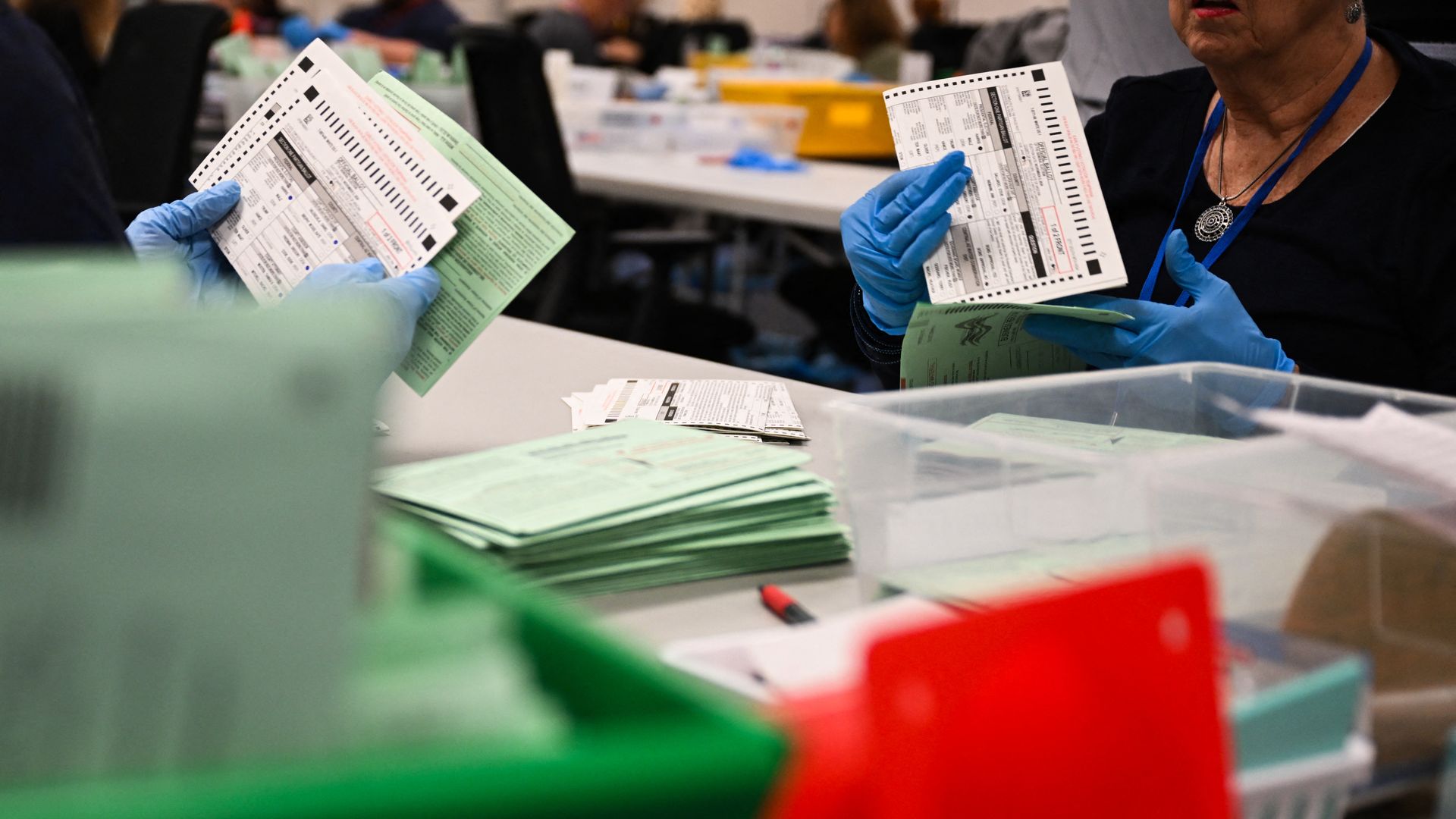
GOP lawmakers are looking to speed up election results by restricting voters' ability to drop off their early ballots on Election Day. Photo: Patrick T. Fallon/AFP via Getty Images
Republican lawmakers are looking to speed up Arizona's notoriously slow ballot-counting process by restricting voters' ability to drop off early ballots on Election Day.
Why it matters: It can take a week or more to determine the winners of close races in Arizona, largely due to the laborious process of verifying signatures on early ballots that voters bring to polling places on Election Day.
State of play: Two proposals introduced for the upcoming legislative session seek to alleviate the problem by getting rid of early ballot drop-offs.
- Under HB2001, sponsored by Rep. Selina Bliss (R-Prescott), voters who deliver their early ballots after 7pm on the Friday before an election would have to show ID like any other voter, which would avoid the signature verification process. It would also extend in-person early voting to the Mondays before elections.
- HCR2001 and SCR1001, identical House and Senate proposals sponsored by Rep. Alexander Kolodin (R-Scottsdale) and Sen. Shawnna Bolick (R-Phoenix), would impose the same cutoff for general elections, but people who miss it would have to cast ballots in person.
Zoom in: The Arizona Secure Elections Act, as Bolick and Kolodin's proposal is dubbed, is a proposed ballot referrals that would amend the Arizona Constitution if approved by voters next November. It would make other noteworthy changes.
- Currently, people who are on the state's Active Early Voting List (AEVL) automatically receive early ballots for each election.
- Under the proposal, people would have to request early ballots while confirming their mailing addresses before each biennial general election.
- Kolodin told Axios that nothing in the act eliminates the AEVL, but it'll "ensure that the correct ballot reaches the correct voter." He didn't respond to questions about whether voters would continue to automatically receive ballots for other elections.
Between the lines: Kolodin, who's running for Arizona secretary of state, told Axios that he limited some provisions of his proposal to general elections because they "consistently draw the highest turnout and, as we've seen in recent years, create the most strain on the system."
The intrigue: Yavapai County Recorder Michelle Burchill, a Republican who supports Bliss' bill, told Axios that the proposed ballot measure is unclear about early ballot requests.
- Her interpretation is that a request by a voter would apply to all elections in a two-year period, but she is unsure when that period would start.
- "I am assuming the vagueness is to allow for some sort of interpretation after the fact," she said.
What we're watching: Bliss' plan would require the signature of Democratic Gov. Katie Hobbs, who vetoed a similar bill last session, while the proposed ballot measure wouldn't.
- Bliss told Axios she believes her bill is something the governor would be willing to sign because Hobbs has probably heard from voters that it's "overdue."
The other side: Hobbs' position from last session is "unchanged" and she won't sign any bill "that makes it harder for Arizonans to cast their ballot," spokesperson Christian Slater told Axios.
By the numbers: Nearly 74% of the state's roughly 4.5 million registered voters are on the AEVL, including about 72% of Republicans, 83% of Democrats and 66% of independents and others.