Arizona's pivotal role in shaping the Voting Rights Act

Add Axios as your preferred source to
see more of our stories on Google.
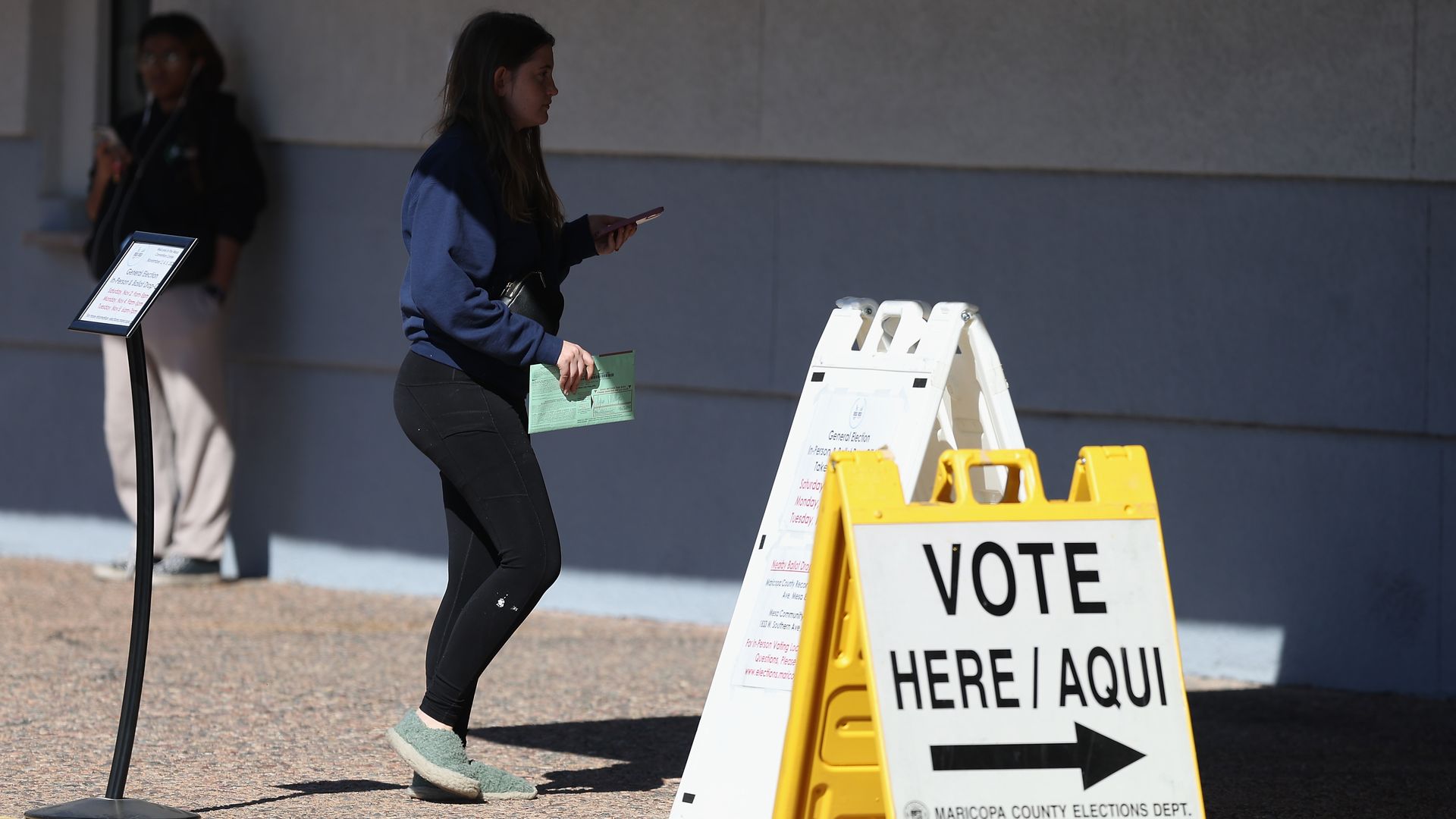
Voters arrive to the Mesa Convention Center polling place on Nov. 5, 2024. Photo: Christian Petersen/Getty Images
Over the Voting Rights Act's 60-year history, Arizona has been shaped by the landmark election legislation and has played a significant role in reimagining the law.
Why it matters: Arizona's complicated history of voter disenfranchisement has made it a key player in the national effort to ensure unfettered voting rights.
Catch up quick: The Voting Rights Act, signed into law by President Lyndon B. Johnson in 1965, created sweeping voter protections by prohibiting race-based discrimination and requiring states to adopt practices to expand the voting power of minority groups.
- The federal legislation forced the end of Arizona's literacy test requirement — a tactic to prevent Latinos from voting — and expanded Native American voter access.
- It also led to the creation of "majority minority" legislative and congressional districts to boost minority representation.
The intrigue: The Voting Rights Act authorized federal oversight of locales with a history of race-based voter discrimination or suppression, requiring them to submit any changes to local election laws or maps to the U.S. Department of Justice for advance approval to ensure no "discriminatory purpose nor a discriminatory effect."
- Arizona was one of nine states subject to this "preclearance."
Zoom in: Since 1975, preclearance was used to halt proposed changes to Arizona election procedures, polling place relocations, at-large judicial elections and more.
Yes, but: The U.S. Supreme Court in 2013 ruled that the formula used to determine which states were subject to preclearance was unconstitutional.
Meanwhile, in 2021, two Arizona election laws landed before the U.S. Supreme Court, leading to one of the "most consequential" voting rights decisions in decades, The New York Times reported at the time.
- The Democratic National Committee challenged the laws — one that required ballots cast at the wrong precinct to be thrown out and the other preventing anyone but a family member from returning a voter's early ballot — alleging they were discriminatory under the Voting Rights Act because they disproportionately impacted rural Native American communities.
- The Supreme Court upheld the laws, essentially saying that voters must be prevented from casting a ballot to prove they were suppressed or discriminated against.
What's next: The Supreme Court heard arguments Wednesday in a case that could further weaken the Voting Rights Act and dramatically change the way Arizona draws congressional and legislative districts.