Arizona immigrant detention sees solitary confinement spike


Add Axios as your preferred source to
see more of our stories on Google.
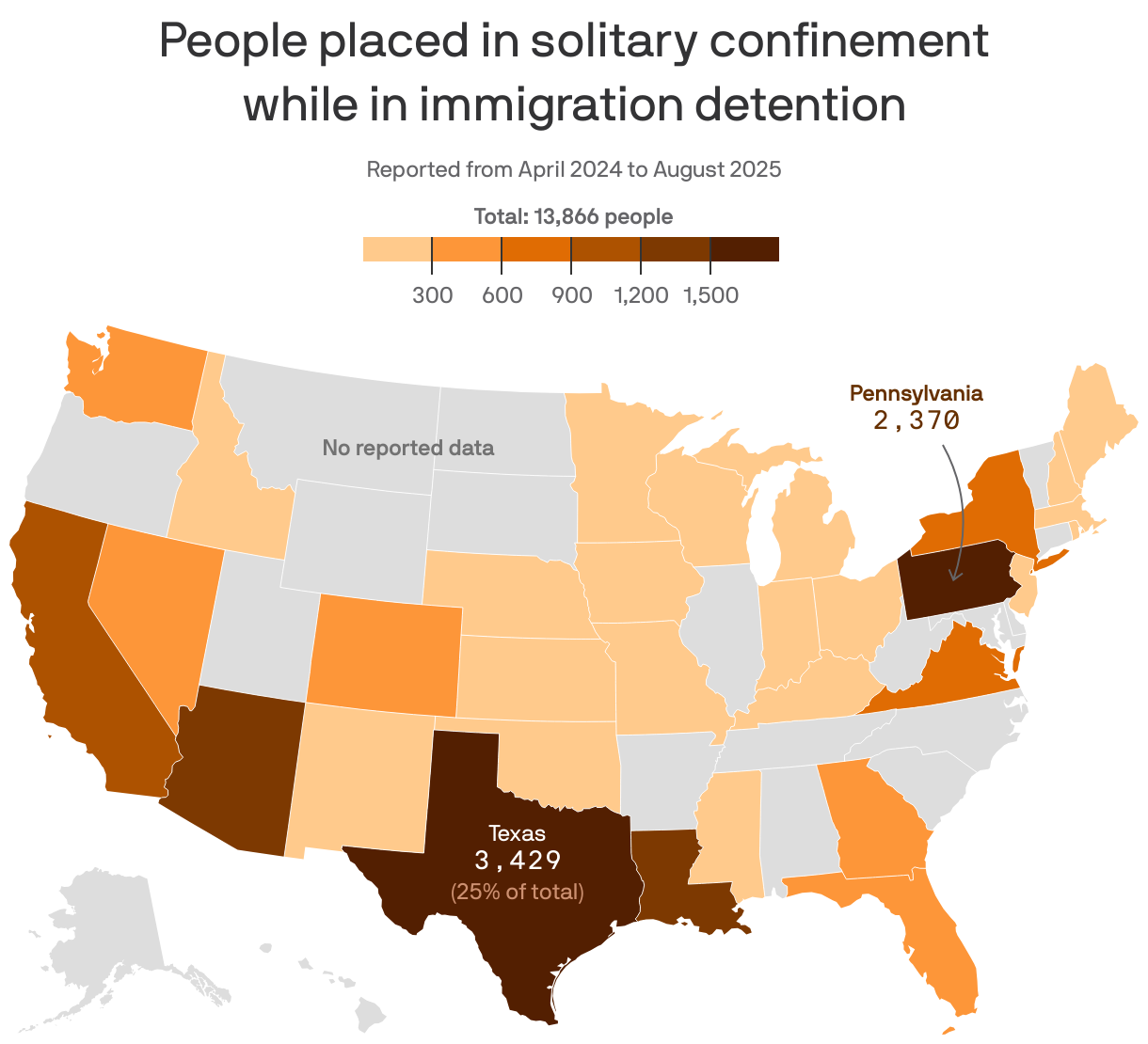
The use of solitary confinement in immigrant detention centers is climbing nationwide this year — with some detainees held in isolation for weeks at a time, new research shows.
The big picture: U.S. solitary confinement placements increasingly drag on for 15 days or longer, which constitutes psychological torture, according to a report by Harvard University researchers and Physicians for Human Rights, citing the United Nations.
- The researchers focused on immigrant detention centers, which experts say are primarily used to hold immigrants and ensure they make their court hearings and check-ins — not to punish them for immigration violations.
Driving the news: Nearly 14,000 people were placed in solitary confinement in immigrant detention centers nationwide between April 2024 and August 2025, including about 1,500 in Arizona facilities, per new data provided exclusively to Axios.
- Arizona facilities had the third-most people of any state, behind Texas and Pennsylvania.
Zoom in: The Eloy Detention Center, a private facility operated by CoreCivic that contracts with U.S. Immigration and Customs Enforcement in Pinal County, had more than 600 people in solitary confinement, and the Central Arizona Florence Correctional Center, another CoreCivic property, had about 270 during that time.
- The other cases occurred at the ICE-operated Florence Service Processing Center, Florence Staging Facility and Phoenix District Office.
- The Eloy facility is one of the largest ICE detention centers in the country.
Friction point: CoreCivic spokesperson Brian Todd said the term "solitary confinement" is often misused by activists, adding the practice is not permitted at any CoreCivic properties.
- He said "restrictive housing" is used for various reasons, including medical and mental health observation and administrative purposes, but individuals maintain "full access to courts, visitation, mail, showers, meals, all medical facilities and recreation."
- "We always strive to ensure detainees are cared for in the least restrictive environment necessary to maintain the safety and security of the institution," Todd said.
Yes, but: Prisoner advocates say "restrictive housing" is just a euphemism for solitary confinement, and the differences are minimal.
Between the lines: The report, which relies on ICE data collections, didn't show the duration of solitary confinement placements for all detainees, just for those labeled "vulnerable," including those with mental health issues. It did not have a breakdown by facility.
- Those labeled vulnerable, who made up one-fifth of detainees between April 2024 and this May, were placed in solitary confinement for an average of 38 days in the first three months of 2025.
- In 2021, the average duration was 14 days, per the report.
- ICE's own directives suggest using solitary confinement for people with mental health conditions only as a last resort.
What they're saying: "We are torturing people simply because they want a better life in the U.S.," says Sam Zarifi, executive director of Physicians for Human Rights, a New York-based organization that uses medicine to advocate against human rights violations.
- Solitary confinement is not only horrific treatment of people, he added, but violates U.S. and international law.
The other side: ICE didn't respond to emails from Axios seeking comment.