Getting an MLK holiday in Arizona wasn't easy

Add Axios as your preferred source to
see more of our stories on Google.
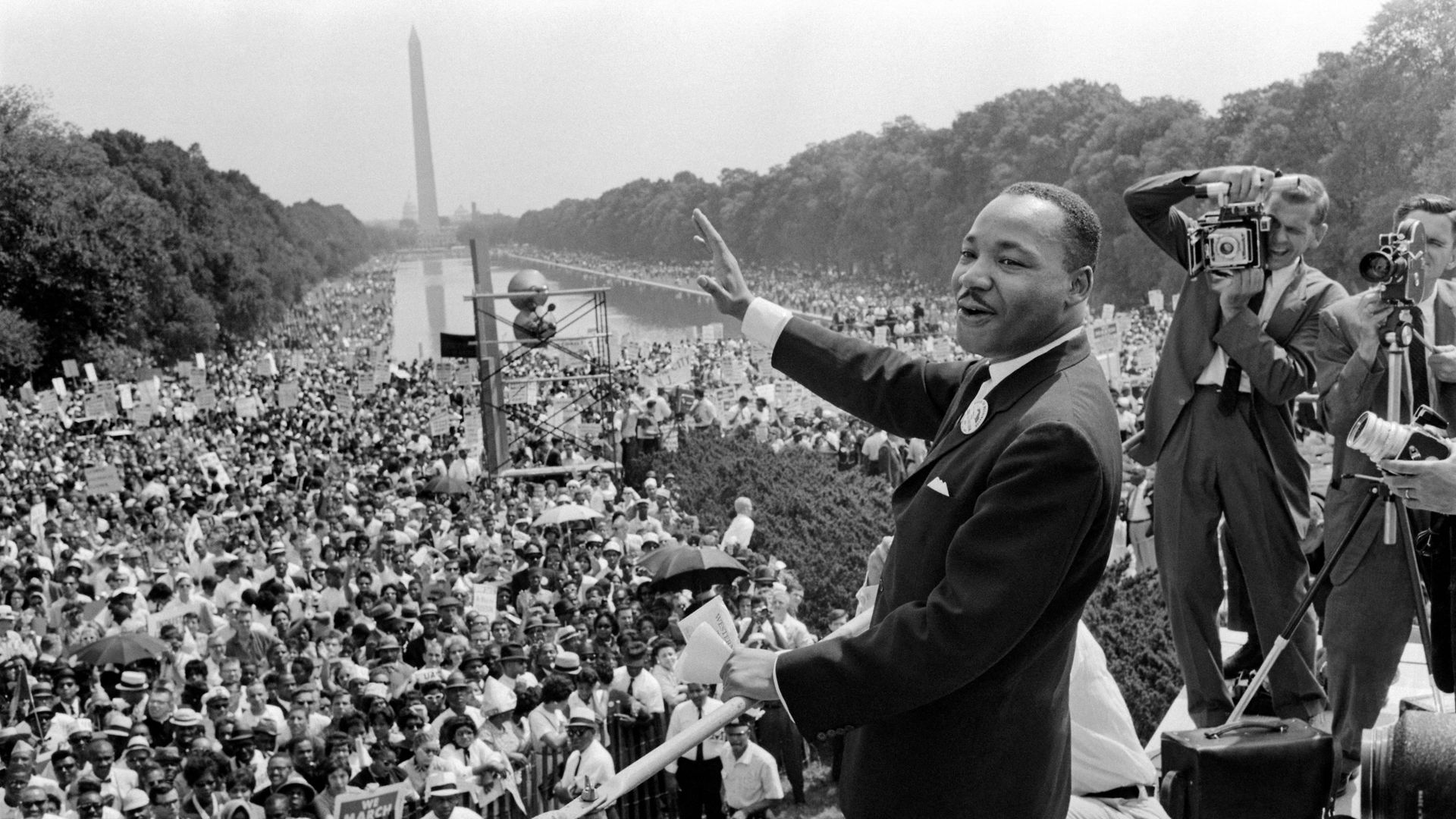
It took several attempts and some acrimonious fights to create a holiday honoring Martin Luther King Jr. in Arizona. Photo: AFP via Getty Images
It took a long and contentious fight to make Martin Luther King Jr. Day a state holiday in Arizona.
The big picture: The movement to carve out a day to honor King began shortly after his 1968 assassination.
- Connecticut was the first state to designate a King holiday, on the second Sunday of January, but it wasn't a legal holiday there until 1976, when it was moved to Jan. 15 and became a paid holiday.
- Illinois was the first state to recognize a legal King holiday in 1973.
- In 1983, President Reagan signed legislation creating MLK Day as a federal holiday, to be observed every third Monday of January.
Flashback: After the Arizona House rejected a King holiday bill by one vote in 1986, Gov. Bruce Babbitt issued an executive order designating a paid MLK Day.
- Yes, but: Attorney General Bob Corbin opined that Babbitt lacked authority to unilaterally create a holiday that gave executive branch employees a paid day off.
- When Gov. Evan Mecham took office in January 1987, one of his first actions was to rescind Babbitt's MLK Day order, which he said hadn't been legally enacted. He urged lawmakers to refer the issue to the 1988 ballot instead.
Between the lines: In late 1989, Gov. Rose Mofford, who replaced Mecham after his impeachment, called a special session where lawmakers passed legislation to create an MLK holiday and eliminate Columbus Day as a paid holiday.
- Opponents collected enough signatures to put the law on hold and refer it to the 1990 ballot.
- Mofford signed a second bill that year to create a King holiday, which kept Columbus Day a paid holiday, too.
- Mecham and other foes collected enough signatures to refer the second bill to the ballot.
1 big controversy: Both measures went to the ballot in the 1990 general election, when voters overwhelmingly rejected the proposal that replaced Columbus Day with MLK Day and narrowly defeated the measure to make both paid holidays.
- Some King holiday supporters believed the result was due to voter backlash over news the NFL would move the 1993 Super Bowl from Arizona if the state rejected MLK Day.
- The NFL moved the Super Bowl to Pasadena, California, following the election, costing the state millions of dollars.
The bottom line: The fiasco prompted lawmakers to refer another King holiday to the ballot in 1992.
- The measure passed overwhelmingly and Arizona became the first state to approve an MLK holiday by a public vote.
- The NFL later picked Arizona to host the 1996 Super Bowl.