How a Trump presidency could impact Arizona's semiconductor industry


Add Axios as your preferred source to
see more of our stories on Google.
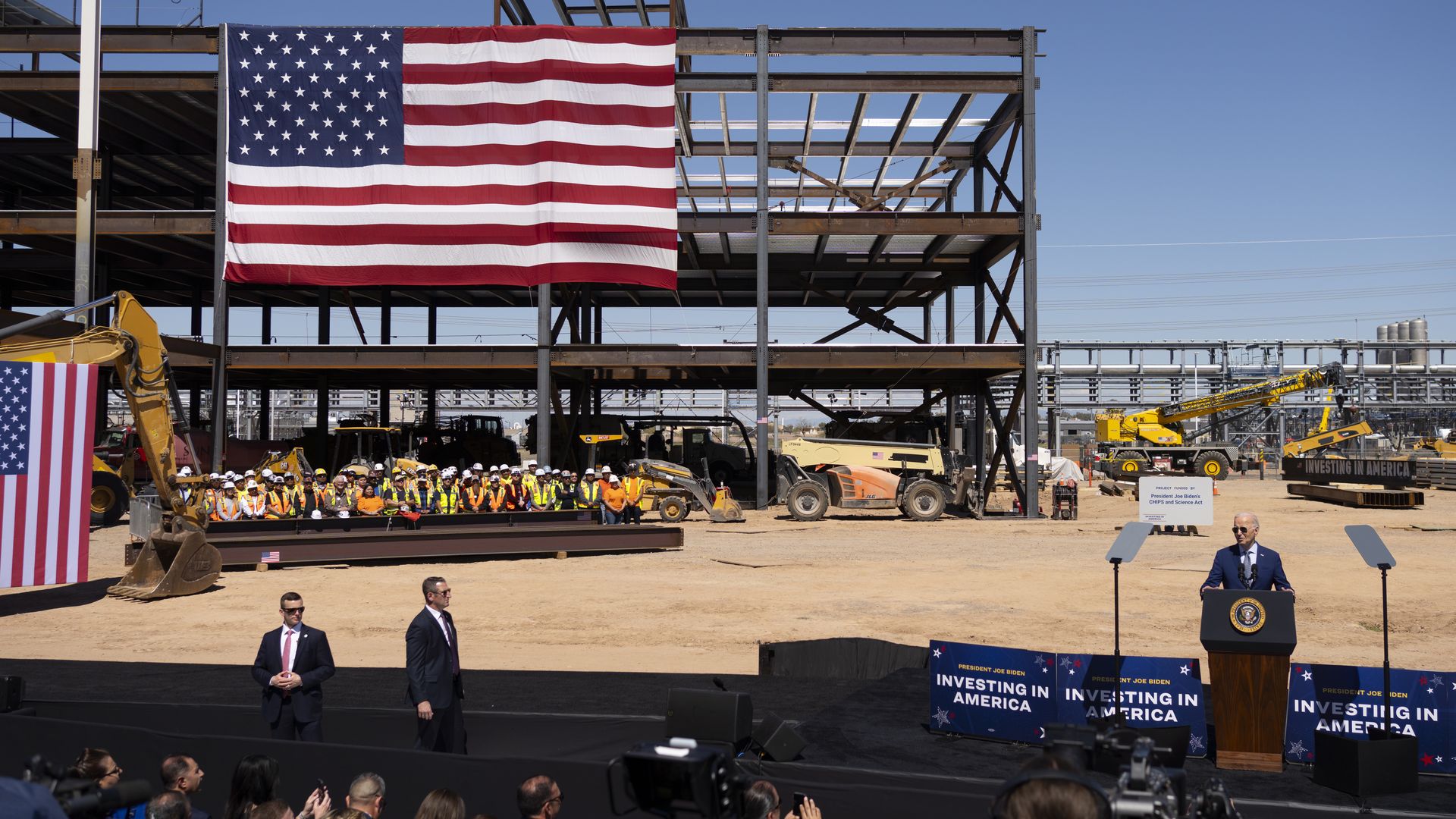
President Biden in March announced CHIPS Act funding for Intel to manufacture semiconductors in Arizona. Photo: Rebecca Noble/Getty Images
With President-elect Trump headed back to the White House — potentially with a Republican-controlled U.S. House and Senate in tow — the fate of the CHIPS and Science Act is in question.
Why it matters: Few states have benefited from the CHIPS Act as much as Arizona.
- The Biden administration this year announced multibillion-dollar grants for the Taiwan Semiconductor Manufacturing Co., and Intel expansions and $400 million for Amkor, a semiconductor packaging company building a $2 billion facility in Peoria.
Catch up quick: Late last month, Trump blasted the semiconductor legislation as "so bad" on the "Joe Rogan Experience" podcast. He also criticized Taiwan for having "stole[n] our chip business."
- Days later, U.S. House Speaker Mike Johnson (R-La.) told reporters Republicans "probably will" try to repeal the CHIPS Act, though he's since tried to walk back the comment.
State of play: Although the federal government has announced $33.7 billion in grants through the CHIPS Act, those funds remain in the due diligence phase and have not been allocated, per the Semiconductor Industry Association.
Threat level: U.S. Sen. Mark Kelly, a CHIPS Act sponsor, immediately pushed back against Trump's comments, saying his plan would "undo all of this hard work" and "kneecap" the state's economy, the Arizona Republic reported in October.
What they're saying: Greater Phoenix Economic Council president and CEO Chris Camacho told Axios that if a repeal were to occur, "all current investments and future investments would be at stake."
- He said more than 35 other semiconductor companies have announced plans to expand or relocate to Arizona because of TSMC and Intel.
Yes, but: Camacho said he remains optimistic that Trump will remember the bipartisan origins of the CHIPS Act and continue investing in American manufacturing.
The other side: Danny Seiden, president and CEO of the Arizona Chamber of Commerce and Industry, told Axios he isn't concerned about the CHIPS Act being repealed under Trump.
- During his first term, Trump was "the main driver for onshoring and reshoring of American manufacturing," Seiden said.
Between the lines: He noted the CHIPS Act could see changes under the next Trump administration, saying there's room for improvement.
- There's a push to expand what funds can be used for, Seiden said, and that could include energy generation because of the demand that semiconductor plants place on electrical grids.
- Trump could also make tweaks that expedite the distribution of CHIPS Act funding.
Zoom in: In a statement, TSMC said its decision to expand in the U.S. was based on consumer demand and "we are committed to continuing our investment [in Arizona] to serve our customers in the U.S. and globally."
- Intel said via a statement that the CHIPS Act "maintains strong bipartisan support" and the company looks forward to working with the Trump administration "as the only American company that designs and manufactures leading-edge chips."
- Amkor declined to comment.
The bottom line: Arizona's semiconductor industry has grown dramatically because of federal government intervention in recent years. It could just as easily trend the other way if the feds change course.