ASU professor explains "How Día de los Muertos became Mexican"

Add Axios as your preferred source to
see more of our stories on Google.
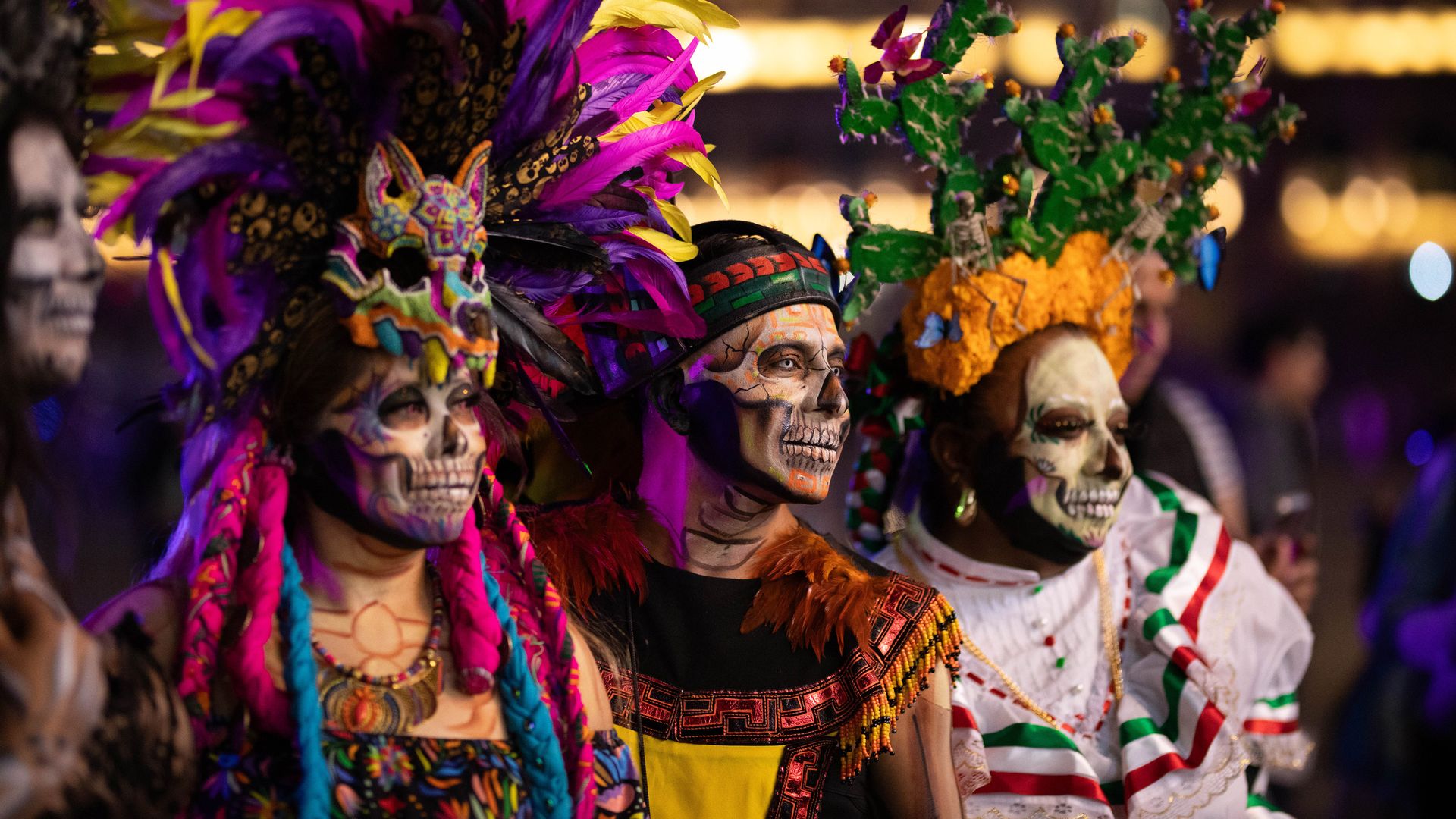
People celebrate Day of the Dead in Mexico City on Oct. 30. Photo: Daniel Cardenas/Anadolu via Getty Images
Millions of people worldwide will celebrate Día de Los Muertos, or Day of the Dead, Nov. 1 and 2 with varied customs to honor deceased loved ones.
Why it matters: The holiday, though often considered a purely Mexican tradition, has cross-continental roots and only became synonymous with Mexican culture in the past century, Mathew Sandoval, an honors college professor at ASU, told Axios.
The big picture: Sandoval is writing a book called "A Cultural History of Day of the Dead: How Día de los Muertos Became Mexican" to correct the holiday's origin story and dissect why Mexican politicians and artists have embraced it over the past 100 years.
- Sandoval received the Public Scholar award from the National Endowment for the Humanities earlier this year, allowing him to take a sabbatical to finish the book. He hopes to publish late next year.
Flashback: The holiday celebrated today is a combination of traditions from Indigenous Mexicans (including the Aztecs and Mayans), African slaves brought by the Spanish to Mexico, and Catholic, Islamic and Pagan Spaniards, Sandoval said.
- Each of these cultures had their own way to honor deceased loved ones.
- When they all convened in central and southern Mexico during Spanish colonization in the 1500s, Day of the Dead as we know it was born with threads from each culture — but until the 1920s, it was only celebrated in this region of Mexico.
The intrigue: The Mexican Revolution from 1910-1920 left about a million Mexicans dead and divided the nation.
- Mexican political leaders, to unify the country, began taking regional practices and incorporating them nationwide. Mariachi music and folklórico dance, for example, were once regional customs that took on a national identity post-revolution, per Sandoval.
- But perhaps no tradition became as ingrained as Día de los Muertos.
What they're saying: "If you're trying to unify a country after a mass death and civil war, it seems like the most opportune holiday that you would use to bridge people together," Sandoval said.
Zoom in: Day of the Dead became known internationally as a "Mexican thing" in the decades following the civil war because Mexico used the vibrant celebrations to encourage American and European tourism, he told us.
- "Although Day of the Dead is incredibly popular among Americans now, I wouldn't say it's a recent phenomenon," Sandoval said. "American interest has been being cultivated for almost 100 years."
The bottom line: "I see Day of the Dead as this really intricate and interwoven global cultural tradition. Not many people want to acknowledge its complexity," Sandoval said.