"Hell on earth": A scathing critique of Phoenix's homelessness and drug crises

Add Axios as your preferred source to
see more of our stories on Google.
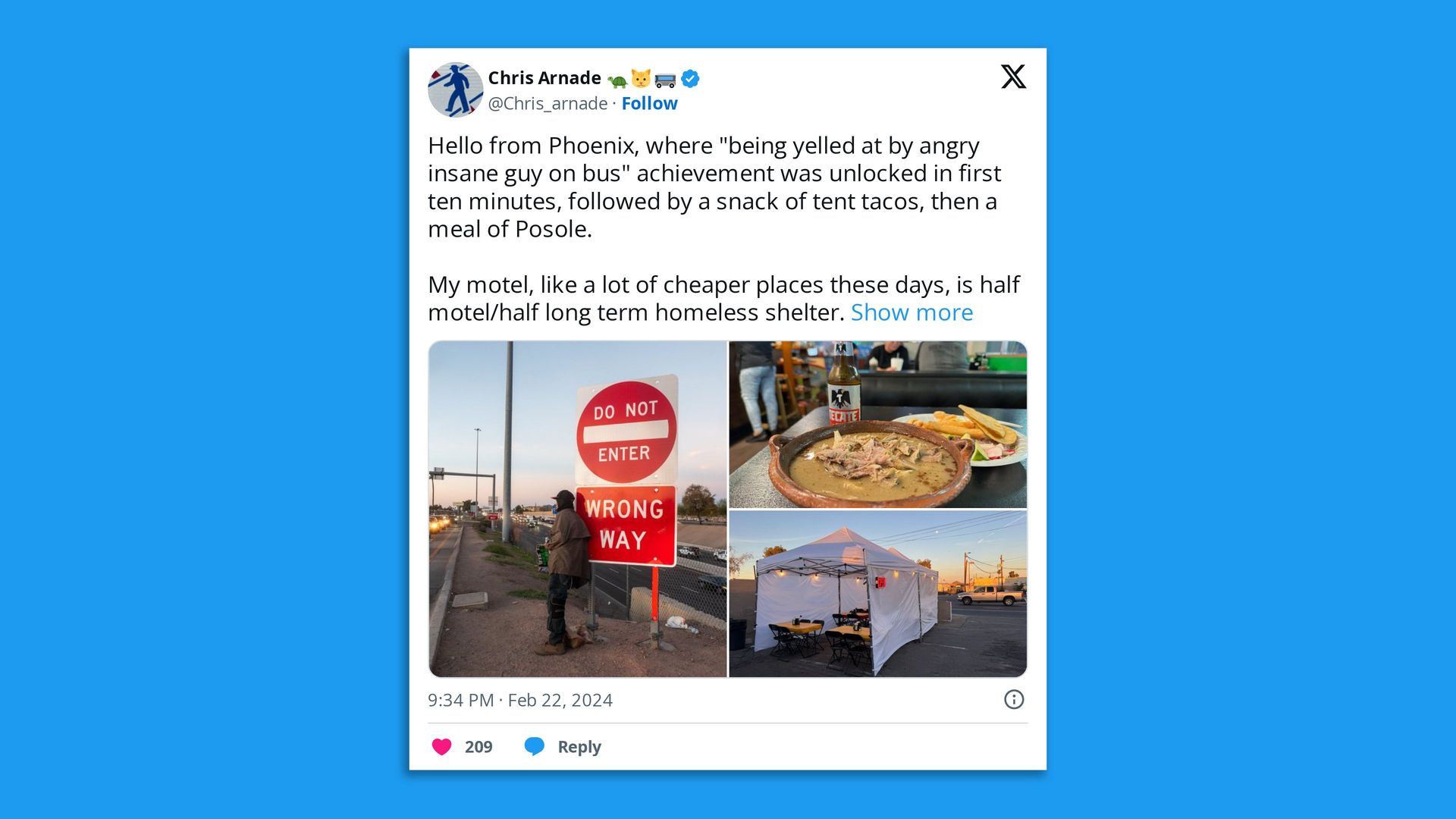
Screenshot: X/@Chris_arnade
Photographer and writer Chris Arnade turned his recent attempt at a car-free trip to Phoenix into a scathing critique of the Valley's homelessness and drug crises.
Why it matters: Arnade provided an on-the-ground look at the chaos and suffering in the Valley's often-ignored working class neighborhoods.
- He also illustrated the everyday impacts of Arizona's record-high homelessness, which the city, county and state have failed to get a handle on despite unprecedented federal funding.
- The column stood in stark contrast to the tunnel-visioned praise of the Valley's growth and innovation seen in recent national news articles.
The big picture: Arnade spent four days here, exploring the west side before he "was so broken, despondent, depressed and ill" that he cut his trip short a fly home, he recounted in his March 3 "Chris Arnade Walks the World" Substack post.
Zoom in: Arnade stayed at the Super 8 near I-17 and Indian School Road in late February and trekked through parts of west Phoenix and found what he described as an "open-air drug market" and "an expansive hell on earth." He described:
- John, an opioid addict with a likely mental disability, who was covered in burns from accidentally lighting himself on fire a few days earlier. John refused to go to the hospital for fear of losing his prime spot behind an empty strip mall.
- The McDonald's near his motel, "a haven for the broken," where he watched a woman argue with someone named Susan, who wasn't there.
- The 24-hour convenience store at 27th Avenue and Indian School Road where all of his credit cards were declined and then locked. "I've used these cards in Senegal, Mongolia, and Ecuador without triggering so much as a security text," Arnade noted.
The intrigue: "It became like one of those old Disney rides, where an animatronic character would pop out from behind a building or bush, holding a bottle of vodka, or an old vacuum cleaner (why), or pushing a train of carts, and mumble something at me, or towards me, or just into the void," Arnade wrote.
Between the lines: Arnade posted on X that he'd received criticism about his Phoenix column, with people noting that the "dystopian" scene could be found in any U.S. city with enough looking.
Yes, but: Arnade argued that Phoenix has an abundance of cheap drugs on the street and is fairly segregated, making it easier for people who live in "nicer parts" to never see the suffering in lower-income neighborhoods.
The bottom line: Arnade ended his column saying he felt "awful for the broken people on the streets" and angry at the systems that had failed them.
- But he said he felt worse for the mostly Mexican American residents who are trying to achieve the "American Dream" in a community overrun by drugs, homelessness and despair.