Why some Arizona K-12 teachers have higher success rates

Add Axios as your preferred source to
see more of our stories on Google.

Illustration: Lindsey Bailey/Axios
Arizona education researchers have created a first-of-its-kind tool that allows high school teachers to track their students' success in college.
How it works: ASU's Helios Decision Center for Educational Excellence has merged Arizona Department of Education data with student performance data from in-state universities and community colleges. Student names and identifying information were removed.
High school teachers and administrators can see what their graduates study in higher education, how well they perform in specific classes and how quickly they graduate.
Why it matters: When combined, the previously siloed data sets allow high schools to learn what programs, techniques and kinds of support have the greatest impact on students' postsecondary success, Decision Center's strategic data project fellow Christopher Salem Ozuna tells us.
What they're saying: Ozuna said the Decision Center allows educators to see only the data for their own school because it's not used to rank or compare districts or teachers.
- "Don't be afraid of this data. It's not being weaponized against you. It's meant to see what happens after your kids leave high school," he said.
Driving the news: The Decision Center used the new portal to identify 12 Arizona teachers whose students have succeeded in higher education and invited them to become a part of the inaugural ASU Impact Corps.
- The selected teachers all teach either STEM or English classes but are from schools of varying sizes and demographics.
The latest: The teachers met in late May to dig into the new data and share philosophies and techniques to see where they had similarities and differences.
- "It surprised me … that this data existed and they were using it in this way. Having access to the data, we can take a closer look at what we're doing well and not doing well as high school teachers," said Milton Johnson, an engineering teacher at Bioscience High School and member of the Impact Corps.
What's next: The ASU Impact Corps teachers will participate in mentor events throughout the summer and fall to share some of their successful strategies with other Arizona educators.
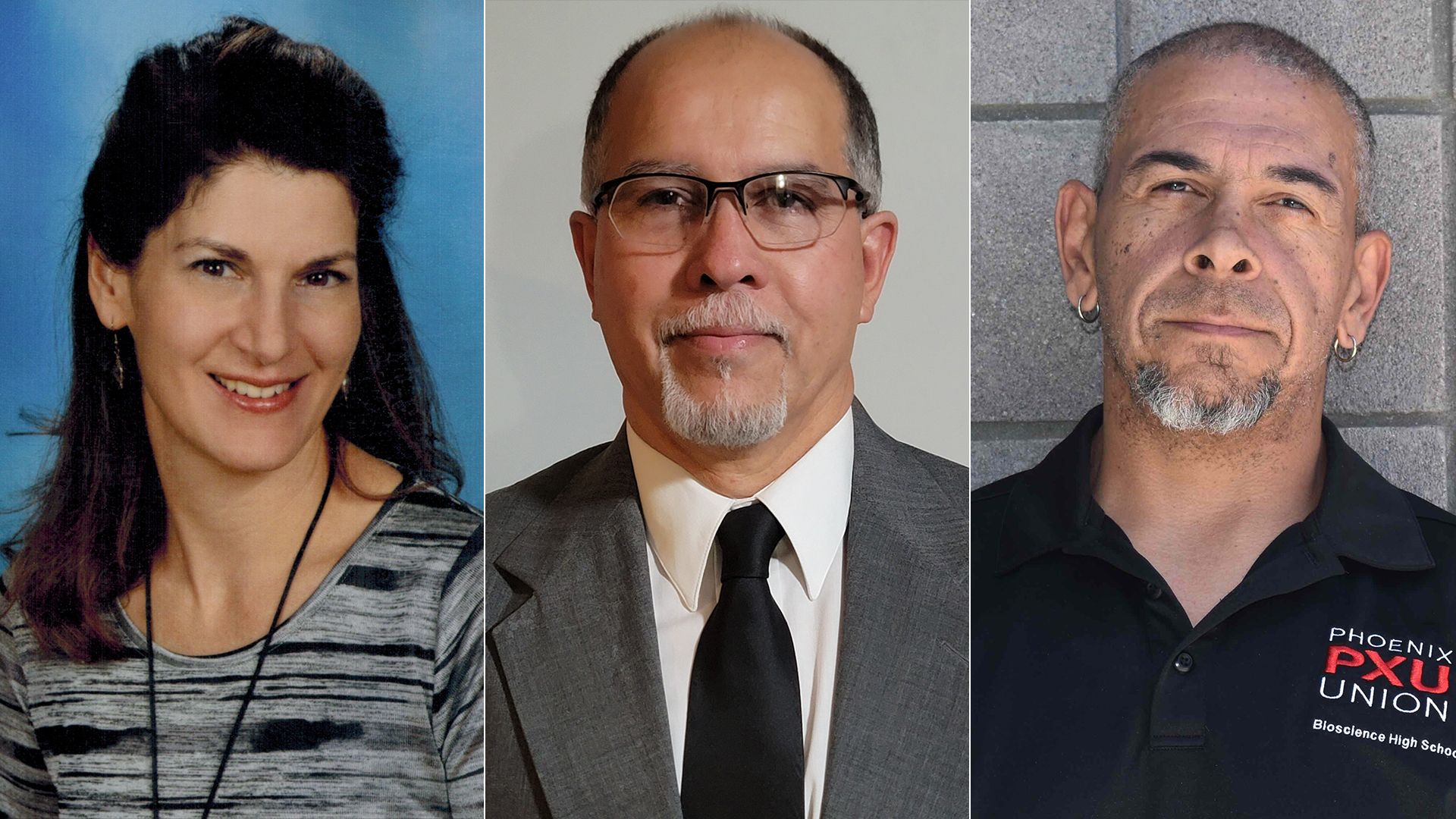
Meet the teachers: We spoke with three of the inaugural ASU Impact Corps teachers to see how they're helping students transition to college.
Juliette Baldwin
AP calculus and physics, Boulder Creek High School in Anthem
Zoom in: Baldwin launched the AP calculus program at Boulder Creek almost 20 years ago. She works closely with the school's engineering teachers to provide students with a well-rounded STEM education.
- Her students have a very high rate of success in 100- and 200-level engineering courses at Arizona universities, and bachelor's degrees in engineering were one of the most popular choices for Boulder Creek graduates over the past five years, according to ASU's Decision Center data.
What they're saying: "I love what I teach. I'm very passionate about it. I love making the connection of all the things they've already learned and what they're about to learn. I feel like I have the ability to communicate those things to them so they have those light bulbs going off."
Fernando Ramirez
Engineering, San Luis High School
Zoom in: Ramirez spent almost 20 years as an industrial engineer before getting his Career Technical Education certification to launch the engineering program at San Luis High School, in the small Yuma County border town of San Luis, in 2016.
- He told us the students get to try mechanical, electrical and civil engineering, in addition to coding and robotics in his classes.
What they're saying: "They find their passion in high school so when they go to the secondary level they already know what they want. They don't waste time deciding what they want to do."
Milton Johnson
Engineering, Phoenix Bioscience High School
Zoom in: Johnson just finished his 14th year at Phoenix Bioscience and works with students who take the engineering track at the STEM-focused high school in downtown Phoenix.
What they're saying: "[My goal] is teaching students to be independent learners — thinkers versus just following instructions. It helps when they get to college because they have a bit of autonomy and self-efficacy."