New Orleans to consider data centers' future within city

Add Axios as your preferred source to
see more of our stories on Google.
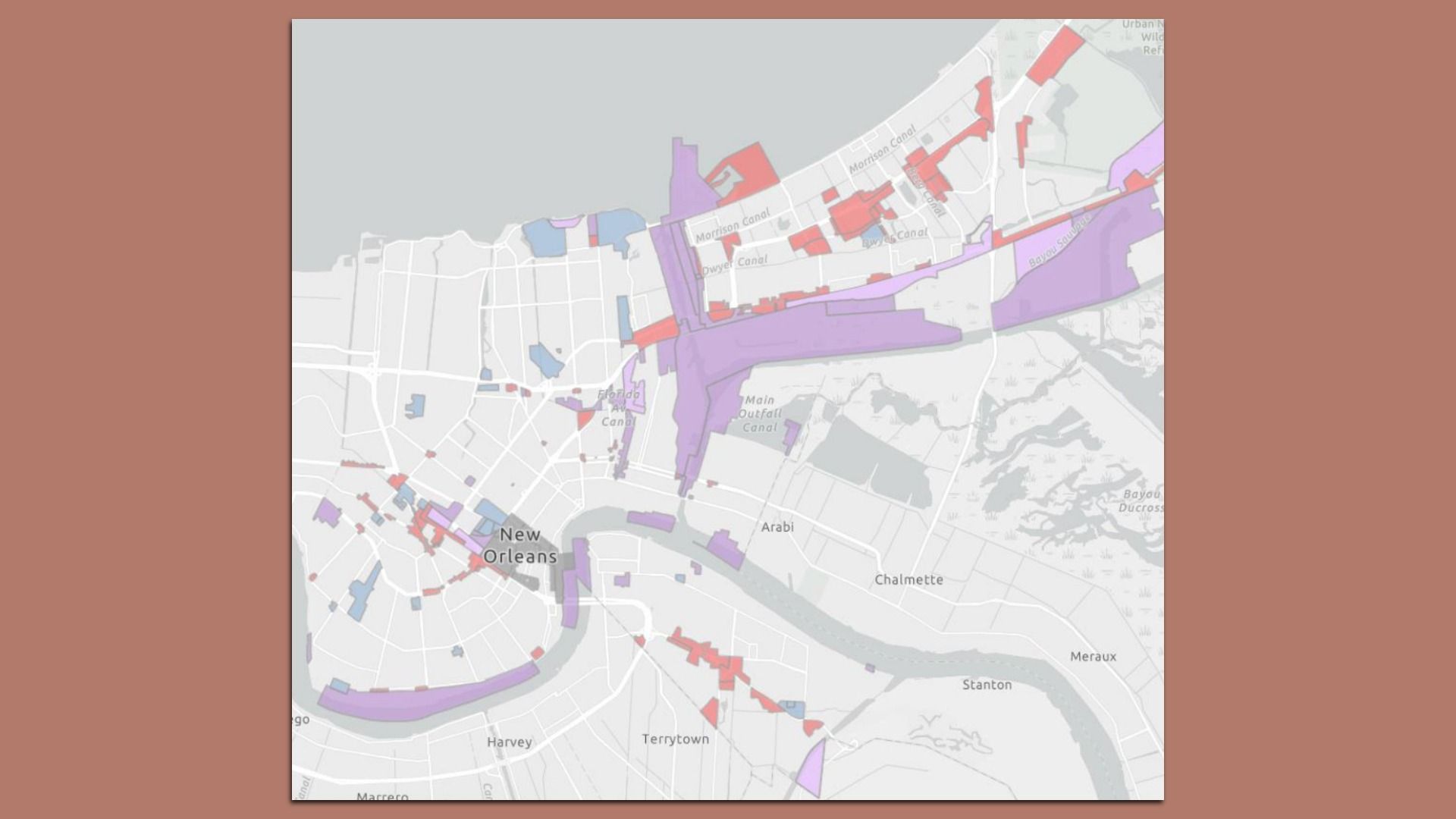
New Orleans City Planning staff recommend conditionally allowing small data centers in the red and blue areas, and small and medium data centers within the dark grey and purple areas. Map: Courtesy of New Orleans City Planning Commission
The New Orleans City Planning Commission is poised to ship new recommendations to City Council that, if adopted, would legislate the future of any additional data centers within New Orleans.
Why it matters: Louisiana has so far thrown out the welcome mat to the controversial facilities, creating potentially yet another disconnect between city and state leadership.
Catch up quick: New Orleans hit the brakes on new data center creation earlier this year with a one-year moratorium as City Council asked the Planning Commission come up with suggestions on how the law should view the facilities.
- "To ban data centers, you have to define them," Council President JP Morrell said at the time.
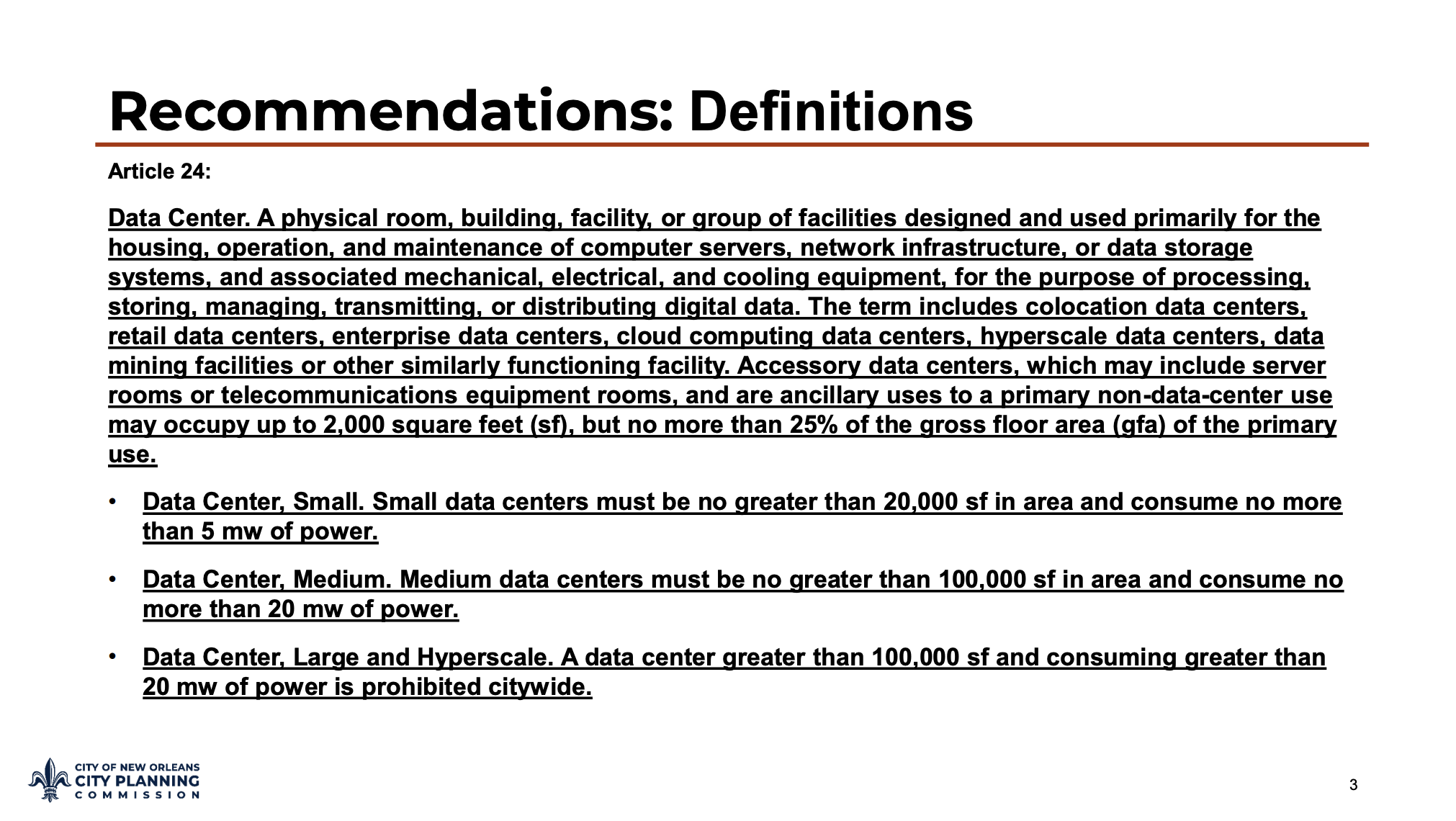
Zoom in: The Planning Commission came up with a three-tiered classification for data centers. Simply put: accessory, then small, medium and large.
- "At one end of the size spectrum are small 'enterprise' style facilities dedicated to one business's (or entity's) computing needs and exist as a small room (even a closet)," commission staff write. "At the other end are huge 'hyperscale' facilities like the Hyperion Data Center being constructed in Richland Parish in Northwest Louisiana."
- "A data center's size correlates to its impacts," the staff continues.
- Ultimately, the planning staff recommends an outright ban on large facilities and conditional limitations on the first three categories, with utility checks and impact assessments required before permitting could begin.
State of play: Under those definitions, New Orleans does already have data centers within city limits, though little is known about them.
- "We really tried to find out exactly how much office space they were taking up, and we were unsuccessful in that endeavor," said planning staffer Laura Bryant. "But we do know that there are data centers that exist downtown. … We felt like that could be an appropriate use for some empty office spaces."
One of those facilities is owned by Lumen.
- "Our facilities aren't traditional data centers; they're secure network interconnection and colocation sites," said Lumen spokeswoman Stephanie Meisse in an email. "They are designed to enable connectivity—linking businesses, cloud platforms, and other data centers—rather than supporting massive, compute-intensive workloads."
- "Think of our facilities more like an airport hub for data, they're where traffic is routed, exchanged, and accelerated," she said.
Driving the news: The Planning Commission first discussed the staff's recommendations at its late July meeting and seemed poised to approve them.
- But a procedural issue kicked the vote to Tuesday instead. See agenda.
Between the lines: The original meeting was sparsely attended, which struck some in the room as surprising given how data centers have turned politically radioactive.
What's next: If the City Planning Commission approves the recommendations and sends them up to City Council, then it's up to the council when they discuss adopting them.
- New Orleans' moratorium won't expire until the middle of next year.
- City Council members can also make rewrites before adoption.
Go deeper: Read the full City Planning staff report.