Even as New Orleans mourns, Carnival begins again

Add Axios as your preferred source to
see more of our stories on Google.
/2025/01/07/1736219412761.gif)
Hundreds of people marched with the Society of Joan of Arc on Monday night, taking to the streets and taking back some of the joy stolen earlier this week from the start of Mardi Gras, New Orleans' most exuberant celebration.
The big picture: The procession wound its way through the French Quarter, passing the St. Louis Cathedral just after President Biden gathered with mourners inside to pay respects to the 14 people who died in the New Year's Day attack on Bourbon Street.
The attack could have happened anywhere. But it didn't. It happened here.
- Why New Orleans? The question has reverberated, spoken and unspoken, in the air for days.
- Investigators haven't clarified, but they've hypothesized that crowd size may have been a draw, and the suspect familiarized himself with the city before New Year's Day.
What I do know is that mourning and celebrating in New Orleans have always been deeply tied together, braided by the human fact that it's impossible to know joy without first recognizing pain.
- You cannot, so the thinking would go, know love without knowing loss. That's why, in a tradition embedded within the city's Black community and tied to roots in West Africa, we dance at funerals.
- And this city is one that knows far more than its share of loss.
Zoom in: It's something many of the conversations and news coverage has touched on since the New Year's Day attack. New Orleans has faced disaster again and again and again.
- As the New York Times recounted over the weekend, the average U.S. county since 2020 has experienced one or two federally declared disasters. In the same stretch, all Louisiana parishes have experienced at least 12.
- And that's not even to mention that the city is crumbling beneath our feet, washing out to sea and often led by people who leave so many of us wanting — and it is exhausting.
/2025/01/07/1736219698676.gif)
But we have not been beaten. Optimism was starting to creep in anyway, according to UNO's latest quality of life survey.
It is whatever makes that possible, that verve, that how-dare-you-even-try attitude, that strength that brought people out Monday night.
- It was always going to be weird. But, as it turns out, New Orleans is pretty good at weird.
"My hope is to recapture what was stolen from us," Joan of Arc volunteer Ramona Graham told me at the procession's start. "That night, that's what was stolen: Our joy and our music."
- "But we're here. We're together, and we're not allowing this to defeat the spirit of our culture."
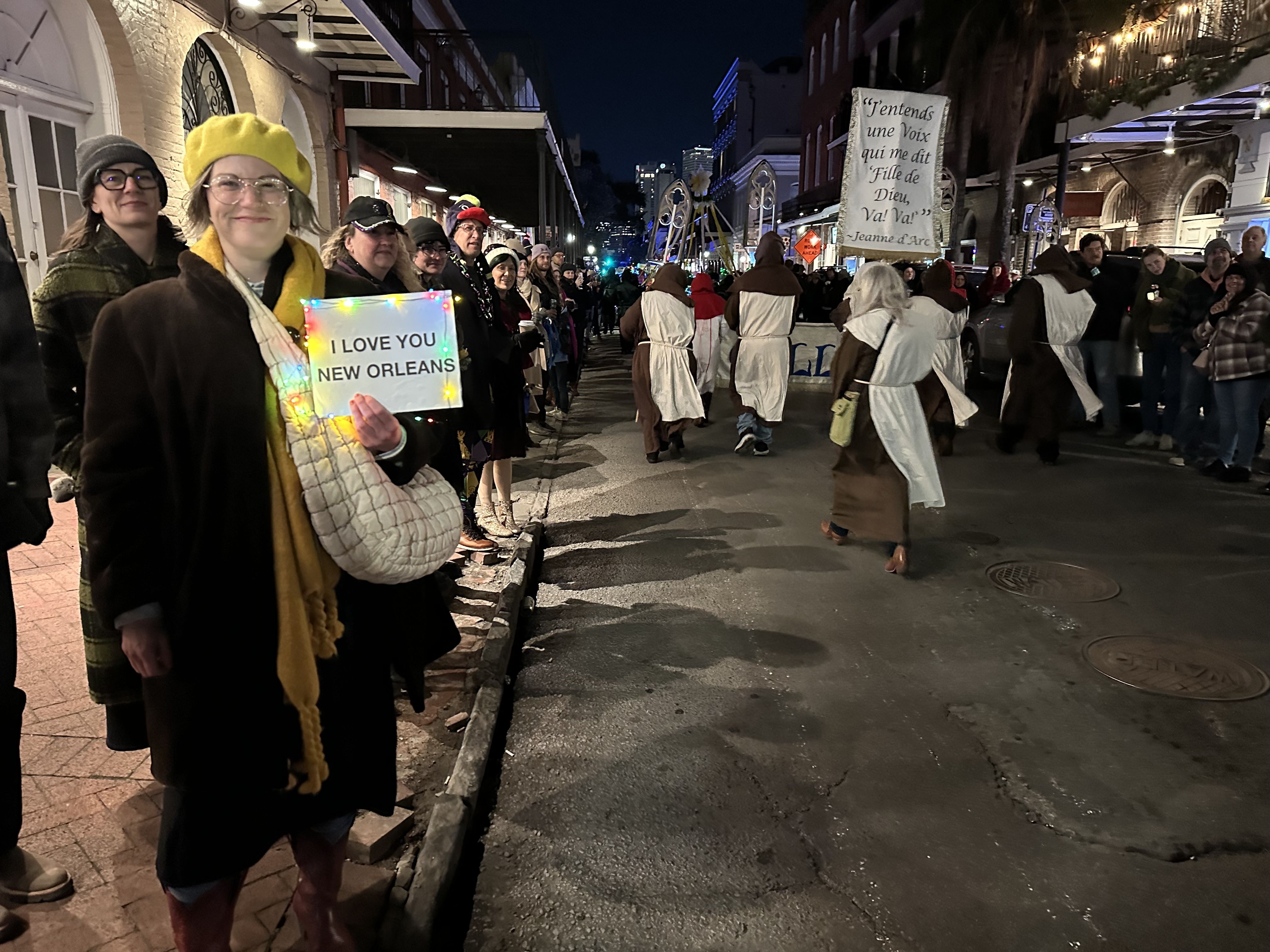
Despite a slightly smaller turnout than usual — Society co-captain Antoinette De Alteriis blamed a mix of safety concerns, the bitter cold and presidential traffic — the whole route still felt joyful.
- As the society wound through the Quarter, it was to a mix of cheers and shouts of "Happy Mardi Gras."
- One parade-goer cupped her hands around her mouth as she yelled "Thank you for marching!"
- Another, silently smiling, held up a small sign. The paper was outlined in in lights, and it said, simply and brilliantly, "I love you New Orleans."