NOMA joins national effort to fight AIDS through art

Add Axios as your preferred source to
see more of our stories on Google.
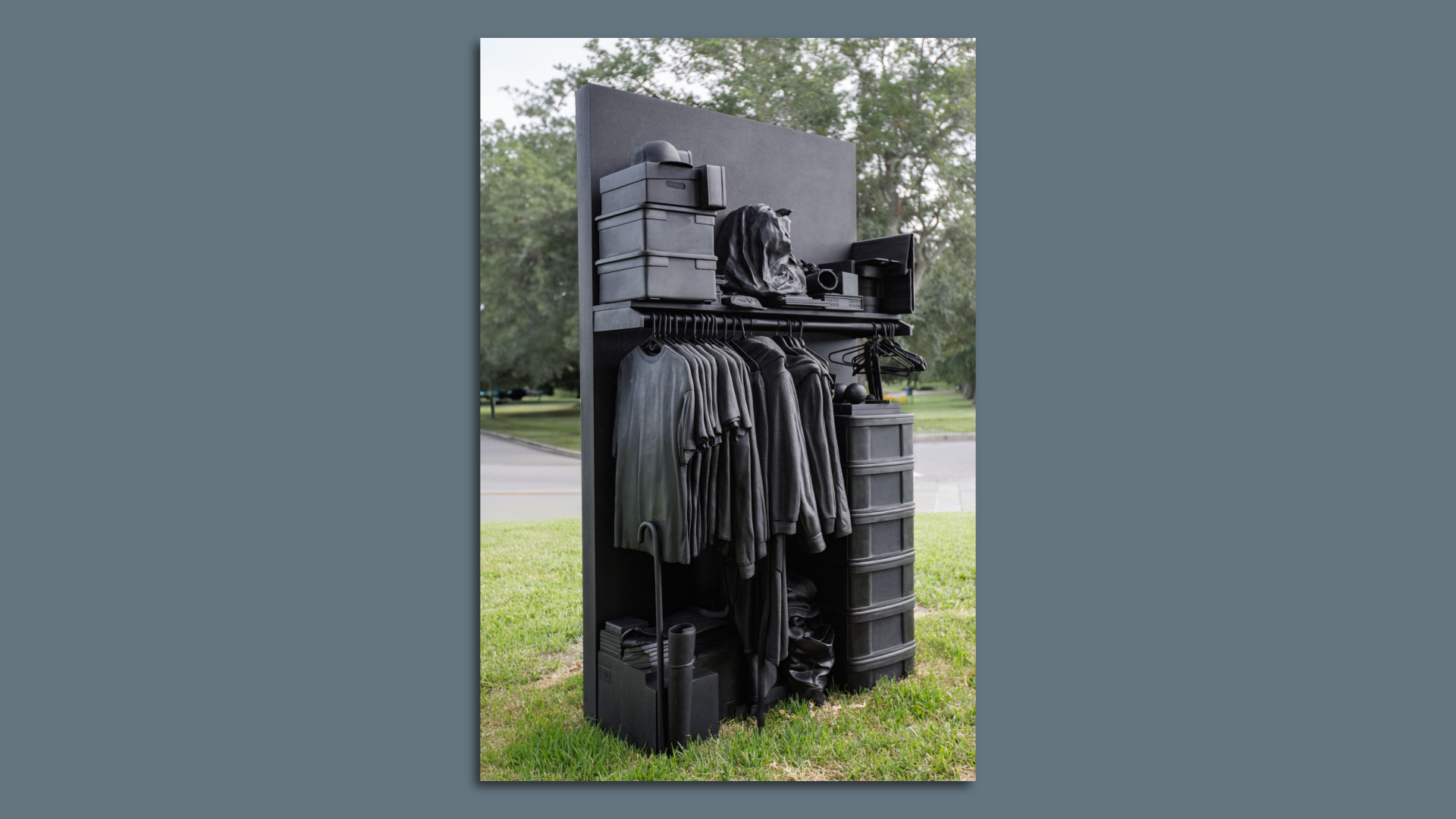
NOMA has a new granite and bronze sculpture by Jim Hodges called "Craig's closet." Photo: Courtesy of NOMA
The New Orleans Museum of Art has new art and programming for AIDS Awareness Month.
Why it matters: Louisiana ranks 4th in the country for new HIV diagnoses, based on 2022 numbers, the state Health Department says.
- HIV is a virus that can cause AIDS.
The big picture: Wednesday is Day With(out) Art, a national project through nonprofit Visuals AIDS that uses art to fight AIDS.
- NOMA will show seven short films on a loop from noon to 5pm in its Lapis Center for the Arts. The films reflect the spectrum of living with HIV today, the museum said.
- NOMA is the only participating venue in Louisiana of the more than 100 across the country.
Zoom in: The museum also has a new sculpture called "Craig's closet" that was part of the New York City AIDS Memorial.
- It's to the right of the museum's entrance on Collins C. Diboll Circle and will be on display through June 2025.
- "A closet is a magical container, a collection of materials, arranged by each of us that at a glance can reveal our values, desires, cares, and even our deepest secrets," the description reads.
Between the lines: Museum admission is free for Louisiana residents every Wednesday, thanks to the Helis Foundation.
By the numbers: Louisiana has about 23,000 people living with HIV, as of June, according to health department numbers.
- Of those, about 11,000 have an AIDS diagnosis.
- Louisiana ranks 12th in the country for its number of HIV diagnoses, based on 2022 numbers, the state Health Department says.
- No HIV cure exists, but there are effective treatments to stop the disease's progression, according to the U.S. Department of Health & Human Services.
Last year, 861 people were newly diagnosed with HIV in Louisiana, with 24% in the New Orleans area. The Baton Rouge area made up 19% of new diagnoses, LDH data shows.
- There are health disparities for Black residents, LDH says. While they make up about 32% of the state's population, Black people represented 68% of new HIV diagnoses last year and 69% of new AIDS diagnoses.
Go deeper: