Louisiana's most segregated school systems, mapped


Add Axios as your preferred source to
see more of our stories on Google.
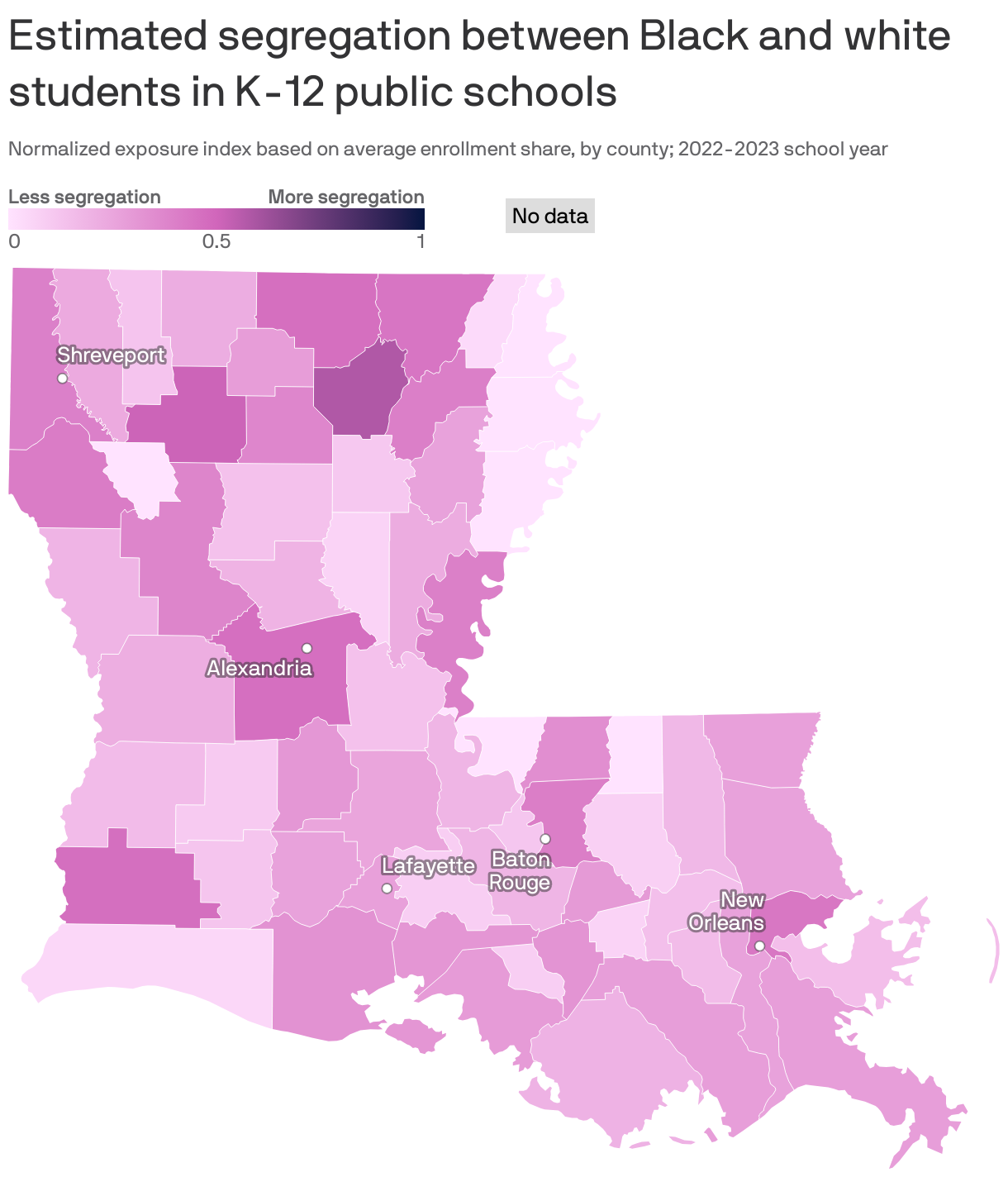
Louisiana's public schools have become more racially segregated in the past 30 years, according to a new report and Axios review of federal data.
Why it matters: Segregated schools disproportionately hurt Black and Latino students because schools where they're the majority often have fewer resources, more teacher shortages, higher student-to-school counselor ratios and greater suspension rates — all of which impacts quality of education.
The big picture: 70 years after the landmark Brown v. Board of Education ruling, American public schools are growing more separate and unequal even though the country is more racially and ethnically diverse than ever.
- Louisiana ranks 19 of the 50 states in terms of the most public school segregation between Black and white students.
- In 2022, Louisiana had a 0.43 rating, up slightly from 1991, when it was 0.39.
- The rating measures segregation by exposure of students of different races and ethnicities. Zero is the least segregated and 1 is the most segregated.
Meanwhile, private schools are popular in Louisiana and enrollment has increased in the past decade.
- 21% of Louisiana's students were enrolled in private schools in 2022. It was even higher in New Orleans: 26%.
- The national average is 14.8%.
By the numbers: Statewide, 42% of public school students were majority white in 2022, while 41.4% were Black, 10.8% Hispanic and 1.7% Asian, according to numbers from The Educational Opportunity Project at Stanford University.


Case in point: The student body at Grace King High School in Metairie has changed dramatically over the past three decades.
- In 1991, it was 76.1% white. Now, it is 12.4% white, 64.7% Hispanic, 18.7% Black and 3.1% Asian, according to Stanford.
- Chalmette High went from 94.1% white to 45.7% white. Slidell High School went from 85.1% white to 48.5% white.
- See individual school data.
Caveat: New Orleans' individual school data only starts after Hurricane Katrina.
- After the storm, schools in Orleans Parish were closed and eventually transitioned to an all-charter system.
Flashback: Racial segregation numbers were slowly climbing in Louisiana until Katrina hit and temporarily disrupted the trend, according to numbers from Stanford.
- Enrollment in New Orleans public schools had been dropping for about a decade before then. In 2005, it plummeted even further, from about 148,000 students to about 97,000.
- In the 2022-2023 school year, about 131,000 students were enrolled in 204 schools. The racial breakdown was 21.4% white and 75.8% nonwhite students, the data shows.
Friction point: White flight to the exurbs has contributed to resegregation nationally, but so have charter schools, which at times can pick and choose who they can accept, Gary Orfield, co-director of the Civil Rights Project, tells Axios.
The other side: Debbie Veney of the National Alliance for Public Charter Schools tells Axios neighborhood schools and charters are not causing racial segregation, but simply serving the students who appear at their doorsteps.
- "The researchers might instead focus on why white families move from neighborhoods and pull their children out of schools when too many Black, Brown or low-income kids start showing up. When we try to integrate, they leave."
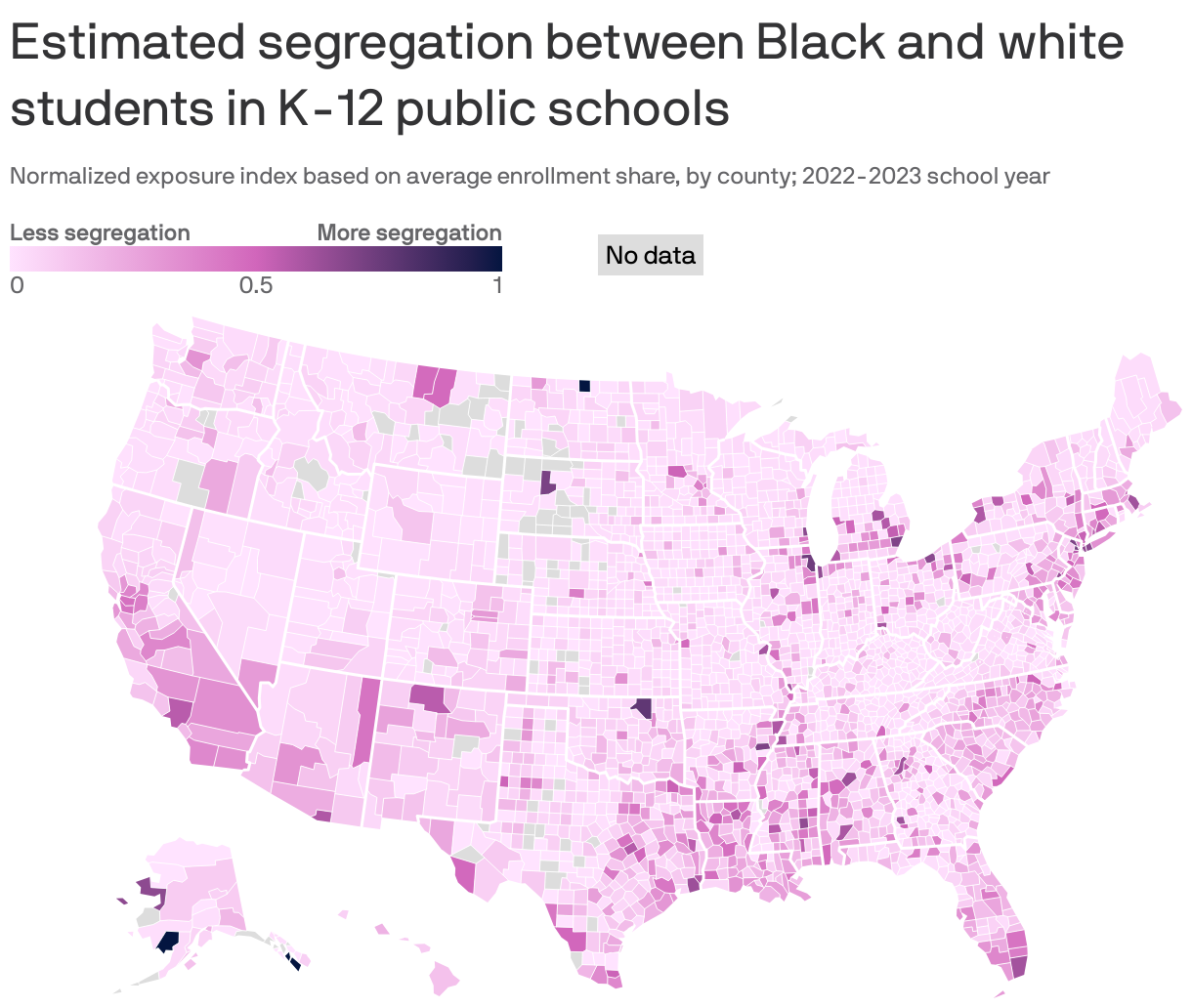
Nationally, schools on average have become less white and more Latino, Asian American and multiracial. But students of color are going to schools with fewer white students and fewer resources, a UCLA Civil Rights Project report found.
- Though 45% of all U.S. students were white, the typical Black student attended a school that was 76% nonwhite in 2021.
- The average Latino student went to school that was 75% nonwhite.
Go deeper