Louisiana's melanoma rate is lower than the national average, but don't relax


Add Axios as your preferred source to
see more of our stories on Google.

We love to see the sun-safe umbrella carriers at Jazz Fest in 2018. Photo: Douglas Mason/Getty Images
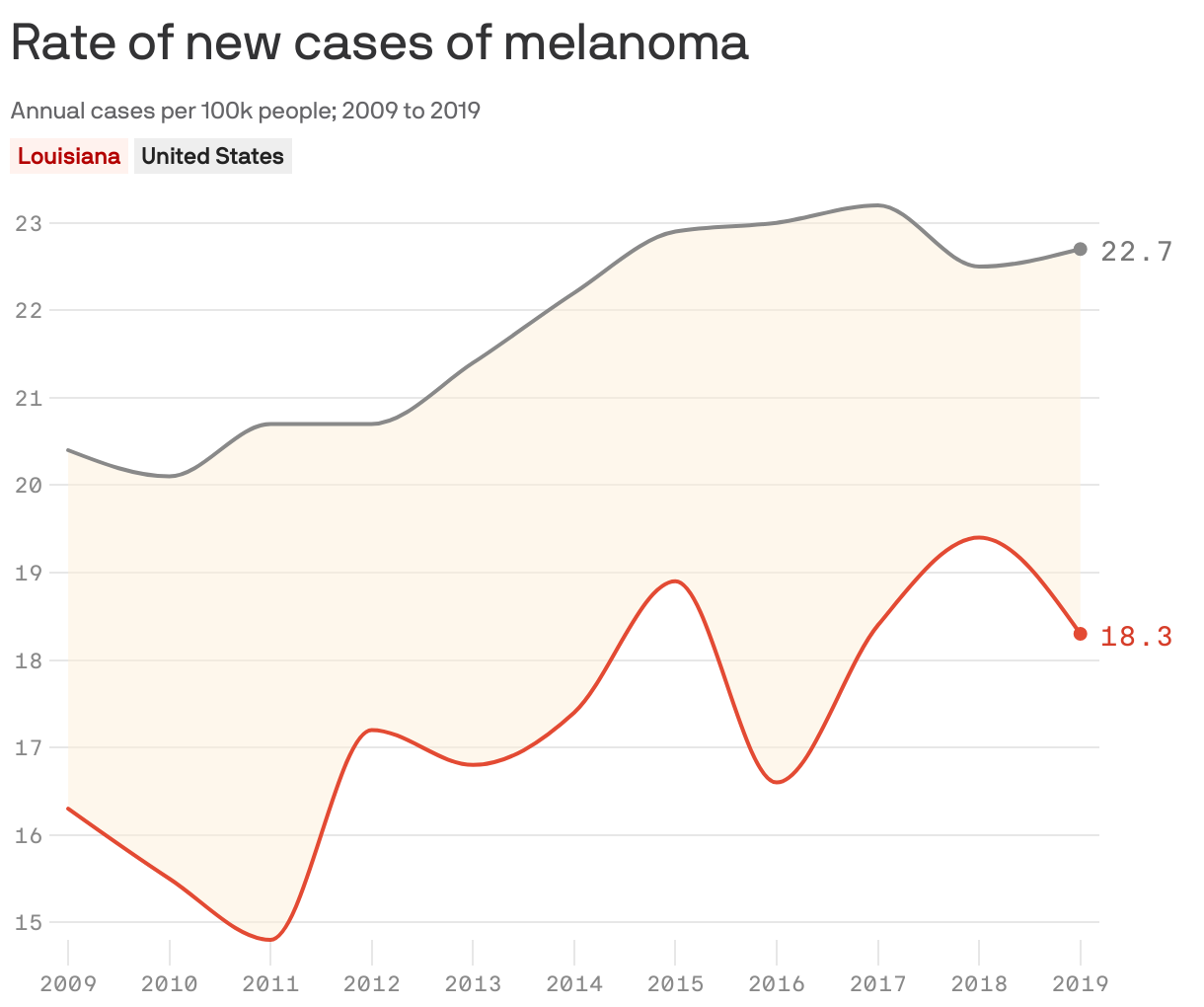
Skin cancer rates in Louisiana are lower than the national average, according to data the Centers for Disease Control and Prevention. But that doesn't mean people should let up on their sun protection strategies.
Why it matters: Experts consistently say that the biggest factor in lowering melanoma rates is managing sun exposure and applying (then reapplying!) sunscreen.
Yes, but: Louisiana’s low rates of skin cancer could be related to a lack of dermatologists, which decreases the chance of diagnosis, Tulane University School of Medicine dermatologist Andrea Murina theorized.
- Dermatologists tend to be in urban communities, she told Axios. And Louisiana's rural population proportion is higher than the national rate, the Times-Picayune has reported.
- Dermatologists are also less likely to accept programs like Medicaid, she said.
- A national disparity between rural and urban dermatologist density has widened in recent years, according to a JAMA Dermatology study.
Zoom in: Elizabeth Grieshaber, clinical assistant professor of dermatology at LSU Health New Orleans agreed. While southeast Louisiana has "plenty" of dermatologists, she said, "we're probably missing a lot of the rural patients in northern and western Louisiana."
Of note: Murina also pointed out that Louisiana was an early state to ban tanning bed usage for minors in 2014.
By the numbers: For every 100,000 people, 14 melanoma cases were reported in Louisiana in 2020. Two people for every 100,000 died of melanoma the same year.
- 95% of melanoma cases in Louisiana in 2020 were among white people.
- Nearly twice as many cases reported were among men than women.
Threat level: While melanoma is far more likely to affect white people, death rates among people of color are higher, partially because cases are harder to detect early, according to the Association of American Medical Colleges.
- Grieshaber highlighted acral lentiginous melanoma, a rare form of melanoma that is the most common form found in people of color — and famously killed Bob Marley.
- "It happens on your hands or feet, which is not proportional to sun damage, so your pigment cells can't protect you against it," she said.
- It's also usually caught much later — when it's more advanced.
Between the lines: The general advice that you should get a "protective" base tan before a beach vacation is not accurate, Axios' Carly Mallenbaum reports.
- A suntan provides an SPF of less than 4 and still "increases your likelihood of developing not only skin cancer but also wrinkles [and] brown spots," dermatologist Nazanin Saedi told Axios.
Yes, and: Grieshaber says Vitamin D deficiencies are also not a reason to seek out more sun exposure. People should instead supplement their Vitamin D intake, she said.
Flashback: Melanoma case totals in the U.S. and Louisiana have risen in the last decade, but Grieshaber and Murina attribute that to vast improvements in early detection technology — and an increase in public awareness.
The big picture: The culture around sun exposure is changing, Murina said. "It's normal to see kids with long-sleeved, sun protective shirts on the beach," she said.
- "Whereas 20-30 years ago, that wasn't the case."
What we're watching: "We're getting better at finding melanomas. We know what to look for," Grieshaber said. One new non-invasive test, for example, is a sticker by DermTech that pulls skin cells off to look for genetic mutations.
Be smart: Those with increased risk factors like lot of freckles, light skin, blue eyes, red hair or a history of skin cancer should get checked once a year. Those with good sun protection habits should start doing it by age 40 or 45, Grieshaber said.
In the meantime (and all the time): Wear sunscreen with a minimum SPF 30, she added.
- And check out the American Academy of Dermatology Association's free skin cancer screenings' calendar.
💭 Carlie's thought bubble: I was diagnosed with melanoma in 2020 on my arm and had it surgically removed. Thankfully, the doctor caught it early, and I'm fine now.
- As a redhead with fair skin and freckles, I'm at a greater risk for skin cancer. I wish I had taken sun safety more seriously when I was younger.
- Now, I'm usually covered with a wide-brim hat, long-sleeve SPF shirt and all the zinc sunscreen. Fingers crossed my scans stay clean. Stay safe out there, y'all.