New Orleans' fastest-growing demographic groups


Add Axios as your preferred source to
see more of our stories on Google.
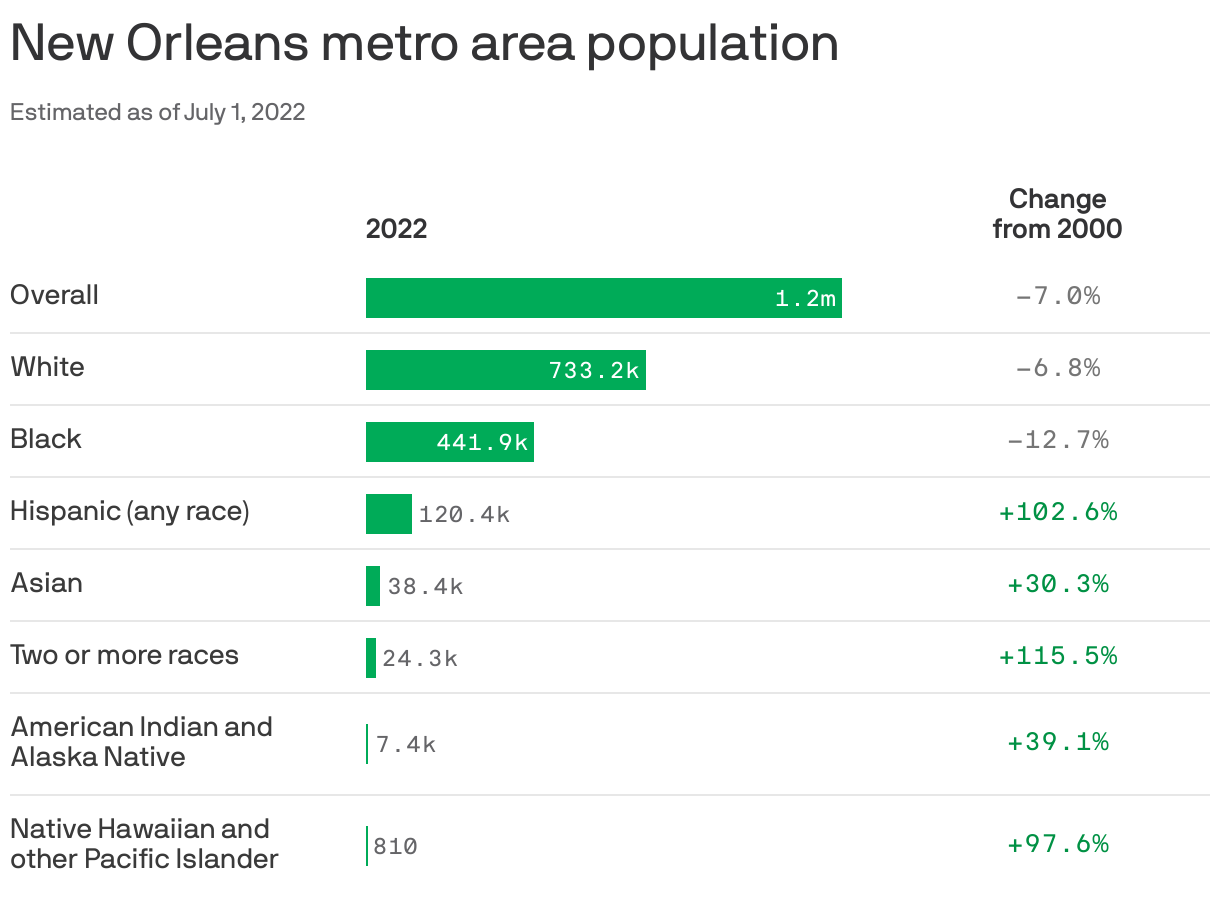
New Orleans' Hispanic population saw the biggest percentage increase of any single demographic between 2000 and 2022, per a new analysis from Axios' Kavya Beheraj and Alex Fitzpatrick.
Why it matters: Such demographic data is a vital snapshot of how New Orleans' racial and ethnic makeup is changing over time, helping to inform policies and programs across the city.
By the numbers: The number of Hispanic residents grew 102.6% to more than 120,000.
- Meanwhile, people claiming two or more races jumped 115.5% to more than 24,000, and the city's Asian population jumped 30.3% to 38,400.
Between the lines: New Orleans spent much of the first quarter of this century rebuilding from Hurricane Katrina, a population-altering event that forced an estimated 1.5 million residents from Louisiana, Mississippi and Alabama to leave.
- New Orleans' overall population has fallen by 7% since 2000, according to the new analysis.
- The Black population drop was particularly steep, at 12.7% to about 442,000.
- The white population fell 6.8% to 733,2000 over the same period.
Driving the news: Climate refugees aside, demographic trends are driven by a combination of factors, including varied birth, mortality and immigration rates (both internal and external) among different socioeconomic groups.
The big picture: Nationwide, the country's Pacific Islander, Asian and Hispanic populations saw the biggest percentage increases between 2000 and 2022.
- The number of Native Hawaiian/Pacific Islanders grew about 120% to nearly 879,000, while the Asian population grew about 105% to 21 million.
- The Hispanic population grew about 80%, to nearly 64 million.
- The Black population grew 31% to 45.4 million.
Of note: The U.S. is still predominantly white, with growth of 19% between 2000 and 2022 to nearly 252 million.
Zoom in: Some states are seeing far more rapid demographic shifts than others.
- In Texas, for instance, Hispanic residents now officially make up the largest share of the state's population, the Texas Tribune reports.
- "The new population figures show Hispanic Texans made up 40.2% of the state's population last summer, barely edging out non-Hispanic white Texans, who made up 39.8%," per the Tribune.
Meanwhile: The country is also rapidly aging, Axios' Emily Peck recently reported, with the median age reaching a record 38.9 last year.
The intrigue: Politicos have long speculated that a growing Hispanic population could move states toward purple or even blue, as our colleagues at Axios Dallas reported.
- But Latino voters are favoring the Democratic Party less.