FEMA checks usually take months to reach Hoosiers

Add Axios as your preferred source to
see more of our stories on Google.
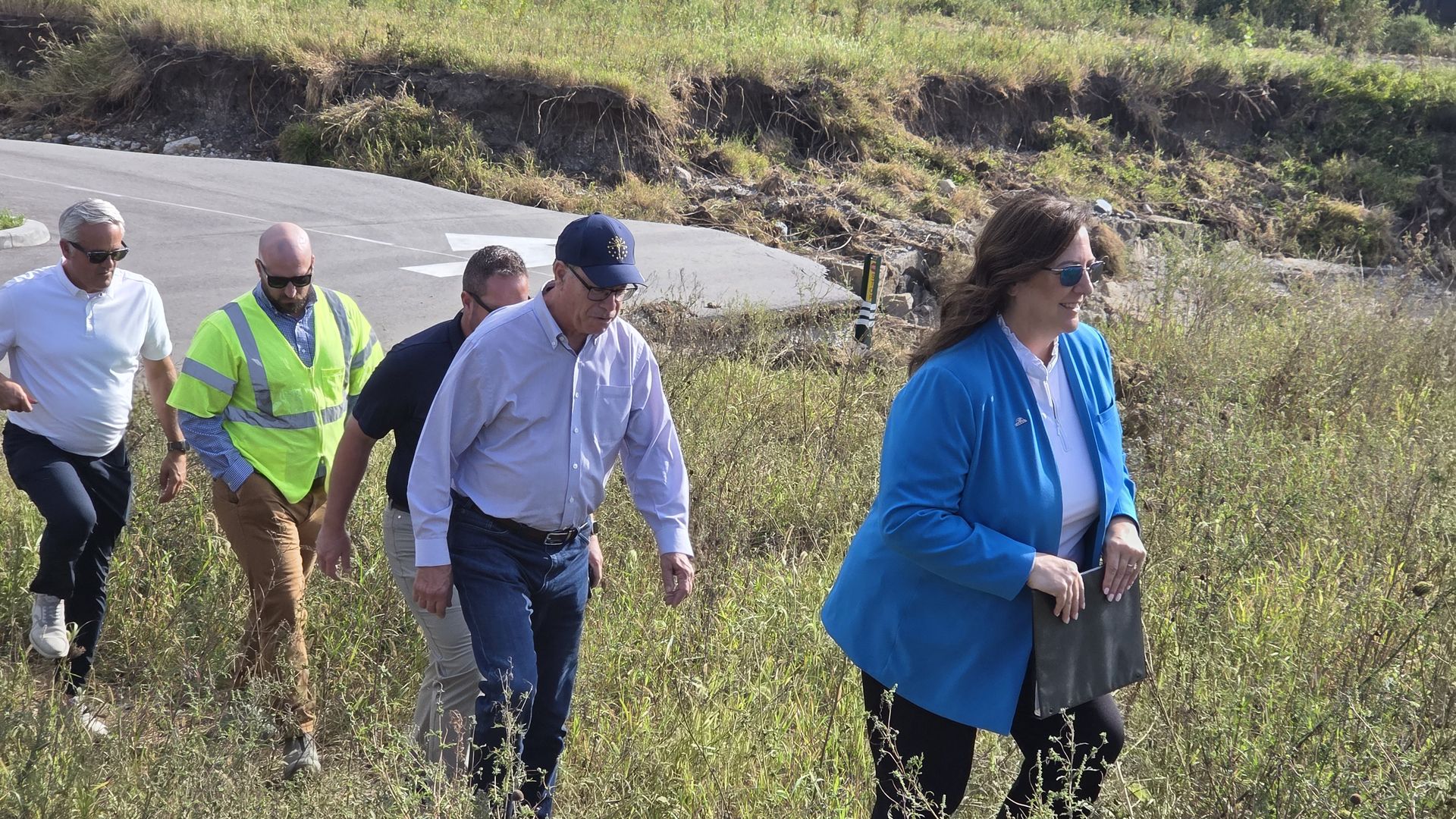
Carmel Mayor Sue Finkam leads Indiana Gov. Mike Braun and others through the flood damage near Hazel Dell Parkway in Carmel. Photo: Justin L. Mack/Axios
As FEMA pitches its pilot for faster payments in Indiana, history tells us that federal support for flood-related public infrastructure repair has typically taken months to reach states.
Why it matters: Courtney Page-Tan, an assistant professor at the O'Neill School of Public and Environmental Affairs at IU Indianapolis, says an analysis of FEMA public assistance data can help put a real-world timeline on what "federal aid is available" actually means for Hoosier communities.
By the numbers: For floods, FEMA has taken an average of 208 days from an emergency declaration to obligating public assistance funds (i.e., approving or earmarking them) in Indiana, Page-Tan found.
- For public assistance projects overall, FEMA took about 202 days to obligate money for debris removal and 194 days for emergency protective measures after an emergency declaration.
- The larger the project, the longer it takes. Page-Tan's analysis found an average of about 310 days for large projects, compared with 220 days for small projects.
Between the lines: Large projects include things like emergency pumping, electrical distribution systems and rebuilding roads.
- Small projects can cover things like donated resources and direct administrative costs, or smaller-scale physical damage.
- "It just really depends on the extent. For some areas, debris removal is considered a large project if it's Hurricane Harvey. But debris removal can also kind of be categorized as a small project if it's been a smaller hazard."
Zoom in: Indiana sits in the middle of the Midwest. Page-Tan says the average funding-obligation times are: 165 days in South Dakota, 167 in Michigan, 208 in Indiana and 330 in Ohio.
- The timeline has generally increased. She tells Axios that average obligation times nationwide rose from about 282 days during the George W. Bush administration to about 489 days during the Biden administration.
- The second Trump administration is currently at about 454 days, though she cautioned that comparing a single year with full presidential terms is difficult.
Yes, but: "That doesn't mean that nothing is happening in that time," Page-Tan says. The clock measures how long FEMA takes to obligate funding to the state, not how long communities sit idle.