Hoosier kids are doing worse than before the pandemic


Add Axios as your preferred source to
see more of our stories on Google.
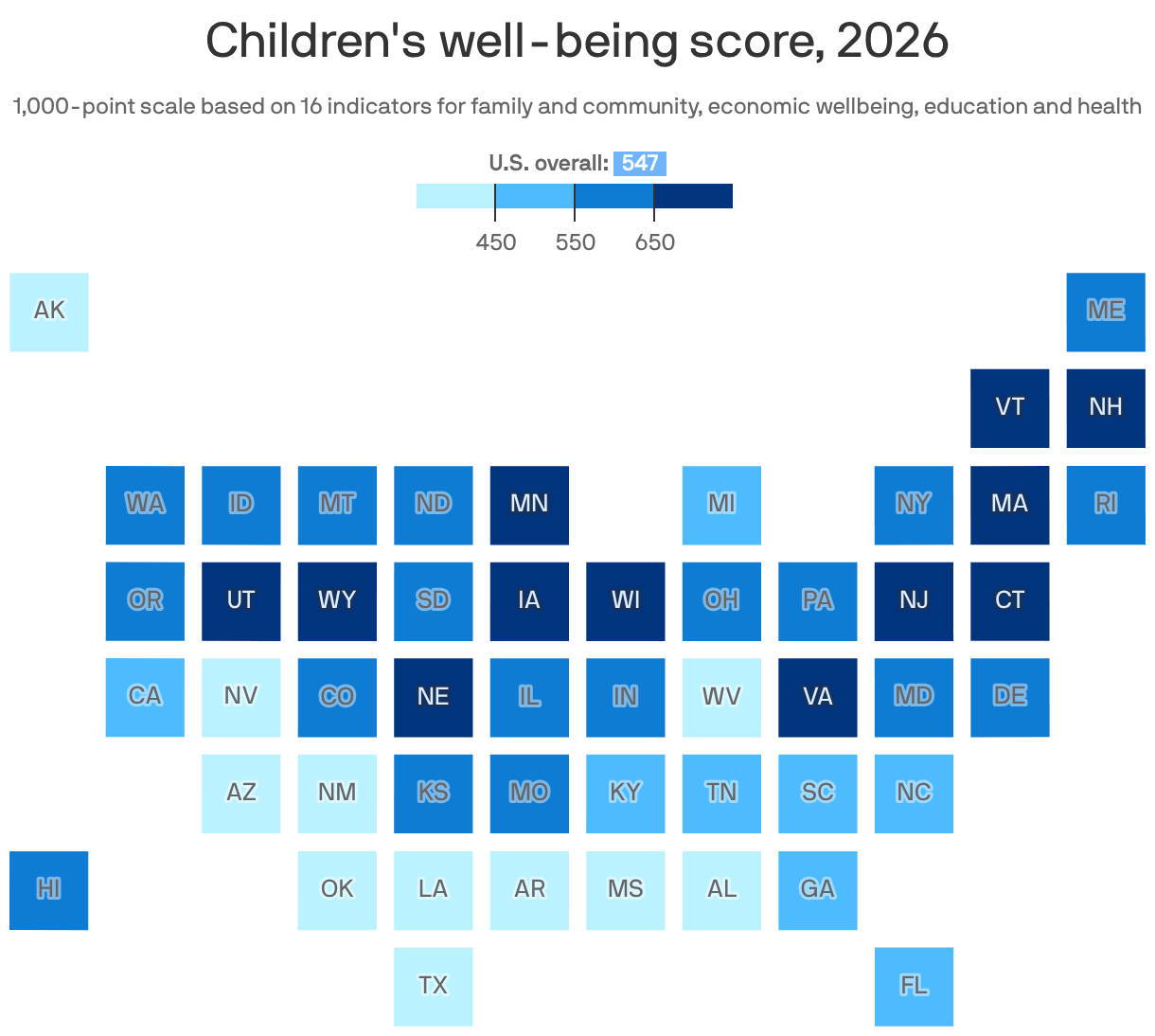
Hoosier children are worse off than they were before the pandemic, according to a new report.
Why it matters: Data comparing economic, education, health and family factors from 2019 to 2024 found that many children were already struggling — before recent safety-net reductions and rising living costs that researchers say could further strain families.
Driving the news: Indiana's national ranking of overall child well-being fell four spots to 29th in the annual KIDS COUNT Data Book from the Annie E. Casey Foundation, released Monday morning.
- The 2026 report examines data from 2019 through 2024, which Leslie Boissiere, Annie E. Casey Foundation vice president of external affairs, says lets researchers see the measurable impact of safety net investments.
- "Early data does raise some concerns about what's going to happen in terms of child well-being and outcomes for children," says Boissiere. "Particularly around economic security in a time when we know costs are rising for food and housing and basic necessities."
Zoom in: The state's economic well-being score and ranking dropped in this year's report, from 11th to 23rd nationwide.
- It found a greater share of children living in poverty or in households with a high housing cost burden in 2024 than in 2019.
Yes, but: Indiana's health ranking improved to 27th, better than in the last four years.
What they're saying: "The data reveal where progress is real and illuminate areas where we thought we were succeeding but still have work to do," said Tami Silverman, president and CEO of Indiana Youth Institute, in a news release.
- "We know kids need stable homes, strong schools, nutritious food, meaningful relationships and opportunities to learn, play and grow so they can grow up healthy and connected and thrive as adults."
Between the lines: The most recent data highlights how, even though Indiana ranks highest in education (11th compared to other states), many students are still struggling to meet academic standards.
- More than half of Indiana fourth graders cannot read proficiently, and nearly seven out of 10 eighth graders are not proficient in math.
- And 60% of young Hoosiers are not attending school — a figure that's remained relatively unchanged.
Zoom out: Children's well-being declined in 29 states and improved in 15.
- Five of the seven highest-ranked states were in the Northeast.
- Eleven of the 15 lowest-ranked states were in the South. However, eight Southern states improved their scores, including South Carolina, which rose 38 points — the largest increase of any state.
Stunning stat: The teen birth rate continues to decline, down 24% for the period researchers examined and down nearly 80% since 1990 — holding at 13 births per 1,000 females ages 15 to 19 in 2023 and 2024.
The bottom line: The report suggests state policy choices can meaningfully influence child outcomes even as national indicators continue to deteriorate.
- There's a "direct correlation" between "how states invest in children and how kids are doing," Boissiere says.