Indiana's income growth lags most other states


Add Axios as your preferred source to
see more of our stories on Google.
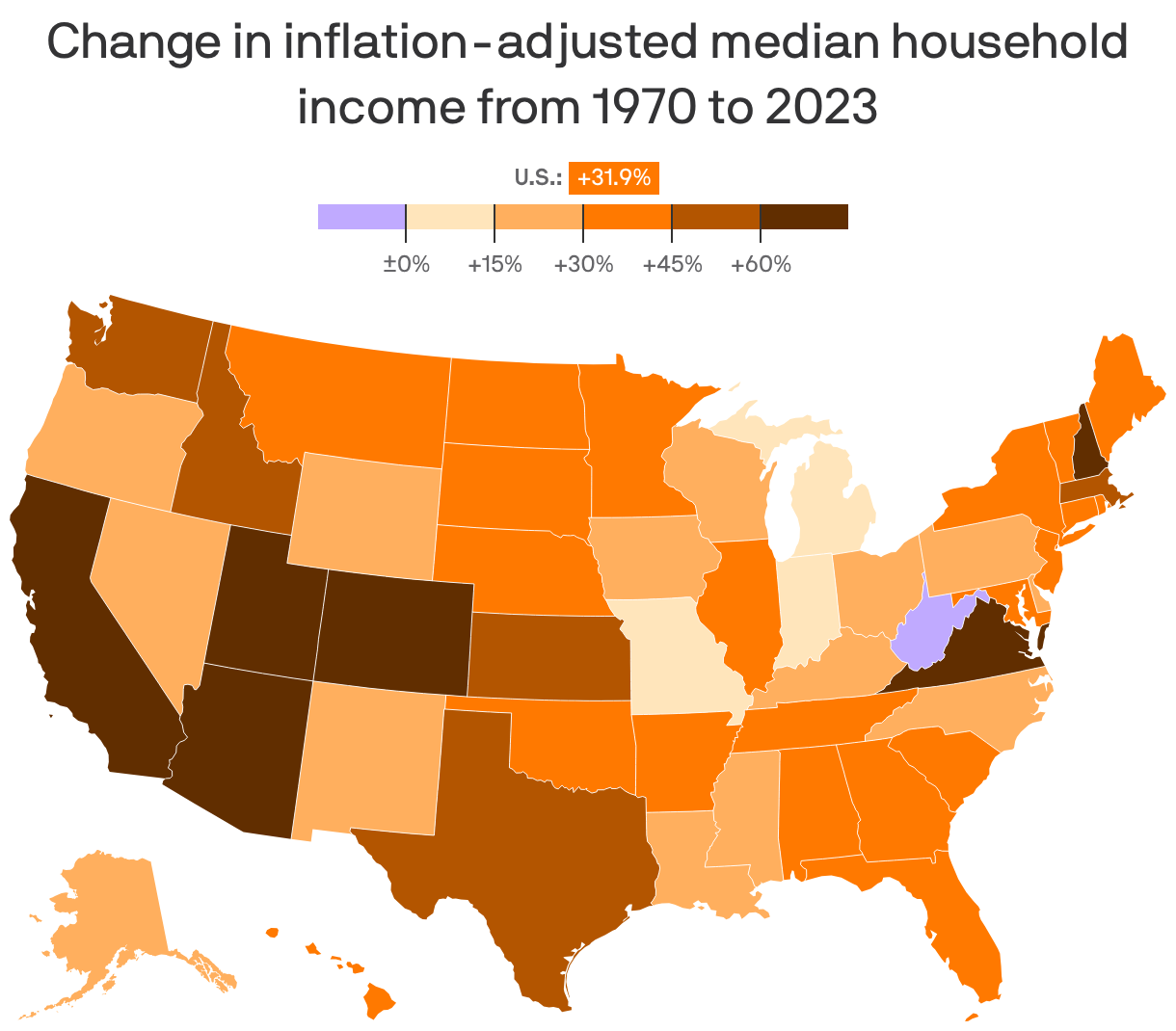
Hoosiers' incomes have seen some of the nation's smallest gains over the past five decades, according to data from a new Urban Institute analysis.
Why it matters: Lagging income growth can make it difficult for Indiana to attract and retain workers, especially young professionals with geographic flexibility looking to become the next generation of homeowners and entrepreneurs.
The big picture: That earnings gap is another hurdle local leaders will need to clear as they embark on an ambitious plan to grow the population in downtown Indianapolis by 20,000 people over the next decade.
By the numbers: After adjusting for inflation, Indiana's median household income has increased by just 14% from 1970 to 2023, going from $60,907 to $69,477.
- That's well below the national growth rate of 32%, and the fourth lowest increase in the U.S.
- Indiana now has the nation's 37th-highest median income. The state ranked 16th in 1970.
What they're saying: "Income alone does not determine a family's prosperity, but it does offer a snapshot of economic growth," the D.C.-based think tank wrote.
Between the lines: Education is the single strongest factor tied to income growth, per the report.
- Another contributor: Immigrants.
- "This could be because immigration leads to economic growth, immigrants seek out growing areas, or both."
Zoom in: Bachelor's degree holders in Indiana increased 22% from 1970 to 2023, according to the Urban Institute.
- Its foreign-born population rose 5%.
Zoom out: Income growth has surged in parts of the West, mid-Atlantic and Northeast, while other regions have largely stagnated.
- New Hampshire (62%), California (61%), and Arizona (60%) round out the top growth states.
- Michigan (2.9%) saw the weakest gains.
- West Virginia was the only state where median household income fell, down 0.4%.