More Indy seniors seek rental flexibility


Add Axios as your preferred source to
see more of our stories on Google.
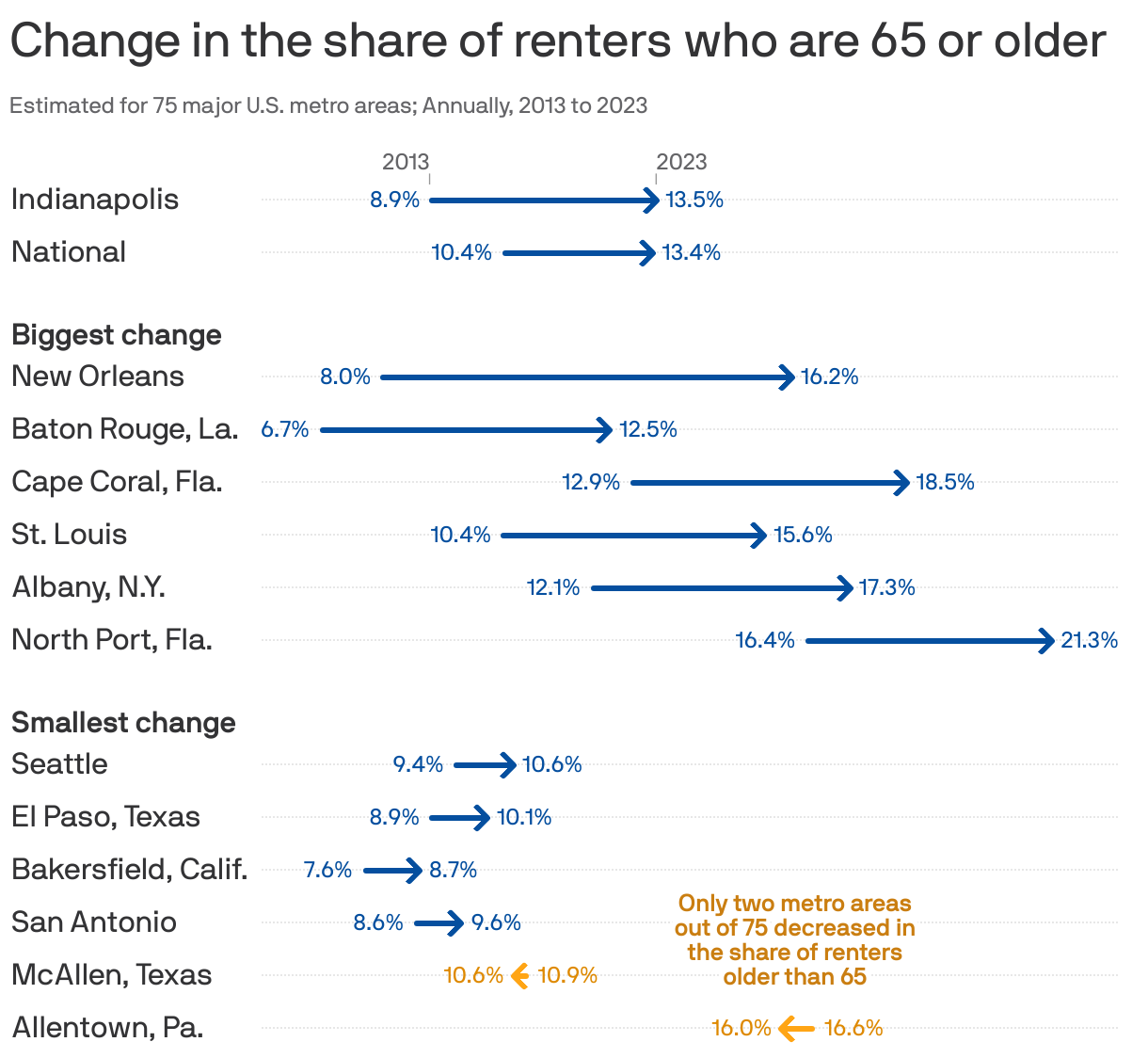
Roughly 13.5% of Indianapolis area renters were 65 or older in 2023, up from 8.9% a decade earlier, according to a report by rental listing site Point2Homes.
The big picture: More older Americans trading home ownership for flexibility coincides with a larger embrace of micro-living, a trend taking off in Central Indiana as people seek a "less is more" lifestyle.
State of play: Many older adults are on fixed incomes and stay in their homes because they're mortgage-free or have a low interest rate.
- But others are renting for less upkeep, to be closer to family or for walkable neighborhoods.
- More Indy seniors are also postponing retirement and want the flexibility to move for a job.
Between the lines: "Active adult" rental communities (think: resort pools and yoga gardens) are expanding quickly as a lower-cost option for those who want to downsize but don't need traditional independent living services, according to the National Investment Center for Seniors Housing & Care.
Zoom in: Hamilton County, in particular, is leaning into such developments to attract the state's rapidly aging population to active adult communities in Noblesville, Westfield and Fishers.
- During this week's Carmel City Council meeting, details were unveiled for an $88 million development on Old Meridian Street that would add 200 apartments for seniors and a new park dedicated to veterans.
By the numbers: Nationwide, the share of renters 65 or older rose to 13.4% in 2023, up from 10.4% in 2013.
- That age group saw the biggest jump of any, researchers found.
- Just two of 75 major U.S. metro areas posted a decline in the share of renters over 65.
Reality check: People ages 25-34 are still the most likely to lease, representing around 27% of U.S. renters, per the report, which looked at Census Bureau data.
What we're watching: "With record numbers turning 65, the shift not only echoes the broader aging of the nation, but also may signal a new approach to housing," Point2Homes researchers wrote.
Go deeper: Buying an Indy home requires $25K more income than renting