1 in 10 Hoosiers over 65 has Alzheimer's


Add Axios as your preferred source to
see more of our stories on Google.
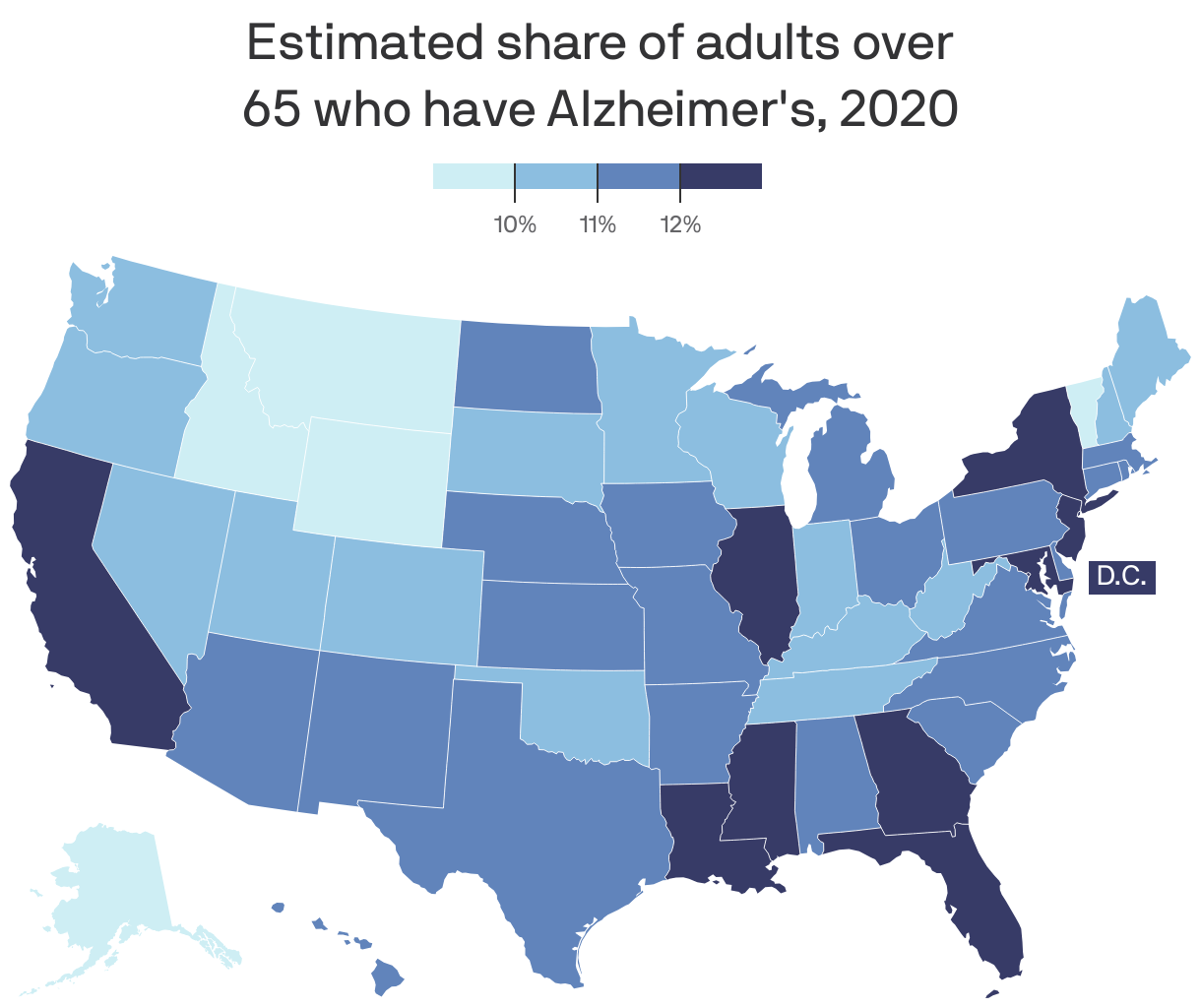
Nearly 11% of Hoosiers over 65 are living with Alzheimer's — more than 121,300 people — according to 2020 data shared in a new Alzheimer's Association report.
Why it matters: More than 7 million American seniors now live with Alzheimer's, the highest number ever recorded, but addressing cognitive decline early can help stave off the disease.
By the numbers: Almost two-thirds of Americans with Alzheimer's are women, per data cited in the report.
- Risk increases with age: 5.1% of people ages 65–74 have it, while a third of people 85 and older have it, per the report.
Zoom in: Indiana's elderly population is expected to grow rapidly in the coming years, according to projections from the Indiana Business Research Center at Indiana University's Kelley School of Business.
- One in every five Hoosiers (over 966,000 people) will be 65 or older by 2030.
- Marion County skews a bit younger. The elderly population percentage is here is poised to reach 16.2% in 2030.
Stunning stat: The research center says the number of people 65 and up in Indiana will surpass 1.5 million by 2050, a 57% increase from 2015.
Threat level: Nearly 18% of Hoosiers 45 and older already have subjective cognitive decline, according to the Alzheimer's Association.
- And the burden of care is often thrust onto family members. The Alzheimer's Association estimates about 219,000 Indiana caregivers provide unpaid care valued at $6.9 billion for loved ones with the disease.
Zoom out: The highest rates of seniors with Alzheimer's are in D.C. (16.8%) and Maryland (12.9%). The lowest is in Alaska (8.8%).
What they're saying: "It doesn't surprise me" that Alzheimer's incidence has increased, because the population is aging and "we're becoming more sophisticated in our options for diagnosing and testing for Alzheimer's disease," Lakelyn Eichenberger, a gerontologist and caregiving advocate at Home Instead, tells Axios.
- With cases climbing and age a key risk factor, early action is critical for managing the disease and accessing new treatments, Eichenberger says.
Warning signs to watch for in high-risk age groups:
- Trouble finding the right word.
- Difficulty judging distances.
- Misplacing things and struggling to retrace steps.
Between the lines: "If you're seeing patterns of these types of signs over an extended period of time," that could mean it's time to see a doctor about cognitive decline, Eichenberger says.
- If symptoms appear suddenly, however, that could be a sign of a different issue.
- Read about more signs and symptoms of dementia here.
Be smart: Keeping your brain on its toes, so to speak, can help prevent dementia.
- That means learning new things and staying social.
- For example, doing a word puzzle and talking through clues with a friend checks two boxes for brain health: mental stimulation and social connection, Eichenberger says.
- And don't skimp on sleep. It's a myth that older adults need fewer Zs.
The latest: The FDA last month cleared the first blood test to help diagnose Alzheimer's disease, potentially paving the way for earlier detection and treatment.
Go deeper: Take a short quiz to assess brain health