Why Indianapolis is getting smaller


Add Axios as your preferred source to
see more of our stories on Google.
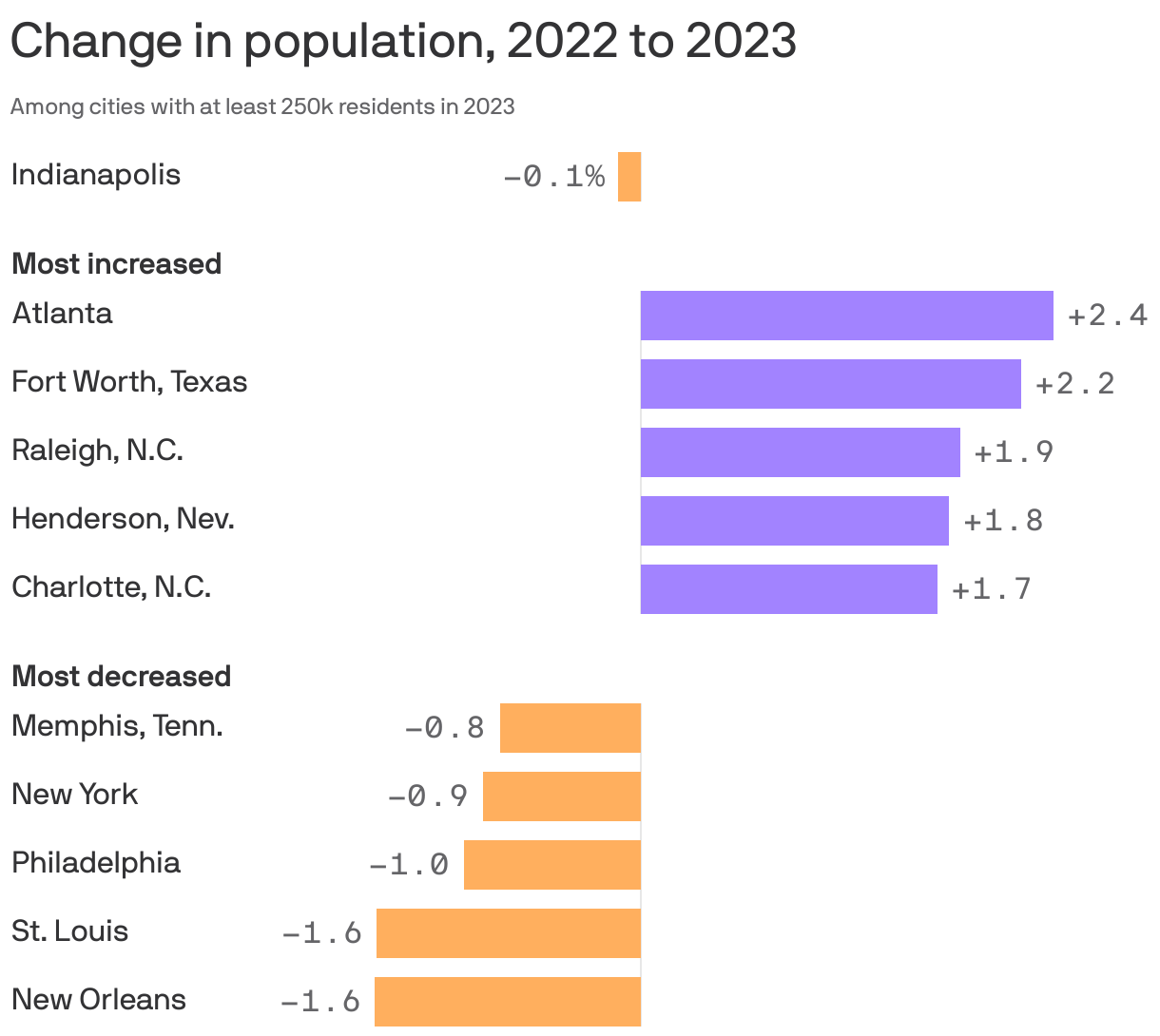
Indy's metro area is growing, but a new study shows the Circle City itself is seeing a small population decrease.
Why it matters: Late-pandemic shifts in where Americans live are still shaking out — with big economic implications for cities experiencing massive growth or rapid decline.
By the numbers: Indianapolis ranks No. 69 among the 91 cities with at least 250,000 residents on the Census Bureau's analysis of the fastest-growing cities in the country.
- Indy's population shrunk 0.13% from 2022 to 2023 and now has 879,293 residents, according to recent Census data.
Yes, but: The Indianapolis metro area grew 2.2% between 2020 and 2023 with more than 45,000 new people.
- The largest drivers of the growth were Hancock (7.5%), Boone (7%), Hamilton (6.5%) and Hendricks (6.2%) counties.
- Marion County experienced a 0.8% drop during that same period.
Between the lines: The Indy metro is an example of how some of America's fastest-growing places are not cities themselves, but their outer suburbs, or "exurbs."
- "Exurbs have sometimes been among the most rapidly growing communities, but this appears to be even more true now than before the pandemic," Census Bureau demographer Luke Rogers said.
- The exurb boom is likely a consequence of high housing prices pushing people farther from the city center and an increase in remote work options that makes living away from employment centers more palatable, per the Census Bureau.
Zoom out: Cities with populations of 50,000 or more grew by an average of 0.1% in the Midwest after declining an average of 0.2% in 2022.
- Atlanta had the highest growth nationally, increasing 2.42% during the period.
- St. Louis and New Orleans saw the biggest drops with a 1.6% decline.
The big picture: Southern cities dominate the list of the fastest-growing big metros, with Florida and Texas alone accounting for eight of the top 20.
- That reflects a continued trend of Americans flocking to areas of the country that face some of the greatest climate risks.