Tracking Indiana's summer COVID wave


Add Axios as your preferred source to
see more of our stories on Google.


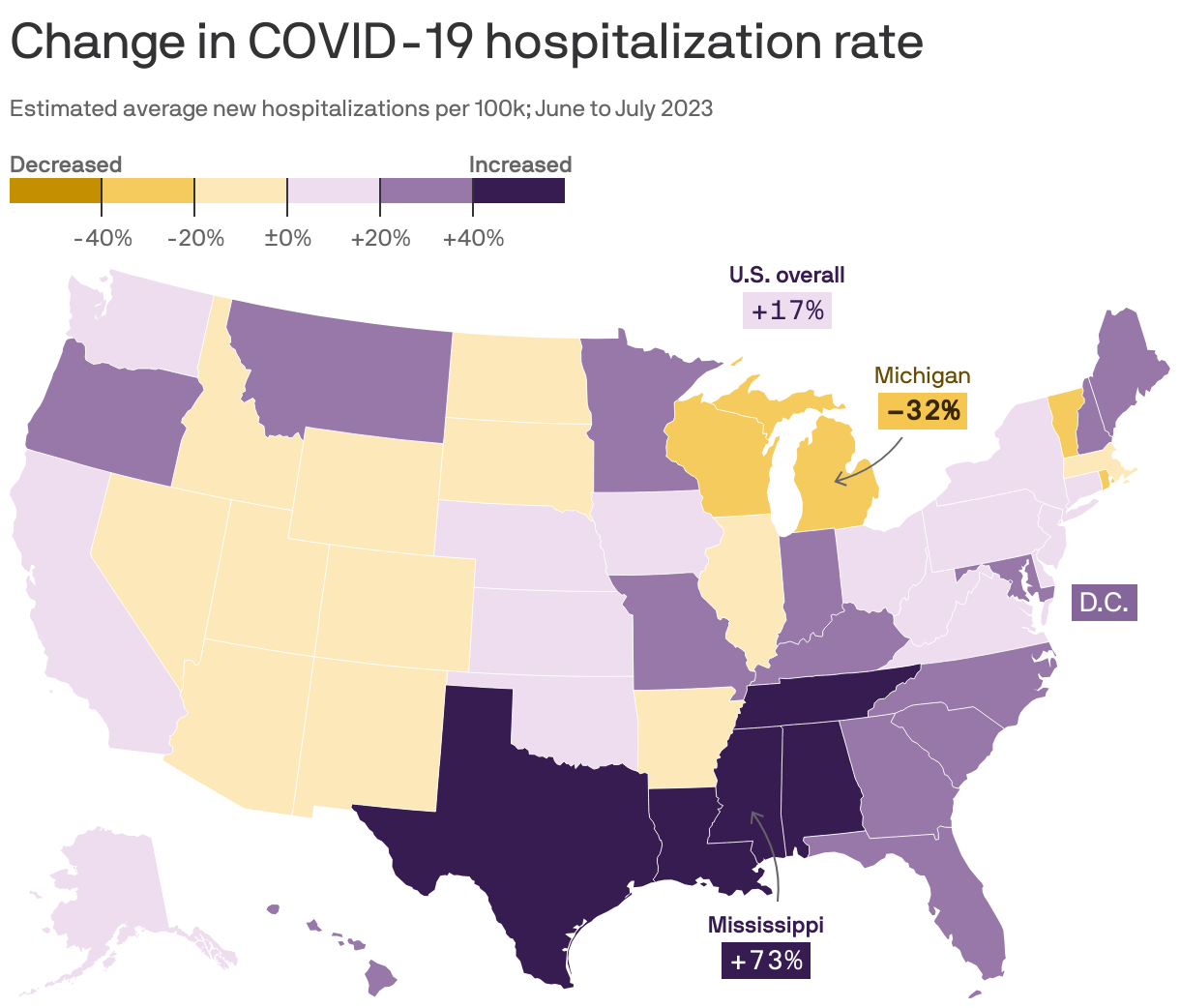
COVID-19 hospitalization rates across Indiana rose nearly 40% between June and July amid signs of a late summer wave sweeping the country.
The big picture: The average COVID hospitalization rate nationwide rose about 17% between June and July, per the CDC.
- A new variant, EG.5, is now the dominant form in the U.S., according to CDC estimates — though it's unclear if it's directly responsible for the rising numbers.
Why it matters: Simply put, our guard is down.
- Many of us put COVID in our rearview mirrors, leaving us both mentally and practically ill-prepared for another wave.
Zoom in: Indiana Department of Health COVID wastewater testing data shows 2,185 cases the week of Aug. 7 — up from 557 the week of June 26.
Reality check: That's still significantly lower than the weekly high of more than 100,000 cases in January 2022.
- And the state's hospitalizations are down nearly 90% from July 2022.
Of note: In both percentage change and raw terms, nationwide hospitalizations also remain far below their pandemic-era peak.
Be smart: With so little testing happening these days compared to the height of the pandemic, hospitalization rates are now one of the best proxies for estimating broader viral spread.
Yes, but: Hospitalizations aren't a perfect metric.
- Because older people are more vulnerable to severe COVID, for example, hospitalization rates are likely to be higher in states or communities with older populations.
- Hospitalization rates are also a lagging indicator — it takes time for infected people to become sick, and more time still for them to become sick enough to require hospitalization.
Zoom out: Hospitalization rates are rising the fastest in Mississippi (+73% month over month), Alabama (+66%) and Louisiana (+66%).
- Yet they're down in Michigan (-32%), Vermont (-31%) and Rhode Island (-31%).
The latest: This uptick comes at a less-than-ideal time with regard to booster availability.
- A newly updated booster is due out this fall. While it wasn't specifically designed with EG.5 in mind, it will likely offer at least some protection, experts told NBC News.
- Those behind on their shots need to decide whether it makes sense to wait for the updated booster or beef up their protection now in the face of this uptick.
- Only 14% of Hoosiers are up-to-date on COVID shots, per the state Department of Health.
The bottom line: There's no sign we're headed for anything like the waves of the peak pandemic era.
- But it's still an alarming trend, and a reminder that COVID will remain a public health concern for the foreseeable future.