Houston's mad dash to lay World Cup grass

Add Axios as your preferred source to
see more of our stories on Google.
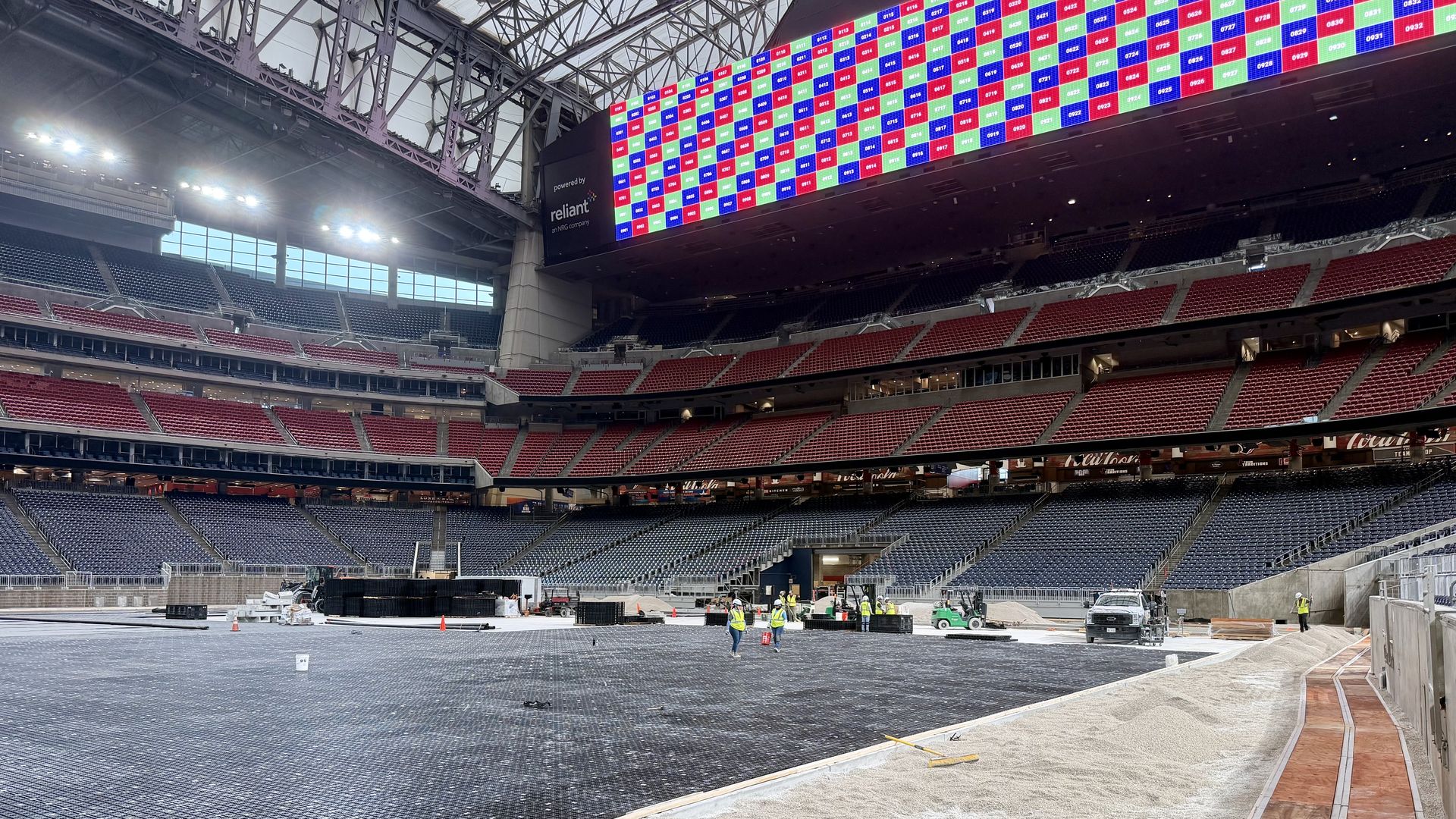
Workers add a water management system layer on Friday. Photo: Shafaq Patel/Axios
Twenty-five refrigerated trucks are hauling valuable grass from Colorado that will soon cover NRG Stadium ahead of Houston's World Cup matches.
Why it matters: This isn't ordinary turf. The FIFA-spec grass has been growing near Denver for the past 18 months and will soon host world-renowned players kicking, passing and scoring through seven Houston matches.
Catch up quick: The grass is largely Kentucky bluegrass with some perennial ryegrass. Since it's designed for cooler climates, NRG Stadium's roof will remain closed and the building temperature will stay at 72 degrees.
- Large grow lights being shipped from Rotterdam, Netherlands — along with the stadium's irrigation and underground aeration system — will help keep the field healthy indoors. The pitch will be patched up in between matches as needed.
- The grass was selected because FIFA wanted to ensure a similar on‑field experience across all tournament venues, John Coppins, the vice president of operations for the host committee, tells Axios.
Flashback: The grass was part of the early planning and pitch for World Cup host cities. Dan Bergstrom, the host committee's pitch consultant, has been working on the project in Houston for more than seven years.
The latest: Workers are installing the stadium's "permavoid" base layer — a system designed to help the field meet FIFA standards for drainage, ball bounce and playability, Coppins says.
- A geotextile fiber cloth will go on top before the sod-on-plastic arrives.
The intrigue: What normally takes about 13 weeks to put together is being squeezed into about three weeks. About 20 laborers are working 12- to 14-hour workdays getting the pitch ready, Bergstrom says.
Follow the money: "As far as stadium elements go, from a host committee standpoint, this is the most significant expense when you tally up the full effort. The concrete work, the grass, the maintenance, the grow lights, all those moving parts — it's a significant expense. But without this, you don't have the World Cup," Coppins tells Axios. The host committee did not disclose cost.
- "It's not really an optional part."
Zoom in: In addition to the field preparation, the four corners of the lower bowl were modified to meet FIFA field dimension requirements.
- The sod is expected to arrive later this month in large rolls and will be stitched together.
- Artificial turf will frame the grass surface alongside LED boards and signage.
Fun fact: Researchers at the University of Tennessee and Michigan State spent five years developing World Cup-ready grass that can be installed quickly, withstand weeks of matches and adapt to different stadium conditions.
- Even though its latitude is similar to Houston, Miami will use Bermuda grass since it has an open-air stadium.
Zoom out: NRG Stadium has undergone a broader facelift ahead of the tournament, including upgraded speakers, video boards, sports lighting and new signage — plus mechanical engineering and plumbing — across NRG Park, general manager Hussain Naqi tells Axios.
- "We've really spent to bring the stadium back up to snuff," Naqi says.
During the tournament, NRG Stadium will temporarily be renamed "Houston Stadium" because of FIFA branding protocols.