Mapped: Michigan's population changes


Add Axios as your preferred source to
see more of our stories on Google.
 Open embedded content from datawrapper.dwcdn.net
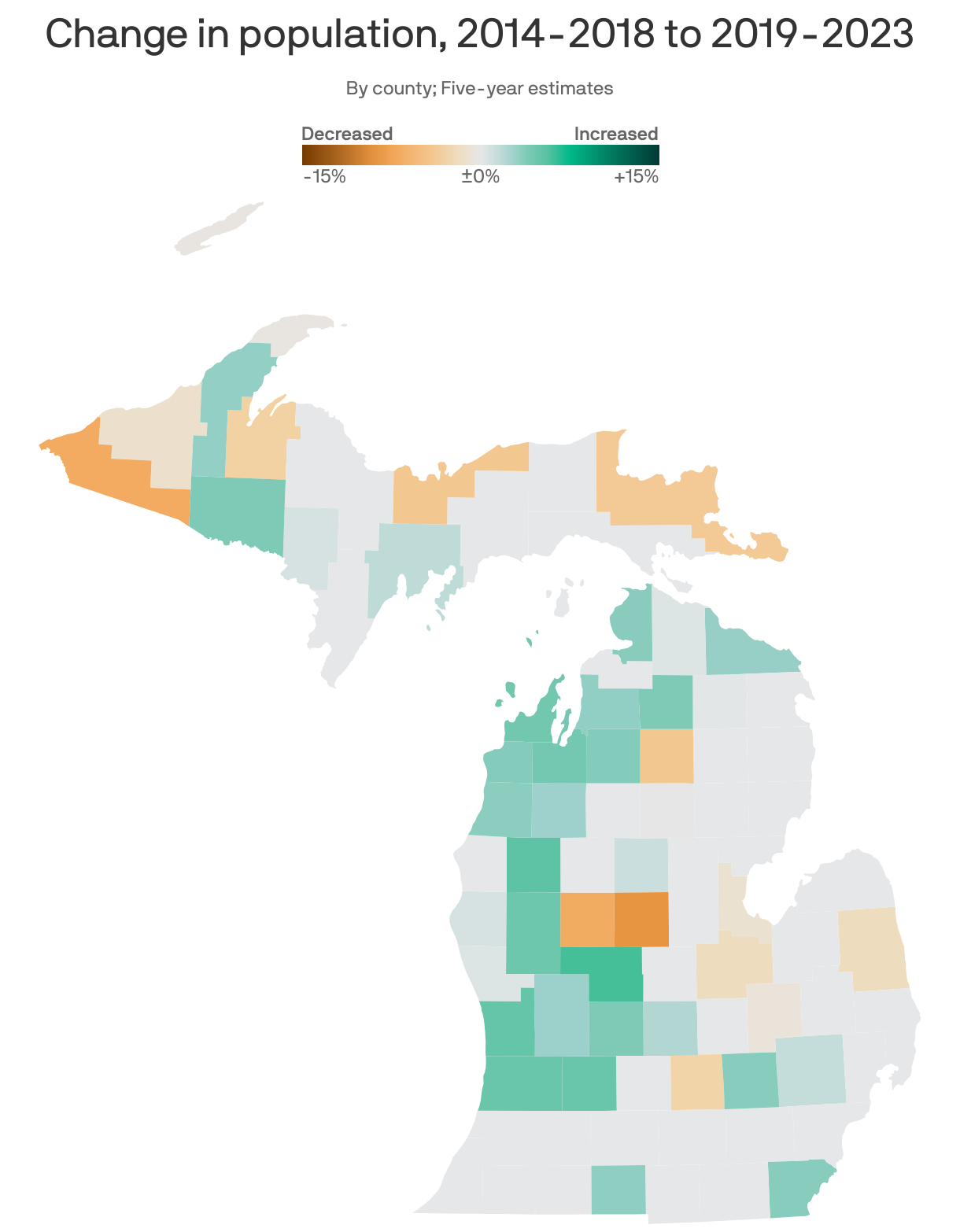
Michigan's population growth isn't clustered around Metro Detroit, per an Axios analysis of the latest U.S. Census Bureau data.
Why it matters: Overall lack of population growth has been a key focus for leaders like Gov. Gretchen Whitmer and Mayor Mike Duggan.
- Though Detroit recently saw its first estimated population increase in decades, the long-term problem lacks clear, effective solutions — and an April report projecting population through 2050 expects Michigan to grow slowly and then decline.
How it works: Axios' zoomed-in view offers a close look at population change within states and counties via the U.S. Census Bureau's 2019–2023 American Community Survey.
- Browse county-by-county changes in our interactive map here.
By the numbers: Michigan's population grew by around 1%, increasing from a five-year average of about 10 million in 2014–2018 to about 10.1 million in 2019–2023.
- For comparison, Colorado saw a 5.1% change during the same period, Texas saw 6.3% growth and Ohio recorded 1.2%.
- The Mitten State county with the biggest increase in that period was central Michigan's Montcalm County (6.3% growth), followed by Lake County (5.4%).
The intrigue: No Metro Detroit counties cracked the top 20 for population growth in Axios' analysis.
- Oakland County ranked 26th with a 1.7% increase and Wayne County's was 0.7%.
Zoom out: Texas, Florida and Iowa are home to some of the country's fastest-growing large counties.
- Some of the U.S.'s fastest-growing areas are also among the most vulnerable to climate change.
Between the lines: Although Americans often move states in search of things like better jobs and lower costs, international migration is still the main driver of population growth at the national level.
- Migration "accounted for 84% of the nation's 3.3 million increase in population between 2023 and 2024," the Census Bureau said in a recent write-up of separate data.
- "This reflects a continued trend of rising international migration, with a net increase of 1.7 million in 2022 and 2.3 million in 2023."