Duggan won't seek fourth term as mayor of Detroit

Add Axios as your preferred source to
see more of our stories on Google.
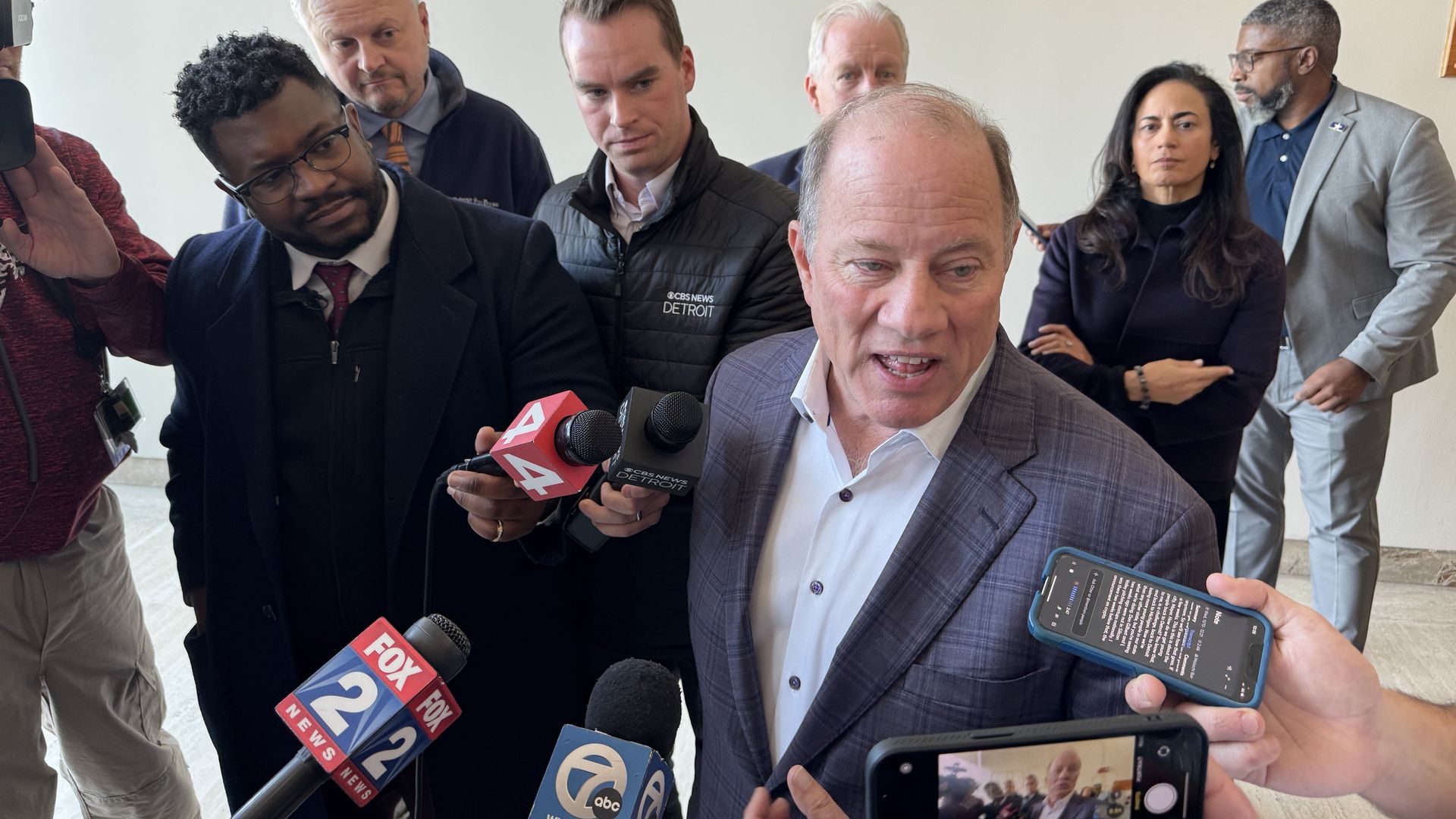
Detroit Mayor Mike Duggan talks to reporters after the announcement. Photo: Annalise Frank/Axios
Detroit Mayor Mike Duggan will not run for a fourth term, he announced Wednesday to an auditorium full of city hall employees.
Why it matters: Duggan bowing out comes as little surprise; the 66-year-old Democrat, who has garnered support from both sides of the aisle, is rumored to be a potential candidate to replace term-limited Gov. Gretchen Whitmer in 2026.
- His announcement will also open the path for 2025 mayoral candidates to start campaigning earnestly.
Yes, but: Duggan has not said if he'd run for governor and declined to speak further on his plans Wednesday. He expects to address the issue in the next several weeks or months.
Flashback: Duggan, a former CEO of the Detroit Medical Center, became mayor in January 2014, amid the city's 2013-14 bankruptcy. He easily won reelection in 2017 and 2021.
What they're saying: In his speech, Duggan said he accomplished his primary goal of growing Detroit's long-declining population. The 2020 Census still showed a 10% decrease, a number the city fought. But this spring, new estimates showed the city growing for the first time since 1957.
- Duggan also spent time looking back at his first campaign, running as a white man to lead a supermajority-Black city with a deep history of discrimination like redlining.
- "The hatred and division (in America) is coming from the fact that we don't take the time to get to know each other, to listen to each other," he said.
Context: Through his decade in office, the mayor steered an administration that righted the city's troubled finances, partnered widely with philanthropy and corporations, and made a goal to destroy blight through demolition.
- He and the city's revitalization made national headlines, and his rapport with national business leaders and the Biden administration helped the city secure anything from COVID-19 testing to federal dollars.
Reality check: The oversimplified "comeback" narrative has also drawn questions from residents and activists about who truly benefits from the new investment in a city with a continuing affordable housing crisis and high poverty.
- His support of billionaires with patchy development histories has drawn criticism for helping corporate interests at the expense of residents in need.

Mayor on the future
While Duggan did not reveal the particulars of his aspirations, he did discuss politics — namely, the future mayor of Detroit and President-elect Trump.
State of play: City Council President Mary Sheffield, council member Fred Durhal III and former council member Saunteel Jenkins are among those who have expressed interest in replacing Duggan as mayor.
"There is talent in this city that can continue the recovery in Detroit and have it extend to more people and be more inclusive," Duggan said during his speech. "I don't have a favorite candidate (for mayor) … I'm going to watch these candidates emerge and see who the right leader is."
- He wants to see someone who can unite people and be honest about what can and can't be accomplished.
The intrigue: Duggan said he's unsure if he will endorse anyone next year.
- He did say James White, Detroit's police chief who recently announced he would leave the city to lead Detroit Wayne Integrated Health Network, is "one of the great leaders I've ever met in my life." But, he said, White "has decided that taking on the challenge of the mental health system is his life's dream."
What's next: The incoming presidential administration will prove a "challenge," Duggan said, echoing Whitmer in saying he'll be looking for common ground with Trump.
- He said he hopes Trump's priorities will include assistance with affordable housing and combatting violence.
Editor's note: The story has been corrected to say Duggan became mayor in 2014 amid the city's bankruptcy (not after it emerged).