Des Moines Public Schools plans closures, restructuring for next decade

Add Axios as your preferred source to
see more of our stories on Google.
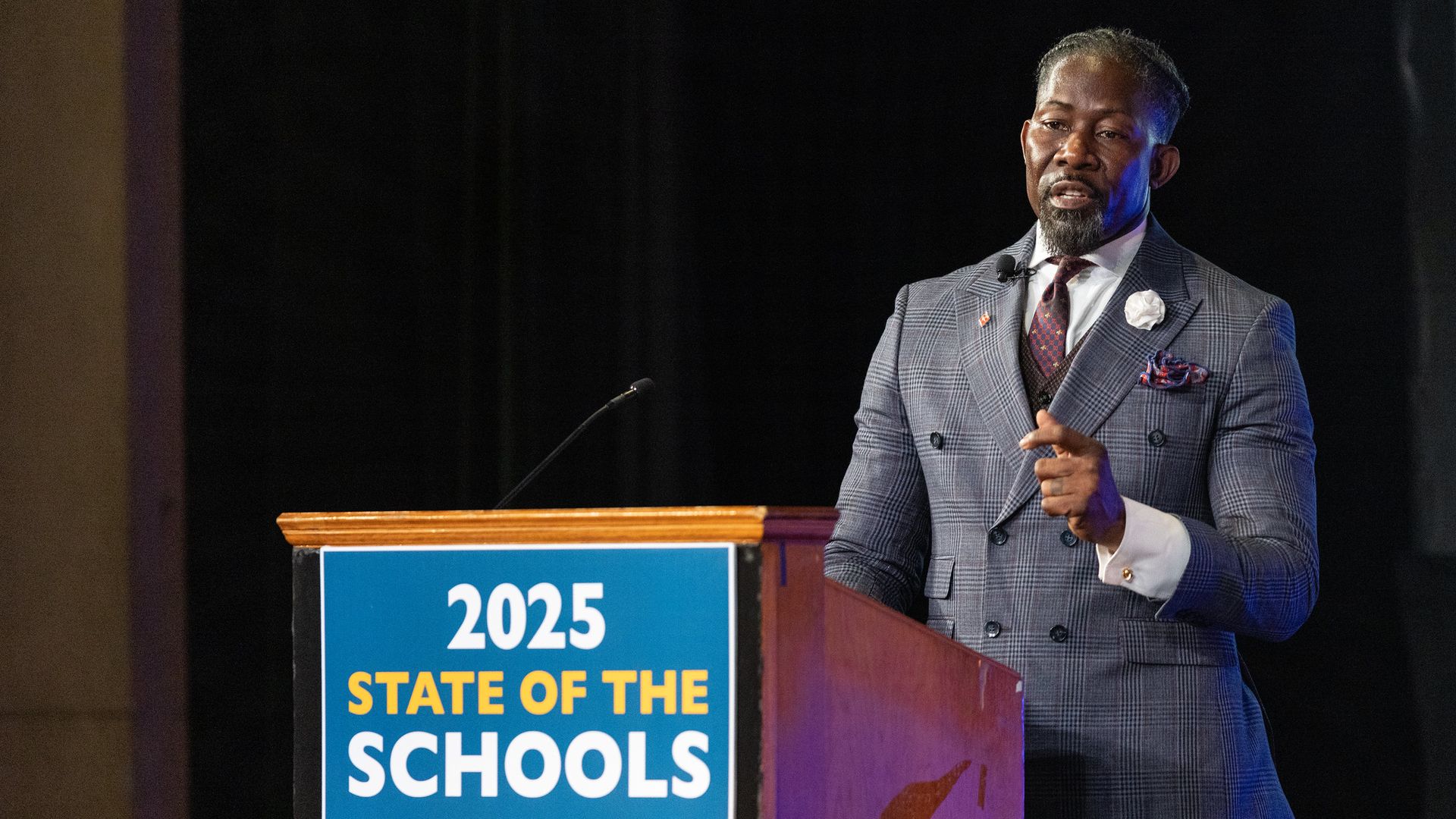
Superintendent Ian Roberts gives the 2025 State of the Schools address. Photo: Courtesy of DMPS
Des Moines Public Schools plans to dramatically reshape over the next decade, including repurposing school buildings and closing some entirely.
Why it matters: The district faces declining enrollment, a strained budget and aging buildings. The new plan aims to reverse this trend by introducing specialized programs designed to retain students and boost academic engagement.
- "We have two choices as a district: We can hide under a rock and do nothing, or we can step up and own our destiny — and we pick the latter," DMPS school board chair Jackie Norris said Tuesday during a presentation on the 10-year plan.
Driving the news: Here are the top three takeaways from DMPS' Reimagining Education event:
School closures
DMPS plans on reducing its middle schools from 10 to five in the next year, with plans to permanently close two buildings and repurpose three others.
What's happening: Sixth grade will be reconfigured into the elementary buildings, while middle schools will focus on seventh and eighth grades.
- Several elementary buildings will close as well to help better allocate resources, district officials say.
Details: Harding and Callanan middle schools will close by fiscal years 2032 and 2036, respectively.
- Walnut Street elementary will close by FY 2030 and Cattell, Stowe and Howe by FY 2033. McKee early childhood center will close FY 2032.
By the numbers: Since 2017, DMPS has lost 2,000 students, leading to financial losses as state funding is allocated annually based on per-pupil enrollment.
- The transition from elementary to middle school is when DMPS loses the most students.
More specialty schools
Beyond the permanent closures, DMPS plans on repurposing several buildings to offer more specialty schools and programming.
What's happening: Students will be able to focus on specific topics like STEM, trade skills, arts, health and advanced academics.
- DMPS also plans on expanding its Montessori school programs.
The big picture: The overall district structure will change from feeding into five traditional high schools into three — East, Roosevelt and Lincoln.
Zoom in: North and Hoover high schools will convert into specialty seventh through 12th grade schools.
- Moulton, Jackson and Pleasant Hill will become specialty pre-K through eighth grade schools.
- Brubaker/Hoyt, Meredith and Kurtz will also transition into specialty schools.
The intrigue: Families can open enroll into any specialty school and are not restricted by neighborhood boundaries.
Expanding full-time preschool programming
By 2035, DMPS will grow from four to six preschool centers and from 20 to 30+ preschool classrooms in elementary school buildings.
Why it matters: Students who were enrolled in preschool outperformed their peers in first through sixth grades by double digits in literacy and math, said DMPS school board chair Jackie Norris.
- "This is a game-changer for setting our kids up for success early on," she said.
The intrigue: The district also plans on providing free busing to its preschools to eliminate transportation barriers.
- Iowa law only requires free transportation for K-12 students.
What's next: People are invited to offer feedback on the plan.