Decades after near-extinction, Ohio's bald eagles are thriving

Add Axios as your preferred source to
see more of our stories on Google.
The next time you spot an eagle soaring through the Ohio sky, remember that sighting is because of successful conservation efforts that saved the majestic bird.
Why it matters: Ohio's bald eagle efforts are a rare but important conservation bright spot — and an indication of our ability to save endangered species.
Driving the news: Jan. 10 is National Save the Eagles Day, a chance to commemorate the country's efforts to repopulate one of our most prominent symbols.
Flashback: Bald eagles love Ohio for its wetlands, rivers and lakes. But by 1979, just four nesting pairs remained in the state as they became endangered across the country.
- Eventually, conservationists learned that widespread DDT usage had poisoned the birds, blocking calcium that allows eggs to withstand incubation.
- DDT was largely banned in 1972, starting the long process of recovery for eagles and many other species of wildlife.
Fun fact: An Ohio wildlife officer was crucial in sounding the alarm in the 1950s about pesticides harming their ability to reproduce.

Eagles have bounced back in the decades since the DDT ban.
- In addition to birds' natural return, organizations like the Ohio Division of Wildlife (ODW) and the Cleveland Museum of Natural History have raised eagles in captivity, coordinated volunteers and tracked nesting patterns.
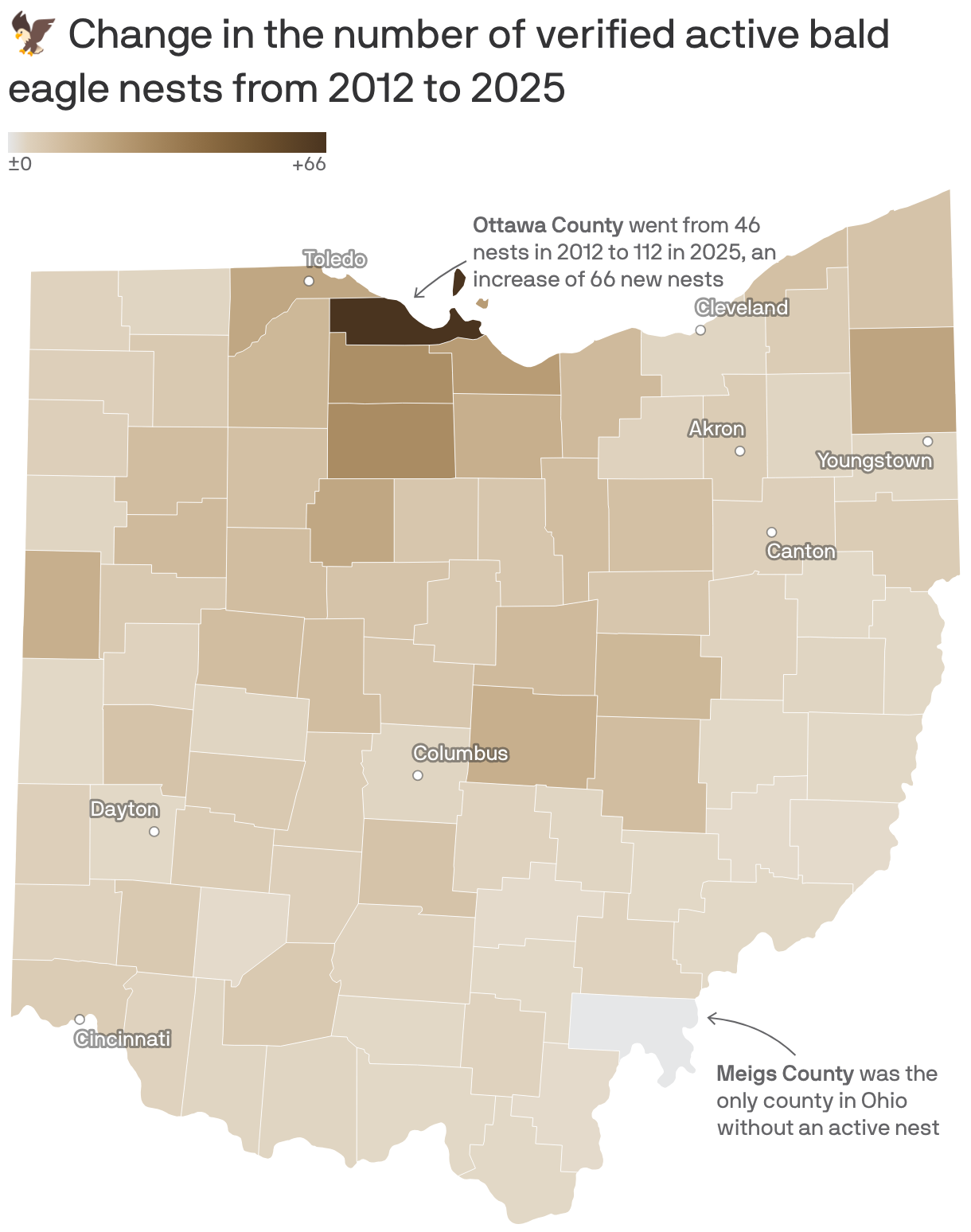
State of play: Ohio's eagle population continues to grow, with our 964 confirmed nests in 2025 marking a 36% increase from 2020 alone.
- There's enough eagle activity in Ohio for the birds to frequently become the subject of local interest and bird enthusiasts, like the Dublin Road nest that's been captivating onlookers since 2018.
What they're saying: "It breaks my heart when I hear people say, 'Humans just screw everything up,'" ODW avian education coordinator Jamey Emmert tells Axios.
- Emmert says it's "easy to be hopeless" about animals and our environment — but the bald eagle's rebound can teach us an important lesson.
- "With proper techniques, conservation, passion, enthusiasm and working together for the common good, we were able to save them. … Yes, we may make mistakes, but we can turn those mistakes around."
Yes, but: Not all birds are thriving.
- Cornell University's 2019 "3 Billion Birds" study sought to calculate the devastating loss of the North American bird population since 1970.
Threat level: For Emmert, that study highlights the way that our wildlife — especially birds — acts as a "canary in the coal mine" (pun not intended, she says) for the rest of our planet.
- "They are such strong indicators of environmental concerns. As tough as birds can be, they're also very fragile animals, and are some of the first species to show us when something is amiss in the environment."