Young adults in Columbus aren't staying home


Add Axios as your preferred source to
see more of our stories on Google.
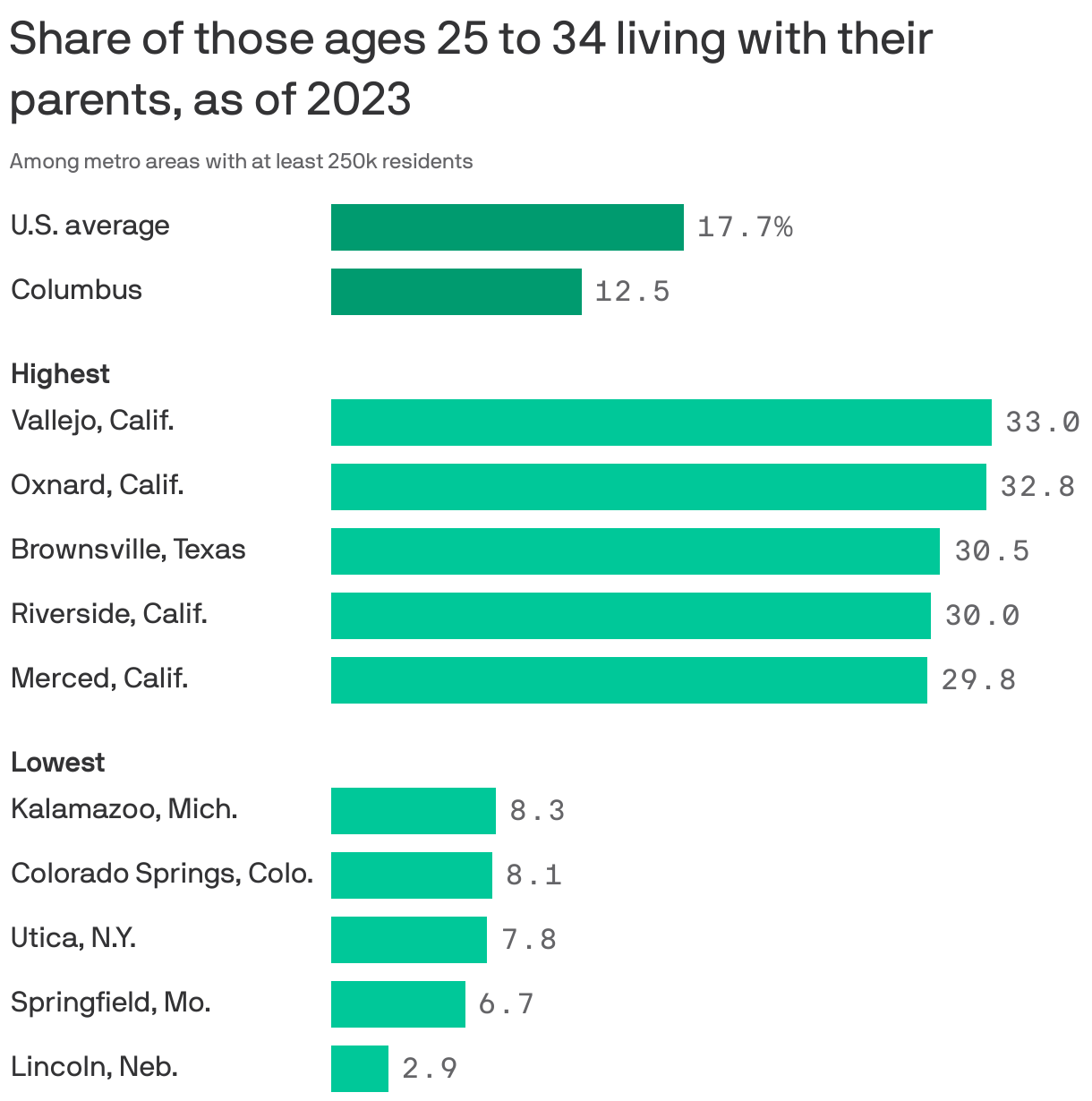
More young adults in Central Ohio are leaving the nest compared to elsewhere in the U.S., a recent analysis finds.
Why it matters: While living at home as a young adult is sometimes viewed negatively as a "failure to launch," it can also reflect economic realities, cultural preferences, caregiving needs and other factors.
By the numbers: In the Columbus area, only 12.5% of adults ages 25 to 34 were living with their parents as of 2023, per a Pew Research Center analysis of census data.
Context: That's well below the national rate (17.7%).
- Nine of the 10 cities with the largest share living at home (all at least 29%) are in California, Texas or Florida.
Zoom out: Pew identifies the Midwest as the region where adults were least likely to live in a parent's home.
- While cities like Chicago, Cleveland and Detroit are slightly above average, most — including Indianapolis (11.9%) and Des Moines (8.9%) — are significantly below.
What they're saying: Even compared to other Midwest notables like Cleveland or Detroit, Columbus' position as a younger city attracting new transplants is likely keeping our numbers down, says Sarah Hayford, an OSU sociology professor and director of the university's Institute for Population Research.
- "Columbus is a city that has more economic growth and population growth," she tells Axios. "As a demographer, population mobility is key. Who's moving to Columbus and who's moving out of Columbus, and how might patterns look different for people who are new residents versus a city where people have grown up and stayed?"


Case in point: Hayford is right; we are a young city.
- Census data shows that in 2022, Columbus' median age of 36.9 was lower than the country's (39) and well below cities like Cleveland (41.8) and Detroit (40.4).
Between the lines: Our figures are also a reflection of our demographics.
- Pew points out that white adults are less likely to live with parents than their Asian, Hispanic or Black counterparts, a major contributing factor in a city with a 53% white population and a newer immigrant population.
- "Those racial differences are also related to racial wealth gaps and differences in housing stock as well," Hayford says.