Big Darby Accord to get its first update since 2006

Add Axios as your preferred source to
see more of our stories on Google.
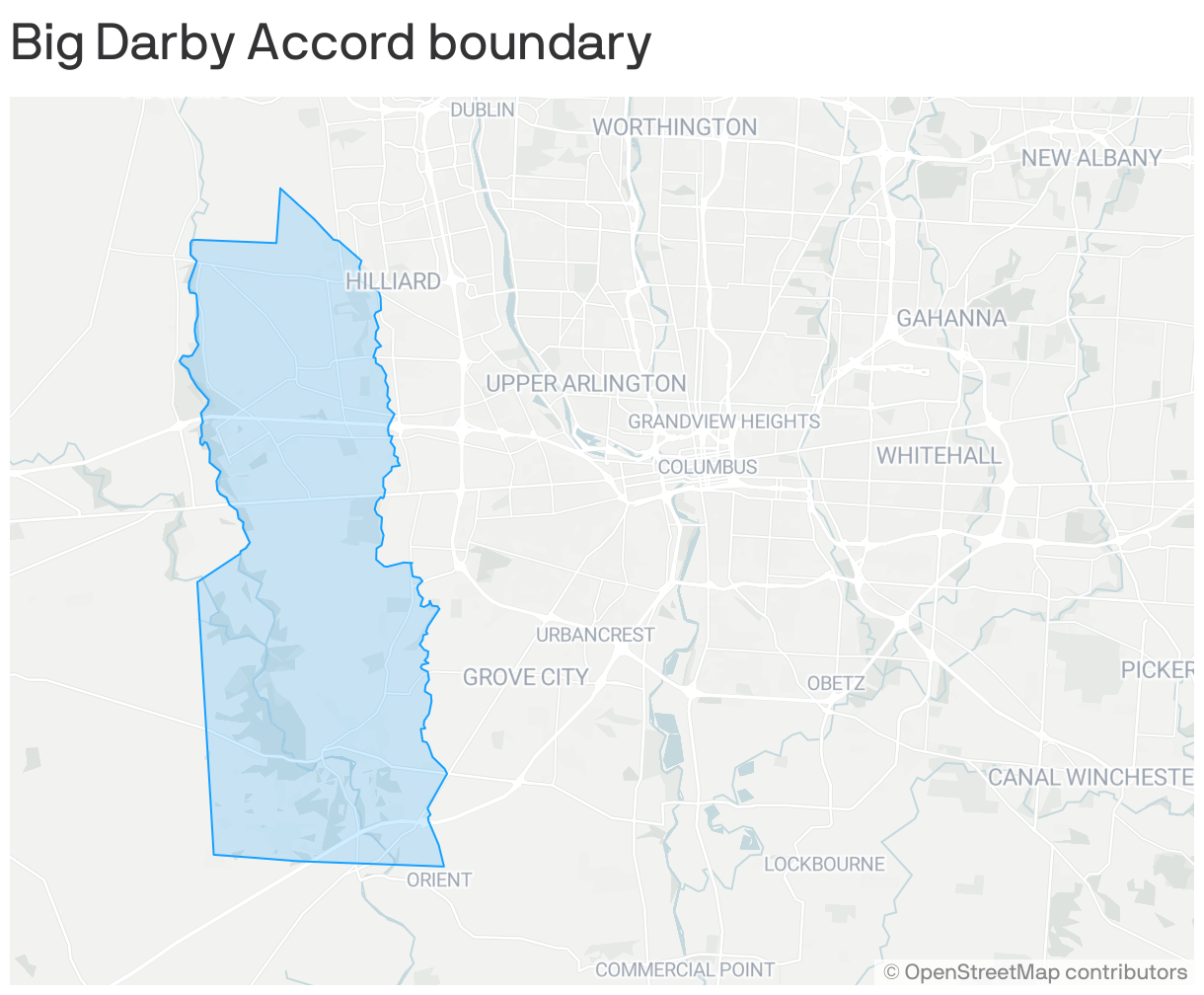
The Big Darby Accord, an agreement among local governments to protect the river's watershed as Central Ohio grows, is getting its first update in nearly 20 years.
Why it matters: Big Darby Creek is one of the most biologically diverse aquatic ecosystems in the Midwest and home to rare species, including two federally endangered freshwater mussels.
- The plan's changes will guide development in western Franklin County.
Catch up quick: Franklin County, Columbus, Hilliard, Grove City, the village of Harrisburg and five townships created the Accord in 2006.
- The agreement sets guidelines for developments within the Accord's 555-square-mile boundary, such as requiring 50% green space and limiting how many "sewer taps" each jurisdiction should connect.
- A panel of representatives reviews proposals, though its rulings aren't binding.
Case in point: Despite being tapped out at 2,000 taps, Hilliard City Council approved a new M/I Homes development last month beyond that limit (300 more, one per household).
- The unprecedented move drew criticism from environmental advocates.
The other side: A 2022 sewer study determined the city had capacity for 1,331 more taps, Hilliard assistant city manager Dan Ralley tells Axios.
- Local zoning requires 70% green space, higher than the Accord's 50%, he notes.
What's next: The Accord's jurisdictions plan to amend its outdated aspects by the end of 2025 with local firm MKSK.
- Population projections are 10 years ahead of schedule, for example, but housing construction didn't keep pace — with just 6,000 units out of 20,000 constructed.
- The agreement also references an ambitious Town Center development plan that never came together. Much of that land will become a solar farm.
Friction point: Darby Creek Association president John Tetzloff wants officials to wait a little longer to approve updates.
- The Ohio Department of Natural Resources is testing Big Darby water quality and surveying mussel populations, which advocates say will provide important baseline data about whether the Accord is actually working.
- "Otherwise we're just throwing darts in the dark," Tetzloff tells Axios.
What they're saying: The updates will also ease local housing pressures while also bringing in revenue to support conservation, Bryan Clark, Columbus' deputy director for regional growth strategies, tells Axios.
Stop by: The first public meeting on the amendment process is April 30 at the Hilliard Library, regarding a water quality monitoring plan. More meetings will be held throughout the year.
How it works
Here's how municipalities can fund conservation while developing within the Big Darby watershed.
Zoom in: Prairie Township recently purchased 57 acres of farmland near its Galloway Sports Complex using state and federal grants.
- The plan is to reclaim it with native grasses and construct a walking trail benefiting visitors and a nearby elementary school, administrator James Jewell tells Axios.
Plus: The township has a tax increment financing agreement in place for a nearby townhome project on Galloway Road.
- Developers will pay toward public infrastructure improvements in lieu of higher taxes, such as water treatment and a township fund to acquire and conserve land.
Another example: Hilliard adopted a 2023 community plan calling for a "greenbelt" on its western side, supported by increased income tax revenue, and a possible partnership with Metro Parks.