Sports betting is a major Ohio moneymaker

Add Axios as your preferred source to
see more of our stories on Google.


Legal sports gambling has become a large revenue source for Ohio, but has also created a new set of challenges for the state.
Why it matters: The state's embrace of sports gambling in all its forms has paid off handsomely for its tax coffers.
- The betting world is inescapable for even non-sports fans, as Ohioans are flooded with ads and wagering kiosks at local businesses.
State of play: Axios reviewed state records and spoke to team officials, a top regulator and a problem gambling nonprofit to get a comprehensive look at sports betting's impact since the 2023 launch.
The big picture: We're far from alone — 38 states and D.C. legalized sports gambling as of February, each with different laws and restrictions.
- And as adoption skyrockets, sports leagues are partnering with the betting companies they once shunned.
Flashback: The 2009 legalization and 2012 rollout of casinos gave Ohio something of a blueprint.
- But the assortment of mobile sportsbooks, 21+ age verifications, geolocation services and other online elements have made it even more challenging.
- "Compared to standing up sports gambling, that was a walk in the park," Matt Schuler, the Ohio Casino Control Commission's executive director, tells Axios.
How it works: The state issues operating licenses for mobile apps and brick-and-mortar establishments like casinos, plus betting kiosks at bars, restaurants, bowling alleys and other small businesses.
- Online licenses require a $150,000 application fee and up to a $2.5 million fee upon issuance, with additional fees each year.
- Licenses for brick-and-mortar locations require a $20,000 application fee, up to $100,000 upon issuance and $10,000 each year.
- Kiosks require a $15,000 application fee and up to $100,000 upon issuance.
The fine print: In addition to licensing, Ohio restricts the type of bets offered and how sportsbooks market themselves.
- You can't bet on a coach's actions (such as number of timeouts called), penalties and fouls, non-sporting elements like halftime show durations or random events like coin flips.
- Last year, the state also banned player-specific prop bets on college sports to curb harassment of young athletes.
- Operators cannot advertise to college students or any other underage resident.
Friction point: Major sportsbooks like DraftKings and Barstool have paid fines for breaking various rules.
- "It was a bumpy start," Schuler says. "Sometimes, in new jurisdictions, operators will kind of push on the regulator to see how far they can go."
Follow the money: Ohioans wagered over $17.5 billion through the first 25 months of legal betting, or around $2,000 for every eligible player.
- That generated over $1.8 billion in revenue for sportsbooks and $330 million in state tax revenue, not including licensing and other moneymaking elements.
- Nearly all of that money goes to the state's General Revenue Fund for schools, while a small sliver funds problem gambling resources.
What we're watching: The state takes a 20% cut of all taxable revenue, up from 10% when it was originally legalized. Gov. Mike DeWine wants to double it again this year but faces opposition.
Online dominates retail betting
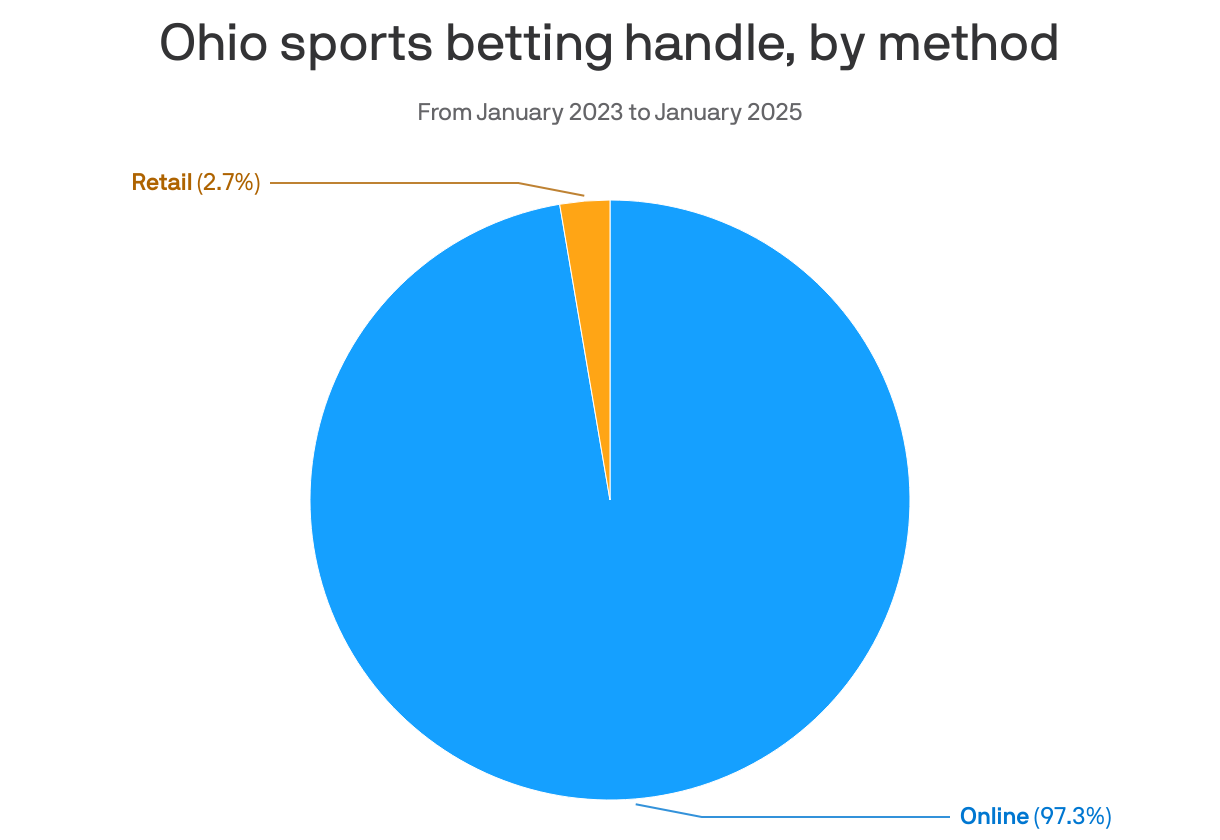
Legalization has flooded our market with in-person sportsbook concepts, but the vast majority of wagers are being placed online.
Ohio businesses that once fought for retail licenses are seeing only a sliver of bets placed, while hundreds of gambling kiosks around the state generate virtually no revenue.
By the numbers: A whopping 97.3% of all money wagered in Ohio is placed online.
- Another 2.5% is wagered at casinos and brick-and-mortar sportsbooks and just 0.15% is bet at lottery kiosks.
- That's despite the state issuing licenses for more than 700 kiosks — 43 in Columbus alone.
Reality check: Schuler tells Axios the state expected online bets to make up at least 90% of wagers but didn't anticipate quite such an extreme split.
- He says those with high hopes for retail gambling were likely imagining "visions of brick-and-mortar (sportsbooks) in Vegas," that aren't a reality elsewhere.
Between the lines: Schuler says in-person sportsbooks are largely a product of gaming companies owning both casinos and online apps.
- "If you're a casino or a racino, you're going to have a sportsbook in there. It's like how every menu, no matter where you go or how nice the restaurant is, they always have french fries."
Case in point: Penn Gaming owns the local Hollywood Casino and the ESPN Bet app. It rebranded the casino's former Barstool Sportsbook to ESPN Bet last year.
The bottom line: Returns for in-person sports betting might be low, but Schuler says retail gambling isn't a cost issue or problem for state regulators.
- "In a lot of ways, I consider it to be easier and more straightforward [than online] because individual Ohioans are working in the sportsbook. Everything they do is documented, accountable, under surveillance."

