Columbus millennials are struggling to get ahead


Add Axios as your preferred source to
see more of our stories on Google.
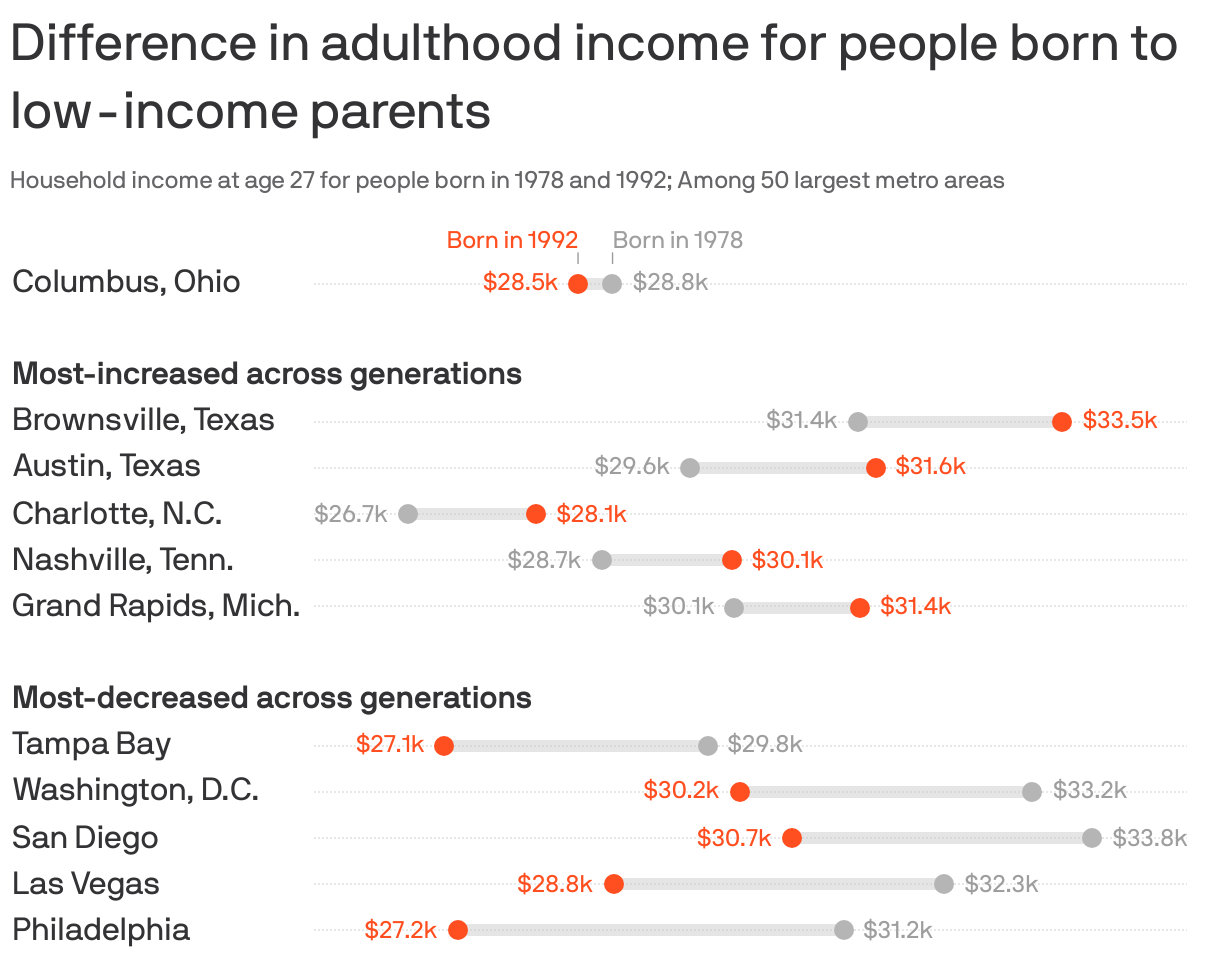
Columbus-area residents born to low-income families are faring slightly worse than the last generation, a new analysis finds.
Why it matters: Intergenerational mobility — the idea that you'll do better than your parents, your children will do better than you, and so on — is core to the American dream.
- But it's far from a guarantee in many major U.S. cities.
What they did: A new analysis from the Census Bureau and Opportunity Insights, a research group at Harvard University, seeks to measure intergenerational mobility at the county level.
- Researchers compared the average household income at age 27 for Americans born to low-income families in both 1978 and 1992 to get a localized picture of changing opportunities over time.
What they found: Millennials born to low-income families in central Ohio earn less at age 27 than Gen Xers made at that age.
- Those born here in 1992 had an average household income of $28,491 at age 27, compared to $28,846 for those born in 1978, a decline of 1.2%.
Zoom out: Income drops were recorded in 38 of the 50 biggest U.S. metro areas, including two others in Ohio.
- Cincinnati incomes declined by 3.2%, while Cleveland dropped by 3.9%.
- Brownsville, Texas, saw the biggest income increase across generations (6.7%), while Philadelphia had the biggest drop (12.8%).
The intrigue: The upward mobility rates of white kids born into low-income families in many parts of the country had fallen, while class mobility among Black kids improved significantly between generations, researchers found.
- Low-income, white 27-year-olds in Franklin County saw the greatest drop in household incomes of any race, dropping by about 2.4% (or $1,000 annually).
- Meanwhile, Black 27-year-olds born to low-income Franklin County households gained 16% in earnings (around $3,000).
Go deeper: Explore the research via Opportunity Atlas' interactive tool.