Ohio's declining life expectancy

Add Axios as your preferred source to
see more of our stories on Google.
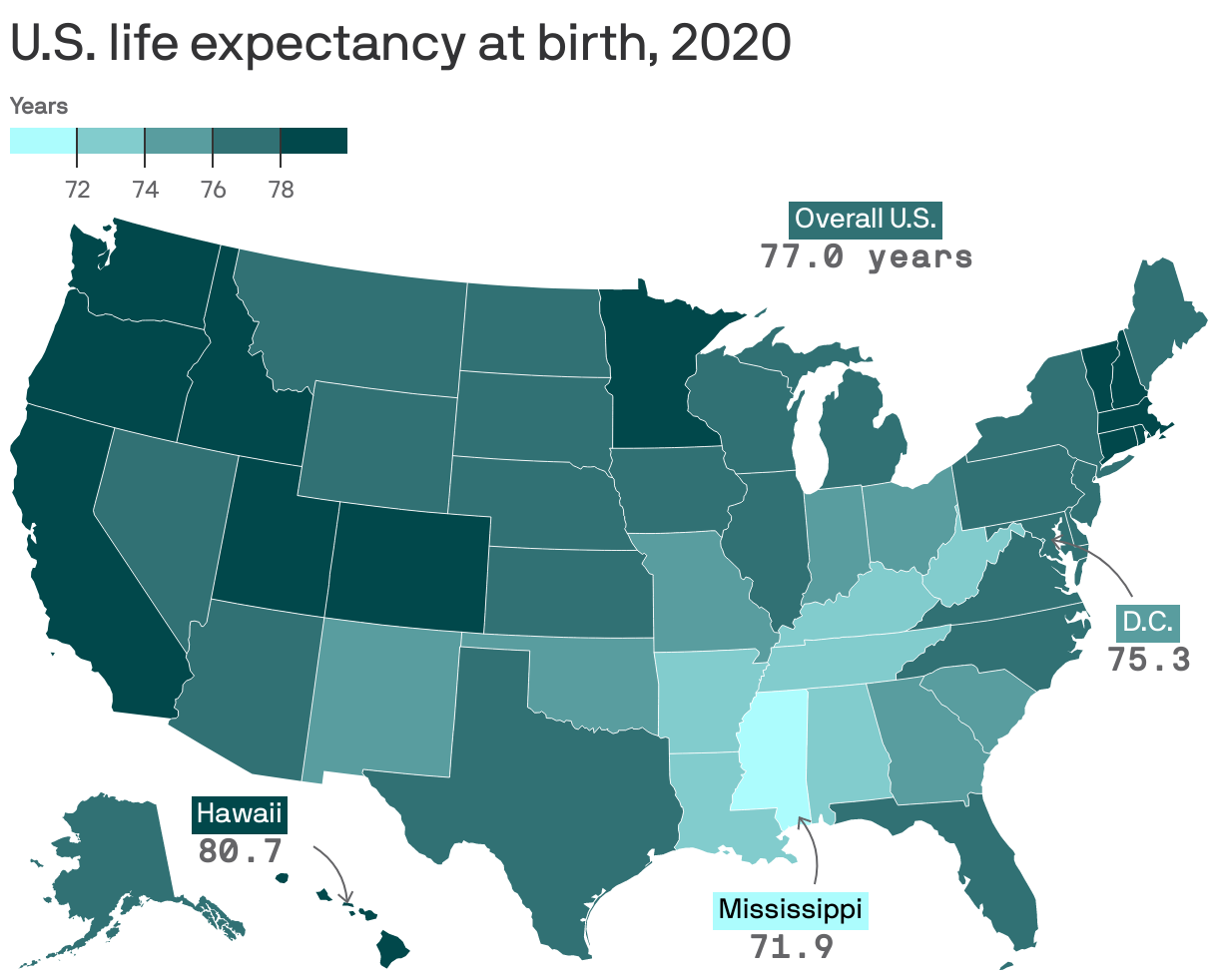
Ohio's life expectancy was the 13th-lowest in the U.S. in 2020, per new CDC data.
- The average lifespan of an Ohioan at birth was 75.3 years — lower than the national average of 77.
Why it matters: The decline reflects deep societal issues, including surging drug overdoses and the deadly COVID-19 pandemic.
Threat level: Ohio's life expectancy has decreased by 1.6 years from 2019.
- Heart disease was the leading cause of death here in 2020, followed by cancer, COVID and accidental injury, including overdoses, according to the CDC.
The big picture: This is a nationwide trend. Life expectancy in the U.S. fell in all 50 states and the District of Columbia from 2019-2020, with a nationwide decline of 1.8 years, Axios' Jacob Knutson writes.
- COVID caused approximately 375,000 deaths in 2020, while over 91,700 people died of a drug overdose.
Zoom in: Ohio's overdose death rate was the nation's fourth-highest in 2020, with 5,204 deaths.
- As of Wednesday, the state had logged 39,406 total COVID-related deaths, with a death rate that's No. 23 among states, per the New York Times.
Of note: An Ohio female's life expectancy (78.1) was 5.6 years higher than a male's (72.5) in 2020, as is typical nationwide.
What's next: Based on provisional CDC data released yesterday, U.S. life expectancy likely dropped again in 2021 by nearly a year, to 76.1, Axios' Tina Reed writes.
- That represents a loss of nearly three years of life expectancy since 2019, the largest overall loss in America since the 1920s.
- The Native American and Alaska Native population was disproportionately impacted, with expectancy dropping nearly two years to 65.2, the data shows.
- Black Americans' expectancy (70.8) declined less than the national average, though it continues to be lower than white Americans' (76.4).