Clevelanders are walking less

Add Axios as your preferred source to
see more of our stories on Google.
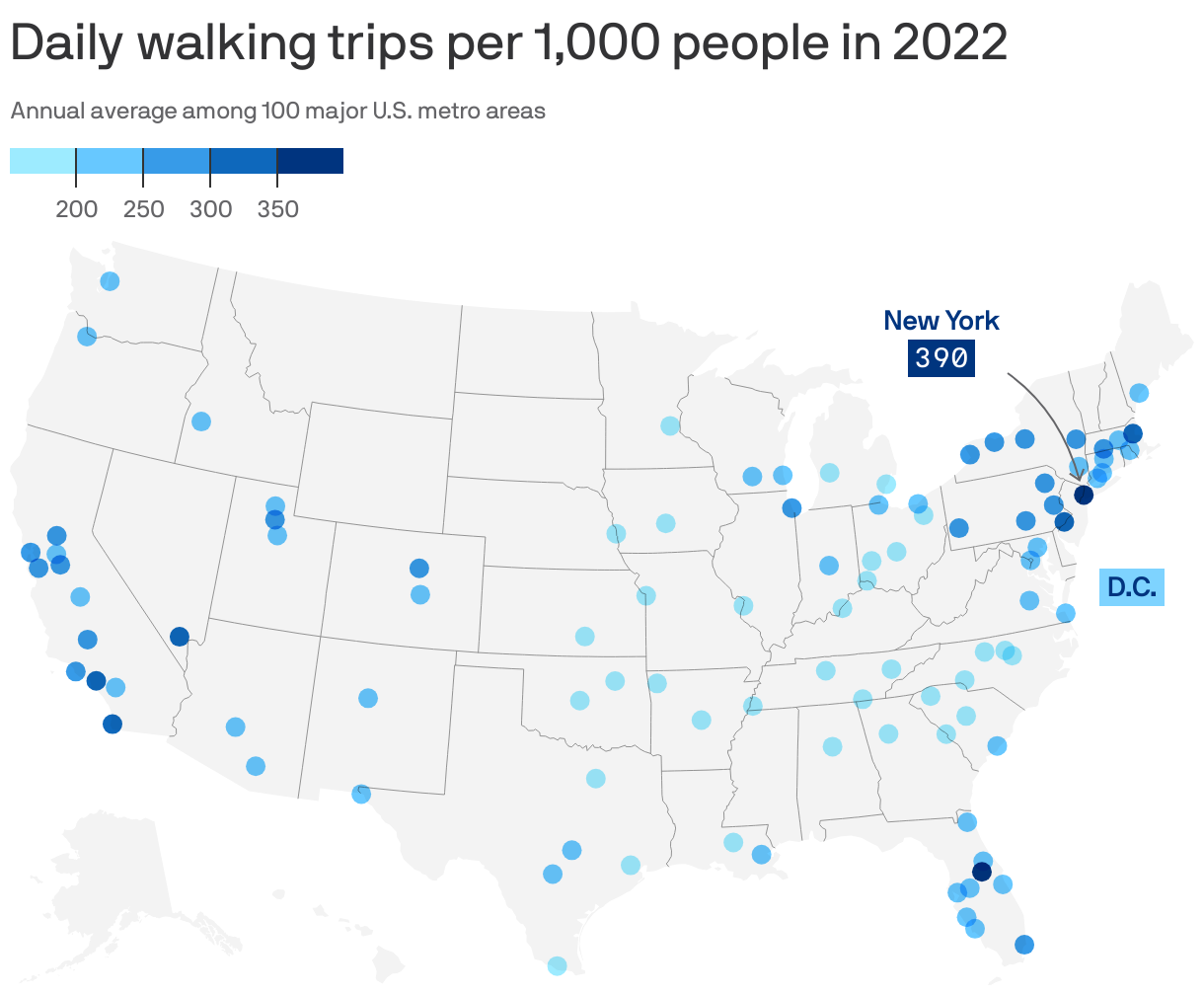
If Cleveland sincerely plans to become a more walkable city, residents will have to step it up.
Driving the news: The number of annual average daily walking trips per 1,000 people in the Cleveland metro area dropped nearly 46% from 2019 to 2022, per a new StreetLight Data report.
- There were 200 annual average daily walking trips per 1,000 people in 2022, compared with 370 in 2019.
Why it matters: Several major downtown development projects are aimed at making Cleveland a "15-minute city," meaning residents can access most amenities via a short walk, bike ride or transit trip.
- That includes a $3.5 billion project that would connect the Cuyahoga Riverfront to downtown's core and a Lakefront Master Plan for the area near North Coast Harbor and Browns Stadium.
How it works: StreetLight measures travel behavior based on anonymized data from mobile devices, vehicle GPS systems and more.
- For this analysis, one "walking trip" is any trip taken by foot that is more than 250 meters — about 820 feet — from start to finish.
The big picture: Nationally, the number of annual average daily walking trips dropped a whopping 36% in the contiguous U.S. from 2019 to 2022.
- "In every metro and state that StreetLight analyzed, walking trips declined over the three-year period by at least 20%," per the report.
Zoom out: Compared with Cleveland, the dropoff was less severe in 15-minute cities like Miami (32%), San Francisco (33%), Pittsburgh (33%) and Boston (36%).
- Yet, it was close to the same or greater in other 15-minute cities like Cincinnati (46%) and Minneapolis (48%).
What they're saying: The pandemic had an "obvious impact," StreetLight says. But beyond that, the group isn't sure what's keeping Americans off their feet.
- Some of this could be remote work, which can make it all too easy to become overly sedentary.
- And some of it could be part of slow downtown recoveries like the one locally. If a city has fewer restaurants and shops open, there's less reason for locals and visitors to walk around.
The bottom line: "For communities focused on safety, climate, health and equity initiatives, an all-hands-on-deck strategy across safety, transit, land use and more will be needed to increase walking activity," per StreetLight's report.