Charlotte's development pipeline: $3.7B in new construction, $1.7B in "reimagined" buildings

Add Axios as your preferred source to
see more of our stories on Google.
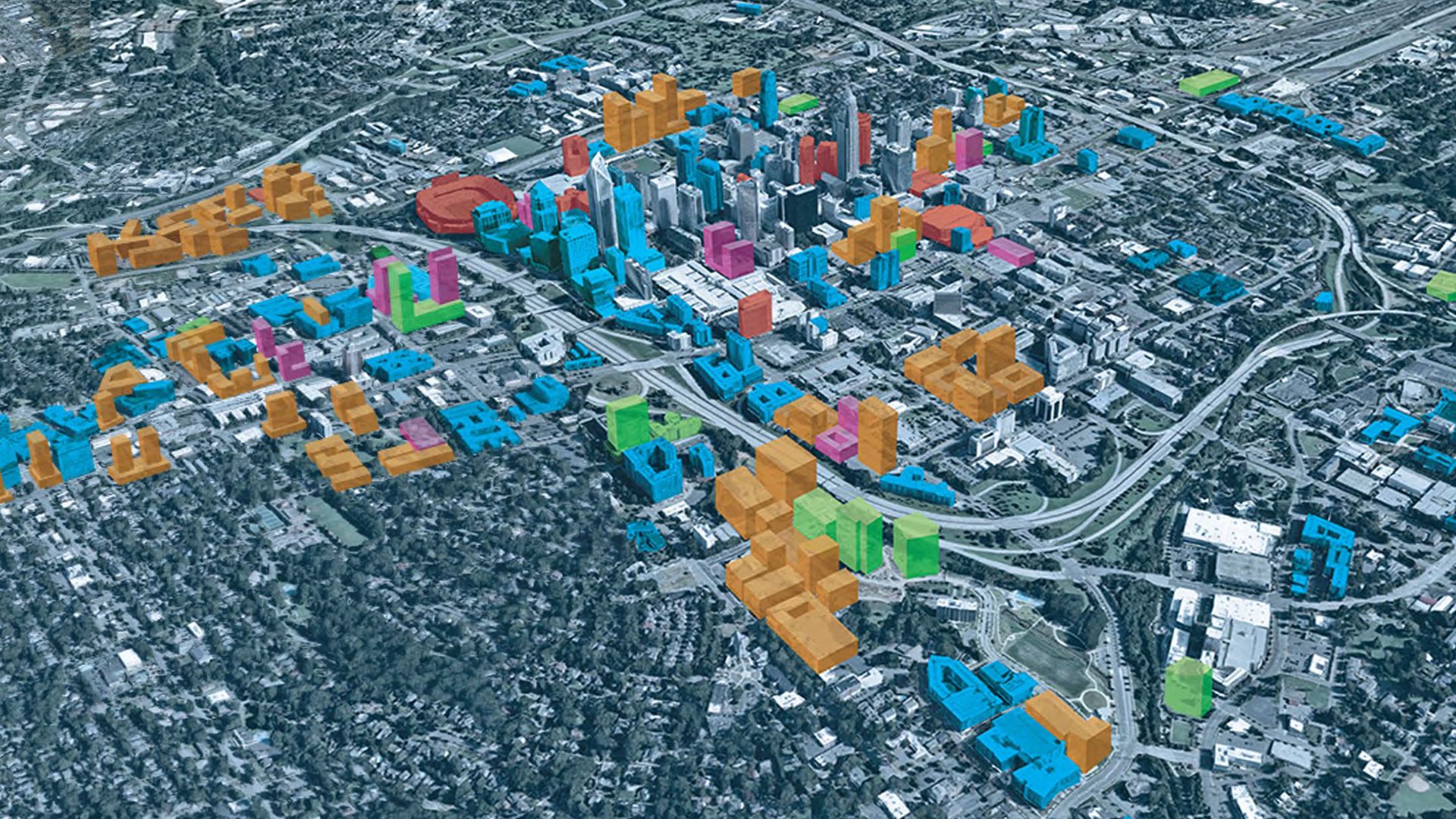
Blue-shaded buildings were built since 2010. Green means under construction. Red is "reimagined" or renovated, like Bank of America Stadium. Purple and orange are planned developments. Courtesy of Center City Partners/Clayton Sealey
Charlotte's urban core has $3.7 billion in new development either under construction or expected to break ground in 2026, according to Charlotte Center City Partners' annual growth report.
- That includes more than 2.2 million square feet of office space, 338,800+ square feet of retail, 1,630+ hotel rooms and 7,110+ apartments.
Why it matters: CCP president and CEO Michael Smith still calls this a "strong pipeline," although the total is down from $4.2 billion in 2024 and $6.9 billion in 2023.
- Many major developments, such as the 23-story 110 East office tower in South End, have exited the pipeline as construction was completed. And few new projects have filled the void due to high interest rates and other economic challenges.
Yes, but: There's a new number to pay attention to this year: $1.7 billion. That's how much the public and private sectors are spending or have spent to rehab more than a dozen older assets across center city — from empty office towers to the NFL stadium.
- A large chunk of that is $800 million being spent on Bank of America Stadium renovations — of that, $650 million came from the city government.
- Other projects include the $375 million Spectrum Center renovations and the $250 million Brooklyn & Church project, converting the old Duke Energy headquarters into apartments and retail.
- Office buildings such as 101 Independence and One South have also undergone makeovers.
What they're saying: CCP's SVP of economic development James LaBar says it's important to show that Charlotte is reinvesting in its aging buildings.
- The organization has set a 2025 goal to make center city a preferred destination for investors and developers who want to work in the older office space.
- Smith says Center City Partners, CLT Alliance and the local government must collaboratively study what other cities are doing to promote building conversions and advocate for "tools" that attract capital. That could mean creating tax incentives, loosening building regulations or establishing other policies that simplify doing business in Charlotte.
Flashback: Last year Charlotte-based developer Asana Partners sought incentives from the city and county government for Brooklyn & Church, but it was unsuccessful.
- County leaders were especially reluctant because the pitch didn't include affordable housing or address economic disparities.
The big picture: Smith says it's important to ensure center city — "the greatest contributor of tax revenue to our community" — doesn't have failed buildings.
- Mecklenburg County will conduct a property tax revaluation in 2027. After that, buildings with declining values will contribute less to the tax base — unless they're reinvested in.
- "That burden will be borne by more single-family homes throughout our community," Smith says.
State of play: Uptown's official vacancy rate is around 23%, according to CBRE's latest report. Much of that is old office, however. Buildings constructed since 2000 are more than 91% leased, according to CoStar.
- Despite the vacancy rate, companies could consider Charlotte as having no availability if there's no new space to lease, LaBar says. The city could miss out on economic development deals because of this.
- "That's when the development community springs into action and projects like Crescents' Carson or Riverside's project ... Queensbridge take flight," Smith says.
By the numbers: In the first half of the 2020s, developers built 8 million square feet of new office, 12,000 new residential units and 2,850 hotel rooms in center city.
- From 2010 to 2019, 7.7 million square feet of office, 13,000 new residences and 1,800 hotel rooms were constructed.
- "We basically have already matched the prior decade," Smith says, "which was the best decade we had ever enjoyed."
Editor's note: This story has been corrected throughout to show the development pipeline's expected office and retail space as well as the number of hotel rooms and apartments.