Uptown’s ghost tower problem may call for local government action

Add Axios as your preferred source to
see more of our stories on Google.
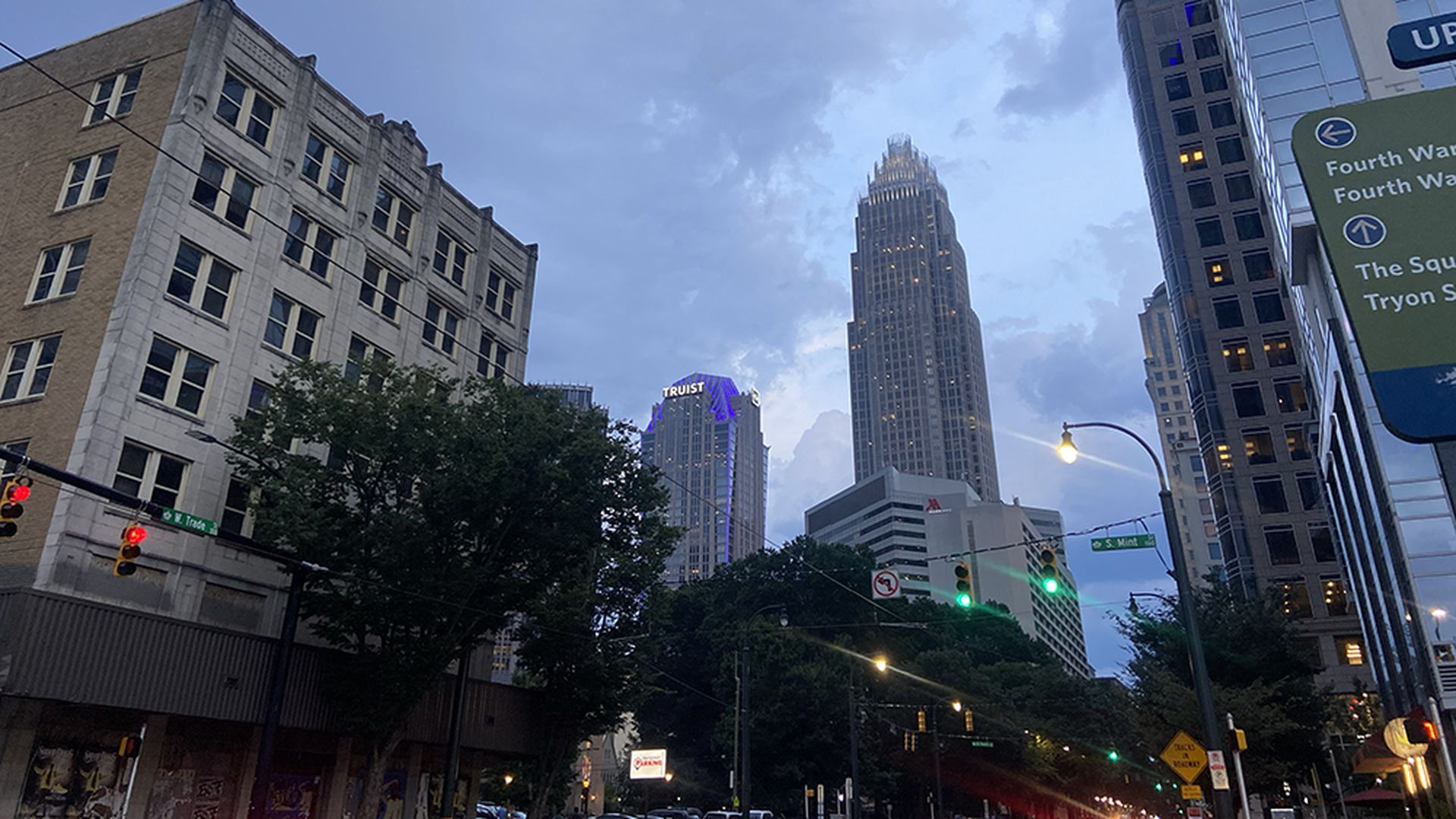
Photo: Alexandria Sands/Axios
Charlotte council members got an ominous picture Monday: A view of the Uptown skyline. But the skyscrapers that identify the city were highlighted in lines of blue and orange, each shade representing an empty floor.
- Despite local job growth, more than half of the floors in five of the pictured buildings are empty.
Driving the news: Four years ago, the pandemic turned U.S. economic centers into ghost lands. Demand hasn’t fully bounced back. City officials are now looking at ways to speed up the revival of empty Uptown towers.
- After being presented with data, council member Ed Driggs called the situation “a little scary.” Mayor Pro Tem Dante Anderson said it was “bleak.”
Why it matters: The square footage of office space per employee is at a 22-year low in Charlotte, according to a presentation that the council’s economic development committee heard Monday.
- The city government is particularly concerned because vacancies adversely impact tax revenues and diminish neighboring values. “We all know if you’re in a house where the house next to you is vacant — doesn’t feel too good,” Ned Curran, a real estate expert and former CEO of Charlotte’s Bissell Cos., told the committee members. “We worry about ancillary damage.”
- The city wants to protect its substantial investments in nearby properties, such as the Bank of America Stadium and the gateway station.
The problem could get worse before it gets better. Over the next 18 months, leases expire on 1.7 million of about 23 million square feet of office space in the central business district, the presentation showed.
- “A lot of these buildings just need to go away,” Curran said. “There’s more inventory than there is demand.”
Zoom out: This conversation’s dire tone marked a change in the rosy, upbeat outlook on Uptown’s future normally held by city leaders and boosters.
By the numbers: In a stabilized office market, vacancies should be in the 7% to 10% range, Curran said. Uptown’s vacancy rate is 18.5%.
- In Ballantyne, it’s 31%. Midtown is 20%. The North End is experiencing a 48% vacancy rate. The University area is at 27%, and SouthPark is at 18%. South End is nearly 16%.
/2024/01/18/1705543603581.jpg)
What’s happening: Cities across the country are dealing with similar concentrations of office vacancies. The phenomenon isn’t just a lingering effect of workers going remote. Companies leasing physical workspaces are on a “flight for quality.” They’re opting for new, shinier offices with trendy amenities and proximity to bars and restaurants.
For Charlotte, the majority of these are along the rail trail in South End.
- Some also perceive South End as safer than Uptown. In the center city, people complain about unsightly offenses, such as open containers and public urination. On New Year’s Eve, a shooting during a fireworks celebration in Romare Bearden Park left five people injured.
The other side: Some suggest the market will correct itself as the economy exits its uncertain state.
- Council member Tariq Bokhari said the city should prioritize business recruitment over supply-side solutions.
- Bokhari noted that South End is limited geographically. Eventually, he said, the growth will move back toward Uptown.
- Developments such as Queensbridge Collective, where Uptown Cabaret used to be, are already set to blur the line between Uptown and South End. But there are no announced office tenants there or in some other incoming developments, like 110 East.
What’s next: Charlotte’s economic development committee had an initial conversation this week about strategies to make use of underused towers. Officials will need to get creative since the city doesn’t have the capital to solve this multi-billion-dollar problem alone.
- Driggs said that the city should focus on incentives, similar to how development regulations aim to get developers to save trees. The city could also incentivize office conversions, possibly for affordable housing.
- “We need to be realistic about what kind of macro impact we can hope to have,” Driggs said.