One way to retain talent? A Mass.-only accelerator

Add Axios as your preferred source to
see more of our stories on Google.
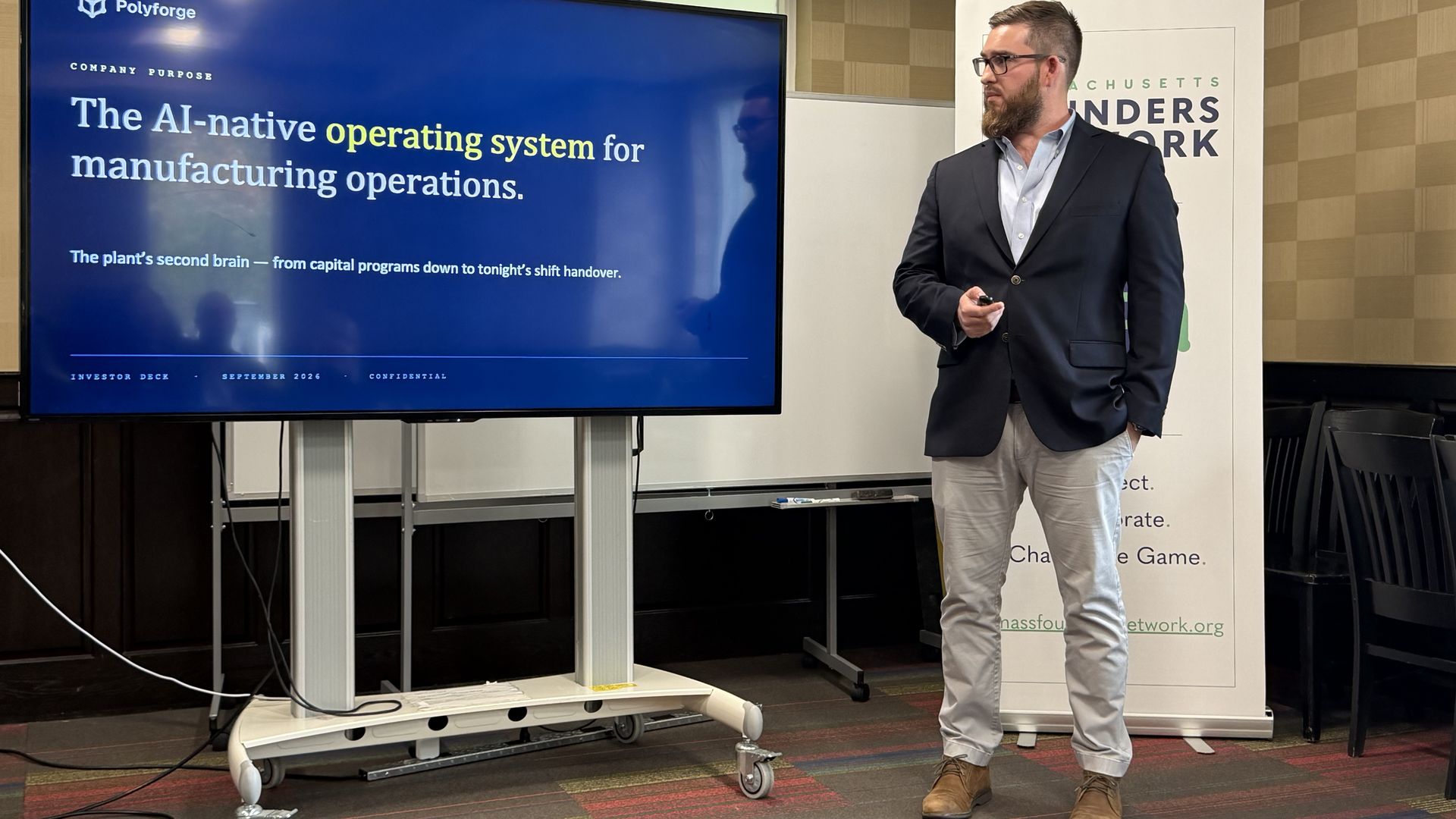
Jared Broberg pitches his platform, Polyforge. Photo: Steph Solis/Axios
The ask was simple: Pitch a product that doesn't just layer AI onto existing software, but uses it to fix a problem affecting life sciences companies.
- The only requirements? It must have high growth potential and be based in Massachusetts.
Why it matters: While state officials court companies offering tax credits and other perks, a group of business leaders is trying to breed homegrown talents and convince them to stay here before they become the next Facebook or ScienceIO.
How it works: The Mass. Founders Network, working with the Massachusetts Business Roundtable, asked life sciences companies to list the problems they'd want to see AI address.
- Their pain points ranged from data security gaps to the risk involved in developing treatments that sometimes don't even work to inefficiencies in drug production, says Jeffrey Thomas, executive director of Lever, which runs the founders' network.
- From there, the network created the AI challenge accelerator.
What they're saying: "Founders often have great ideas, and they develop their ideas and they don't know if there's a market for it," says JD Chesloff, the roundtable's president and CEO.
- "We know there's a market because we asked."
Catch up quick: The network got roughly two dozen applications and selected five finalists for the accelerator, which ran through the summer.
- Four remaining finalists pitched their product to a pair of judges last week in a meeting room at UMass Amherst's Charles River campus in Newton.
Zoom in: The biggest life sciences companies have pioneered rare-disease treatments and other medical breakthroughs, but run their manufacturing sites on email and a whiteboard.
- Jared Broberg developed a fix in weeks.
- His software tracks incidents and spoiled batches, sick employees and any other updates manufacturing teams need to communicate to keep production consistent.
- "I just started building this out of frustration over what was available," says Broberg, who has worked in biomanufacturing for 15 years.
- A Massachusetts native, Broberg says he hopes to continue building Polyforge from his home state.
Zoom out: The roundtable's annual survey of its members suggests AI is concerning employers even more than the state's high cost of doing business.
- Nearly 80% of employers surveyed identified AI and related technology as their main strategy for boosting productivity.
- Their biggest concern was whether they will have workers equipped to capitalize on AI's potential, Chesloff wrote in Commonwealth Beacon.
What's next: SequestBio, a Cambridge-based startup whose platform predicts which cancer patients are at highest risk of their disease returning or spreading, won the pitch competition and the $35,000.
- Thomas says he hopes to connect the finalists with therapeutics companies, with help from Chesloff.
- The companies get a homegrown fix, and the startups get another reason to stay in Massachusetts, Chesloff says.